
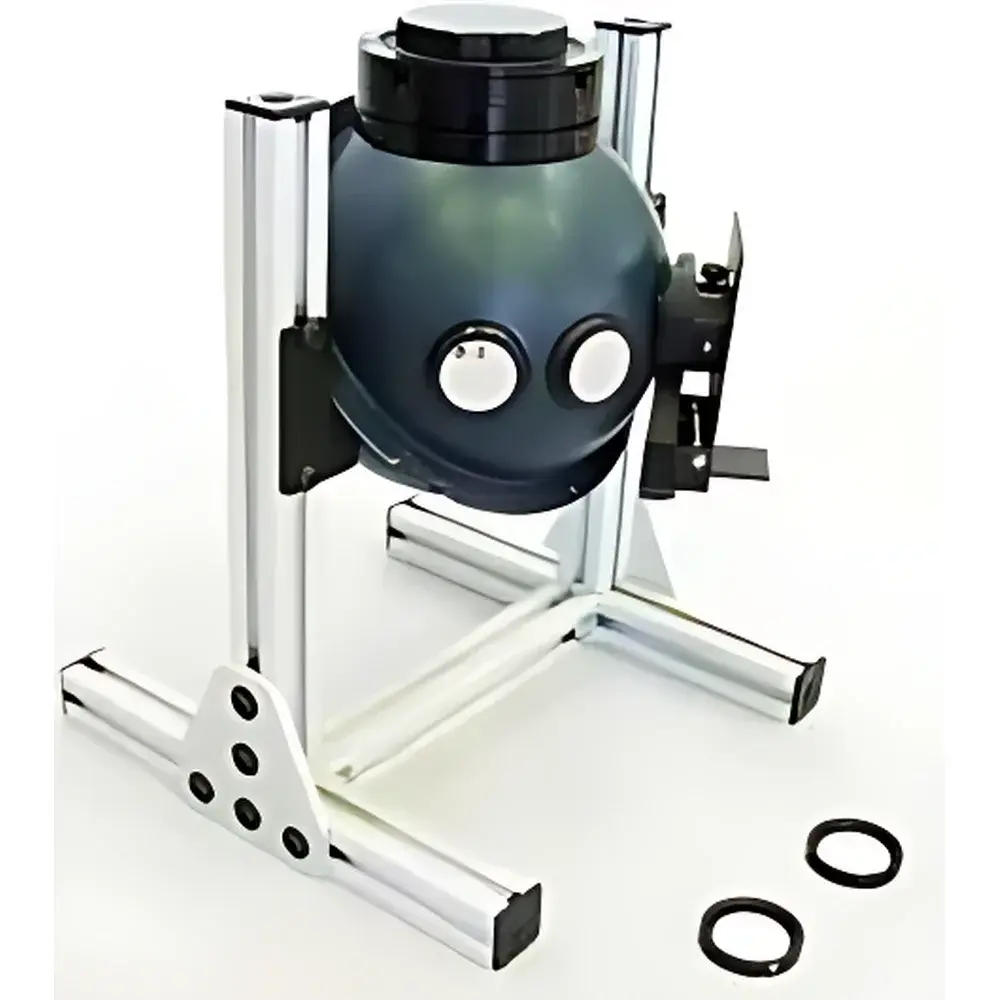
Labsphere LSS Reflectance and Transmittance Measurement System
| Brand | Labsphere |
|---|---|
| Origin | USA |
| Manufacturer Type | Authorized Distributor |
| Product Origin | Imported |
| Model | LSS |
| Component Category | Light Source |
| Pricing | Available Upon Request |
Overview
The Labsphere LSS Reflectance and Transmittance Measurement System is a modular, spectrophotometric test platform engineered for precise, repeatable quantification of spectral reflectance (ρ(λ)) and transmittance (τ(λ)) across the ultraviolet–visible–near-infrared (UV-VIS-NIR) range (typically 200–2500 nm, dependent on detector and source configuration). Built upon Labsphere’s proprietary integrating sphere technology, the system operates on the principle of diffuse hemispherical measurement: incident light from a calibrated broadband or monochromatic source illuminates a sample placed at the sphere port; reflected or transmitted radiant flux is uniformly collected by the sphere’s highly reflective (≥99% BaSO₄ or Spectralon® coated) interior surface and directed to a spectroradiometer or photodetector array. This geometry ensures compliance with ASTM E1331 (Standard Test Method for Reflectance Factor and Color of Opaque Specimens by Spectrophotometry) and ISO 2813 (Paints and varnishes — Determination of specular gloss), enabling traceable, geometry-independent optical property characterization essential for R&D, quality control, and regulatory documentation in optics, coatings, display, and photovoltaic industries.
Key Features
- Modular architecture supporting configurable source–sphere–detector combinations, including deuterium–halogen lamps, tungsten-halogen sources, or pulsed xenon systems for extended spectral coverage and stability.
- High-precision integrating sphere (standard 50 mm, 100 mm, or 150 mm diameters) with certified reflectance uniformity and low baffle shadowing error (<0.2% residual non-uniformity).
- Dual-measurement capability: simultaneous or sequential reflectance (specular-included or excluded via removable gloss trap) and transmittance modes using standardized sphere port layouts per CIE 15:2018.
- Thermally stabilized optical bench and vibration-damped mounting to minimize drift during long-integration spectral scans (e.g., low-light thin-film measurements).
- NIST-traceable calibration options available for both spectral irradiance (W·m⁻²·nm⁻¹) and reflectance standards (certified pressed PTFE or ceramic tiles).
Sample Compatibility & Compliance
The LSS system accommodates flat, rigid, or flexible samples up to 50 mm × 50 mm (custom fixtures support larger or curved substrates). It supports transmission measurements for transparent, translucent, and semi-transparent materials—including optical filters, AR/HR coatings, polymer films, glass substrates, and semiconductor wafers—and reflectance measurements for opaque or diffusely scattering surfaces such as paints, textiles, solar absorbers, and display panels. All configurations comply with ISO/IEC 17025 requirements for testing laboratories, and measurement protocols align with ASTM E903 (Solar Absorptance, Reflectance, and Transmittance of Materials Using Integrating Spheres), ASTM F2446 (Optical Properties of Transparent Plastic Films), and USP (Spectrophotometric Absorbance Measurements). Optional GLP-compliant audit trails and electronic signatures are supported when integrated with validated software modules.
Software & Data Management
The system is operated via Labsphere’s proprietary SpectraSuite™ or optional third-party platforms (e.g., OceanView, LabVIEW-compatible drivers). Software provides real-time spectral visualization, automated wavelength calibration, multi-sample batch processing, and export of reflectance/transmittance data in CSV, XML, or industry-standard CIE XYZ/Lab formats. All raw spectral acquisitions include metadata stamping (timestamp, operator ID, instrument serial number, calibration certificate ID), satisfying FDA 21 CFR Part 11 requirements for electronic records and signatures when deployed in regulated environments. Data integrity is enforced through checksum validation, version-controlled method templates, and encrypted local storage with optional network backup integration.
Applications
- Development and validation of anti-reflective, high-reflectance, and dichroic optical coatings.
- Quantitative assessment of solar thermal absorptance/emissivity for building envelope materials and CSP components.
- Color consistency evaluation of automotive paints, cosmetic packaging, and printed electronics under standardized illuminants (D65, A, F2).
- Quality assurance of optical filters used in fluorescence microscopy, machine vision, and remote sensing payloads.
- Characterization of transparency and haze in OLED encapsulation films, touch sensor layers, and augmented reality waveguides.
FAQ
What spectral range does the standard LSS configuration cover?
Standard configurations span 350–1100 nm using silicon CCD detectors; extended ranges (200–2500 nm) require InGaAs or PbS detectors and appropriate source pairing.
Can the system measure both reflectance and transmittance on the same sample without reconfiguration?
Yes—dual-port sphere variants allow rapid switching between modes using motorized baffles and shutter sequences, preserving alignment integrity and reducing measurement uncertainty.
Is NIST-traceable calibration included with purchase?
Calibration certificates are optional add-ons; standard delivery includes factory baseline verification against internal reference standards, with full NIST-traceable kits available separately.
Does the LSS support compliance with ISO 13485 or IEC 62304 for medical device optical testing?
While the hardware itself is not certified, its metrological traceability, documented uncertainty budgets, and software audit trail capabilities enable integration into ISO 13485-compliant quality systems for optical component verification.
How is stray light minimized in high-dynamic-range measurements (e.g., >OD4 filters)?
Stray light suppression is achieved via dual-monochromator optics (optional), black-anodized internal baffling, and order-sorting filters—reducing effective stray light to <0.01% in UV-VIS configurations.




