
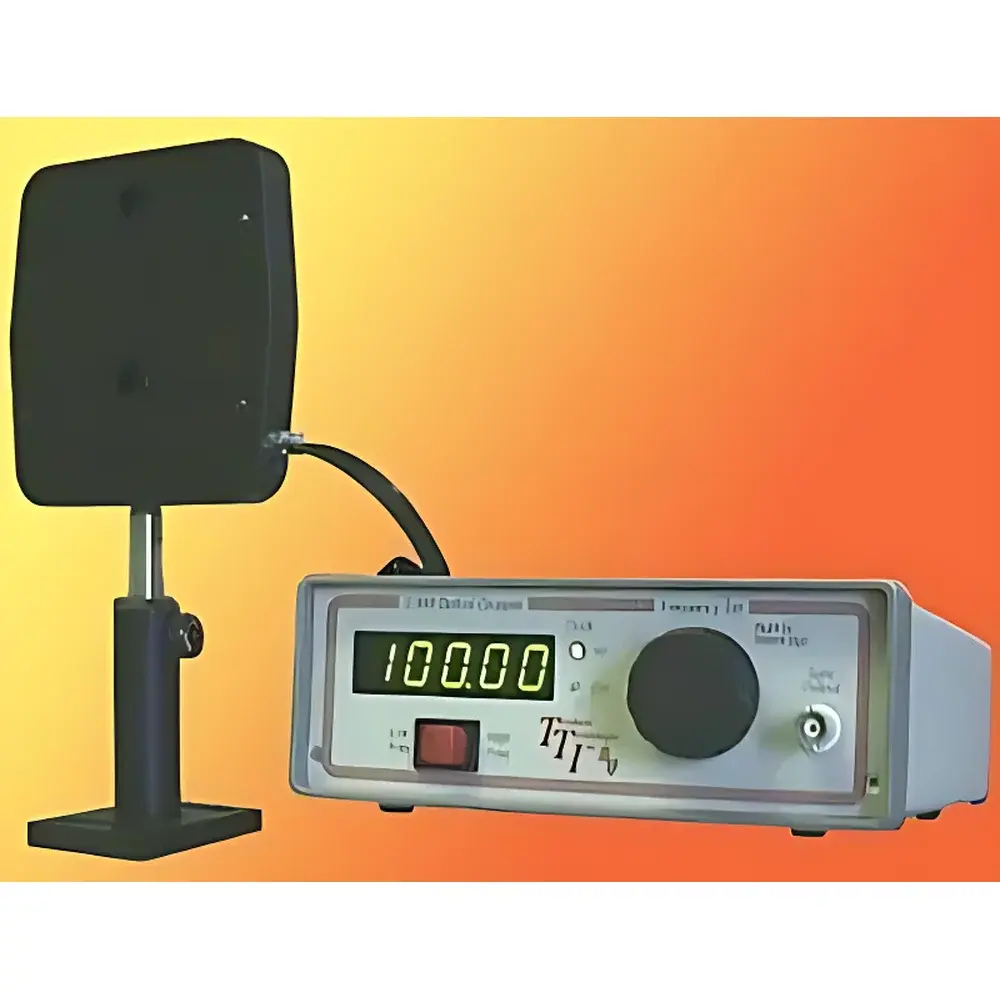
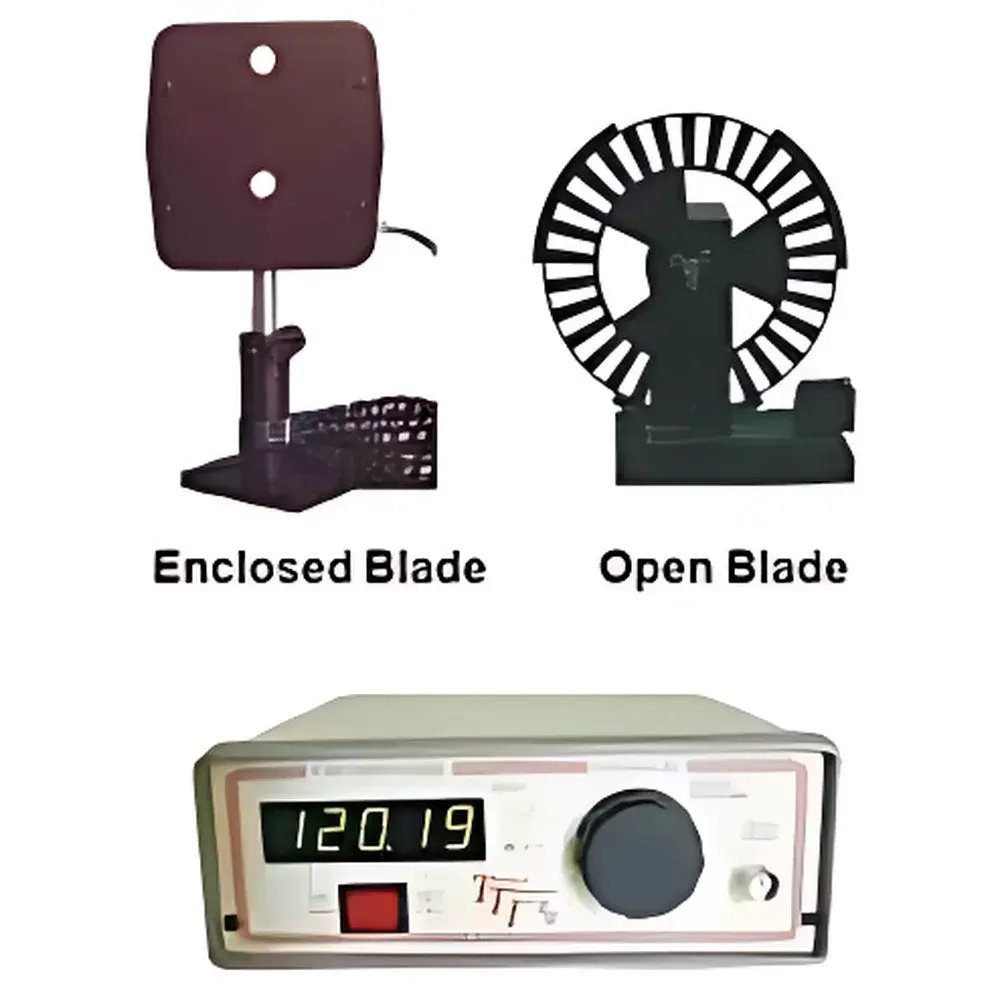
TTI C995 Optical Chopper
| Brand | TTI |
|---|---|
| Origin | USA |
| Model | C995 |
| Frequency Range | 4 Hz to 5 kHz (internal/external slot dependent) |
| Aperture Diameter | 15 mm |
| Blade Diameter | 4.1 in |
| Display | 5-digit green LED |
| Frequency Resolution | 0.001 Hz (RS-232), 0.01 Hz (front panel) |
| Phase Jitter | 0.1% pk-pk (3-slot), 1.0% pk-pk (30-slot) |
| Sync Input | TTL/CMOS square wave, 4–5000 Hz |
| Output Signal | TTL/CMOS compatible square wave |
| Temperature Coefficient | <10 ppm/°C |
| Operating Temperature | 0–40 °C |
| Power | 95–260 VAC, 50–60 Hz, ≤15 VA |
| Weight | 1.36 kg |
| Dimensions (Chopper Head) | 114 × 114 × 51 mm |
| Dimensions (Controller) | 69 × 178 × 231 mm |
| Mounting | Dual #8-32 threaded holes |
| Compliance | CE, RoHS |
Overview
The TTI C995 Optical Chopper is a precision electromechanical modulation instrument engineered for stable, repeatable interruption of continuous optical beams in laboratory and research-grade optical systems. It operates on the principle of synchronous mechanical beam interruption using rotating chopper wheels with precisely machined slots—enabling conversion of CW light into a periodic, frequency-defined signal essential for phase-sensitive detection techniques. Designed for integration with lock-in amplifiers, photodetectors, and spectroscopic setups, the C995 delivers high temporal fidelity across its full operational bandwidth (4 Hz to 5 kHz), with low phase jitter and exceptional long-term frequency stability. Its phase-locked loop (PLL) architecture ensures precise synchronization to external reference clocks—a critical requirement for multi-channel interferometry, pump-probe experiments, and noise-reduction protocols compliant with ISO/IEC 17025 traceability frameworks.
Key Features
- Wide, continuously adjustable chopping frequency range: 4 Hz to 500 Hz (inner 3-slot wheel) and 40 Hz to 5 kHz (outer 30-slot wheel), optimized for both low-noise DC-coupled detection and high-speed AC-coupled measurements
- High-resolution digital control: 5-digit green LED display with front-panel resolution of 0.01 Hz and RS-232 remote control resolution down to 0.001 Hz
- PLL-based synchronization engine enabling sub-3-second lock acquisition to external TTL/CMOS-compatible clock sources (4–5000 Hz), supporting multi-instrument timing coherence in complex optical benches
- Robust chopper head design featuring dual apertures (15 mm diameter), precision-machined aluminum blade (104 mm diameter), and integrated safety shroud that fully encloses rotating components during operation
- Standardized mechanical interface: 4.75″ × 4.75″ × 2″ square footprint with two #8-32 tapped mounting holes—compatible with standard optical rails, posts, and kinematic mounts per ANSI/OPI 1.0-2019 dimensional guidelines
- Low-drift crystal-controlled oscillator with temperature coefficient <10 ppm/°C, ensuring minimal thermal drift over extended acquisition periods typical in GLP-compliant material characterization workflows
Sample Compatibility & Compliance
The C995 accommodates free-space optical paths up to 15 mm beam diameter and is routinely deployed with HeNe lasers, diode lasers, broadband lamps, and synchrotron-derived soft X-ray sources (with appropriate vacuum-compatible variants). Its TTL/CMOS-compatible sync I/O and output signals ensure seamless interoperability with data acquisition systems from National Instruments, Keysight, and Thorlabs. The device complies with CE marking requirements under Directive 2014/30/EU (EMC) and 2014/35/EU (LVD), and conforms to RoHS 2011/65/EU restrictions on hazardous substances. While not intrinsically rated for cleanroom or Class 100 environments, its sealed controller enclosure and non-outgassing chopper head materials support use in ISO Class 5 laboratories when operated within specified ambient conditions (0–40 °C, non-condensing humidity).
Software & Data Management
The C995 supports bidirectional RS-232 communication at 9600 baud (N-8-1, 3-wire configuration), enabling full remote parameterization—including frequency setpoint, sync mode selection, and real-time status interrogation—via terminal emulators or custom Python/Matlab scripts using standard serial libraries. No proprietary drivers are required; ASCII command protocol documentation is provided in the user manual (Rev. D, 2022). Audit trails for frequency changes can be logged externally via host software, satisfying basic FDA 21 CFR Part 11 record-keeping prerequisites where electronic signatures are not mandated. Firmware updates are performed manually via RS-232; no network connectivity or cloud dependency is implemented—ensuring air-gapped system integrity in secure research facilities.
Applications
- Lock-in amplifier signal recovery in FTIR, Raman, and photothermal spectroscopy
- Modulation transfer function (MTF) calibration of imaging detectors and CCD/CMOS sensors
- Pump-probe time-resolved absorption studies requiring synchronized excitation and probe gating
- Background rejection in low-light fluorescence lifetime measurements (FLIM)
- Reference channel stabilization in dual-beam spectrophotometers per ASTM E275-21
- Calibration of optical power meters and radiometric standards under ISO/IEC 17025-accredited test procedures
FAQ
What is the minimum resolvable frequency step when controlling the C995 remotely via RS-232?
The RS-232 interface supports frequency resolution of 0.001 Hz across the full 4 Hz–5 kHz range.
Can the C995 operate without an external reference clock?
Yes—the internal crystal oscillator provides autonomous operation; external sync is optional and used only when phase alignment with another instrument is required.
Is the chopper head vacuum-compatible?
No—the standard C995 chopper head is designed for ambient atmospheric operation only; vacuum-rated versions require custom engineering and are available under separate part numbers.
What is the maximum beam power density the 15 mm aperture can tolerate?
TTI specifies no optical damage threshold; users must ensure incident irradiance remains below the damage threshold of the chopper blade coating (typically ≤1 W/cm² for CW visible/NIR lasers). For pulsed systems, consult pulse energy limits per ISO 21254-1.
Does the C995 support analog voltage input for frequency control?
No—it accepts only digital TTL/CMOS square-wave sync signals; analog voltage-to-frequency conversion requires external circuitry or a dedicated function generator.



