
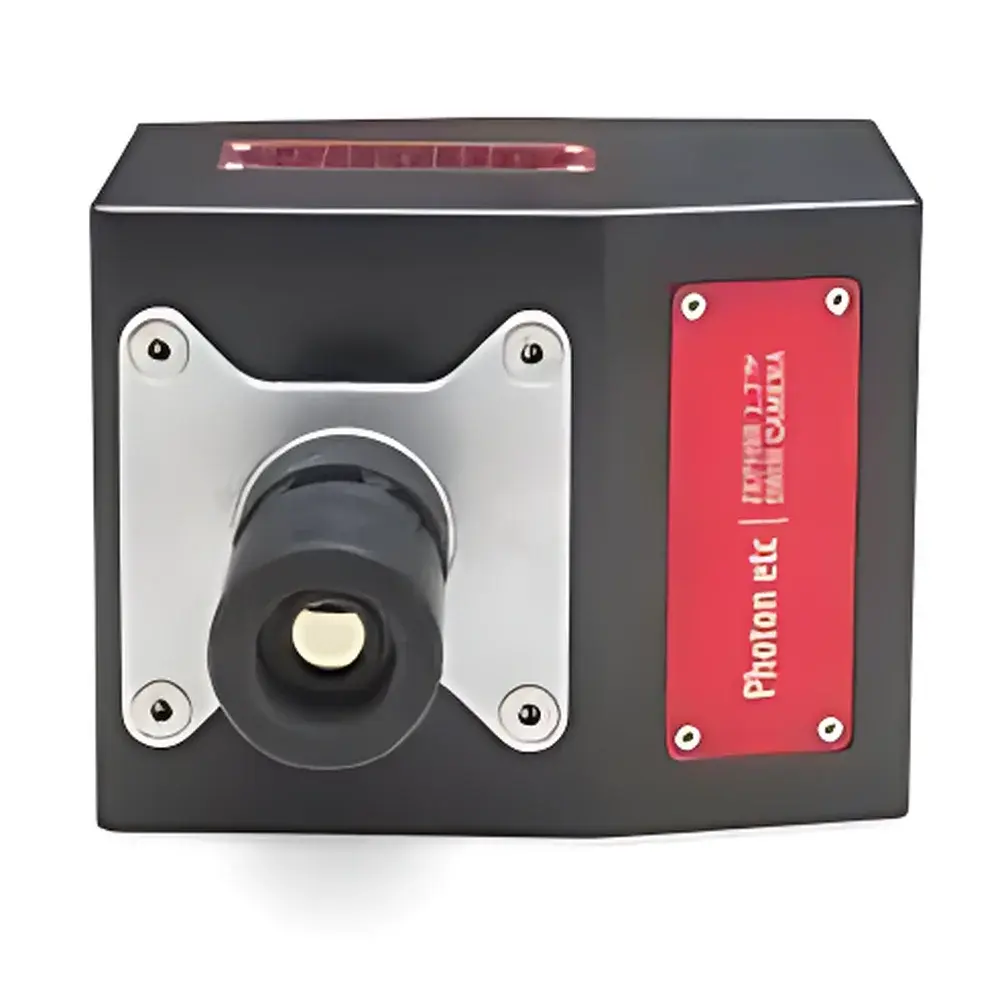
Photon etc ZEPHIR 2.9 Short-Wave Infrared (SWIR) Camera
| Brand | Photon etc |
|---|---|
| Origin | Germany |
| Model | ZEPHIR 2.9 |
| Effective Resolution | 320 × 256 pixels |
| Pixel Size | 30 µm |
| Spectral Range | 0.85–2.9 µm |
| Frame Rate | Up to 340 fps |
| Cooling | 4-stage TEC with forced air |
| FPA Type | HgCdTe (MCT) |
| Operating FPA Temperature | −80 °C |
| Readout Noise | 150 e⁻ (high gain), 1650 e⁻ (low gain) |
| Full-Well Capacity | 168 ke⁻ (high gain), 3.5 Me⁻ (low gain) |
| Dynamic Range | 14 bits |
| Quantum Efficiency | up to 85% |
| Operability | >98.5% (typical) |
| Interface | CameraLink™ |
| Power Supply | 12 VDC @ 5 A |
| Dimensions | 169 mm × 130 mm × 97.25 mm |
| Weight | 2.6 kg |
| Certifications | CE |
Overview
The Photon etc ZEPHIR 2.9 is a high-performance, thermoelectrically cooled short-wave infrared (SWIR) imaging camera engineered for scientific and industrial applications requiring sensitivity across the extended SWIR band—from 0.85 µm to 2.9 µm. Unlike conventional InGaAs-based detectors limited to ~1.7 µm, the ZEPHIR 2.9 integrates a mercury cadmium telluride (HgCdTe or MCT) focal plane array (FPA), enabling deep spectral coverage critical for molecular overtone absorption analysis, semiconductor inspection, and low-light thermal contrast imaging. Its 4-stage thermoelectric cooler (TEC) stabilizes the FPA at −80 °C, suppressing dark current to ≤54 pA and ensuring shot-noise-limited operation under demanding integration conditions. With a maximum full-frame rate of 340 fps and sub-millisecond exposure control (1 µs to 100 ms), the system supports real-time process monitoring, laser beam profiling, and time-resolved spectroscopic imaging—without compromising radiometric fidelity or spatial uniformity.
Key Features
- Extended spectral response from 0.85 µm to 2.9 µm, optimized for C–H, O–H, and N–H vibrational overtones in organic materials and polymers
- HgCdTe (MCT) FPA with 320 × 256 pixel resolution and 30 µm pitch, delivering high quantum efficiency (>85% peak) and excellent pixel operability (>98.5% typical)
- Four-stage TEC cooling with forced-air heat dissipation, achieving stable −80 °C FPA temperature in ≤10 minutes and maintaining thermal drift < ±0.1 °C over 8-hour operation
- Low-noise readout architecture: 150 e⁻ RMS read noise (high-gain mode), supporting high-dynamic-range quantitative imaging in low-photon-flux environments
- Flexible gain and readout configuration: dual-gain settings (10.30 e⁻/ADU and 216 e⁻/ADU), ITR (Integrate-Then-Read) mode, and programmable ROI binning for adaptive frame-rate optimization
- Robust mechanical design compliant with industrial vibration and EMI standards; compact footprint (169 × 130 × 97.25 mm) and 2.6 kg mass facilitate integration into OEM optical benches and automated inspection platforms
Sample Compatibility & Compliance
The ZEPHIR 2.9 is compatible with standard SWIR-compatible optics (f#/1.5 cold shield), fiber-coupled spectrometers, and laser sources operating within its spectral window—including tunable OPOs, supercontinuum lasers, and quantum cascade lasers. It meets CE marking requirements for electromagnetic compatibility (EMC Directive 2014/30/EU) and low-voltage safety (LVD Directive 2014/35/EU). While not intrinsically rated for hazardous environments, its sealed aluminum housing and conformal-coated PCBs support deployment in controlled laboratory, cleanroom (ISO Class 5–7), and factory-floor settings adhering to ISO 9001 and IATF 16949 quality management systems. For regulated industries, raw image data export (14-bit TIFF or HDF5) enables traceable calibration workflows aligned with ASTM E1548 (Standard Guide for Characterization of Optical Detectors) and ISO/IEC 17025 documentation requirements.
Software & Data Management
Photon etc provides the ZEPHIR Control Suite—a cross-platform application (Windows/Linux) supporting real-time acquisition, non-uniformity correction (NUC), flat-field calibration, and radiometric linearization. The SDK includes C/C++, Python, and MATLAB APIs with full access to hardware registers, trigger synchronization (TTL input/output), and metadata tagging (exposure time, sensor temperature, gain index). All acquired frames embed timestamped EXIF-like headers compliant with DICOM-SWIR extensions under development. Audit trails, user authentication, and session logging are configurable to satisfy GLP/GMP documentation needs. Export formats include lossless 14-bit TIFF, memory-mapped binary, and HDF5 with embedded calibration coefficients—ensuring interoperability with third-party analysis tools such as ENVI, MATLAB Image Processing Toolbox, and Python’s scikit-image.
Applications
- Spectroscopic Imaging: Hyperspectral cube acquisition in push-broom or snapshot modalities for pharmaceutical tablet coating uniformity, agricultural grain moisture mapping, and polymer blend identification
- Industrial Process Monitoring: Real-time detection of thermal anomalies in photovoltaic cell scribing, battery electrode drying, and glass annealing via emissive SWIR contrast
- Laser Diagnostics: High-speed beam profiling of 2-µm fiber lasers, QCLs, and free-electron laser pulses with µs-scale temporal resolution
- Defense & Security: Covert surveillance through obscurants (fog, smoke) and silicon-based camouflage detection using 2.5–2.9 µm atmospheric transmission windows
- Astronomy & Remote Sensing: Ground-based solar observation (e.g., He I 1083 nm and CO bandheads near 2.3 µm) and UAV-mounted vegetation stress assessment via water-band reflectance ratios
FAQ
What cooling method does the ZEPHIR 2.9 use, and how does it compare to Stirling coolers?
The ZEPHIR 2.9 employs a 4-stage thermoelectric cooler (TEC) with forced-air heat rejection. Unlike Stirling cryocoolers, it offers zero mechanical vibration, no moving parts, and rapid cooldown (<10 min to −80 °C), making it ideal for vibration-sensitive optical setups. While Stirling systems achieve lower base temperatures, the ZEPHIR’s TEC delivers sufficient dark-current suppression for most SWIR applications without maintenance or helium dependency.
Is the camera suitable for quantitative radiometry?
Yes—when paired with NIST-traceable calibrated sources and applied factory NUC/flat-field corrections, the ZEPHIR 2.9 supports relative radiometric accuracy better than ±3% across its dynamic range. Absolute calibration requires user-specific source characterization per ASTM E1256-22.
Can I synchronize multiple ZEPHIR units for stereo or multi-spectral capture?
Yes—the CameraLink™ interface supports hardware triggering via TTL inputs/outputs, enabling sub-microsecond inter-camera timing alignment. The SDK also provides software-triggered master-slave acquisition modes for synchronized multi-camera deployments.
Does the camera support region-of-interest (ROI) readout to increase frame rate?
Yes—programmable ROI selection allows partial-frame readout, increasing effective frame rates beyond 340 fps (e.g., 640 fps at 160 × 128 ROI) while preserving full bit-depth and linearity.
What is the warranty and service policy for industrial integration?
Photon etc provides a 24-month limited warranty covering material and workmanship defects. Extended service plans—including on-site calibration, firmware updates, and priority technical support—are available for OEM integrators under contractual SLAs compliant with ISO/IEC 17025 traceability requirements.





