
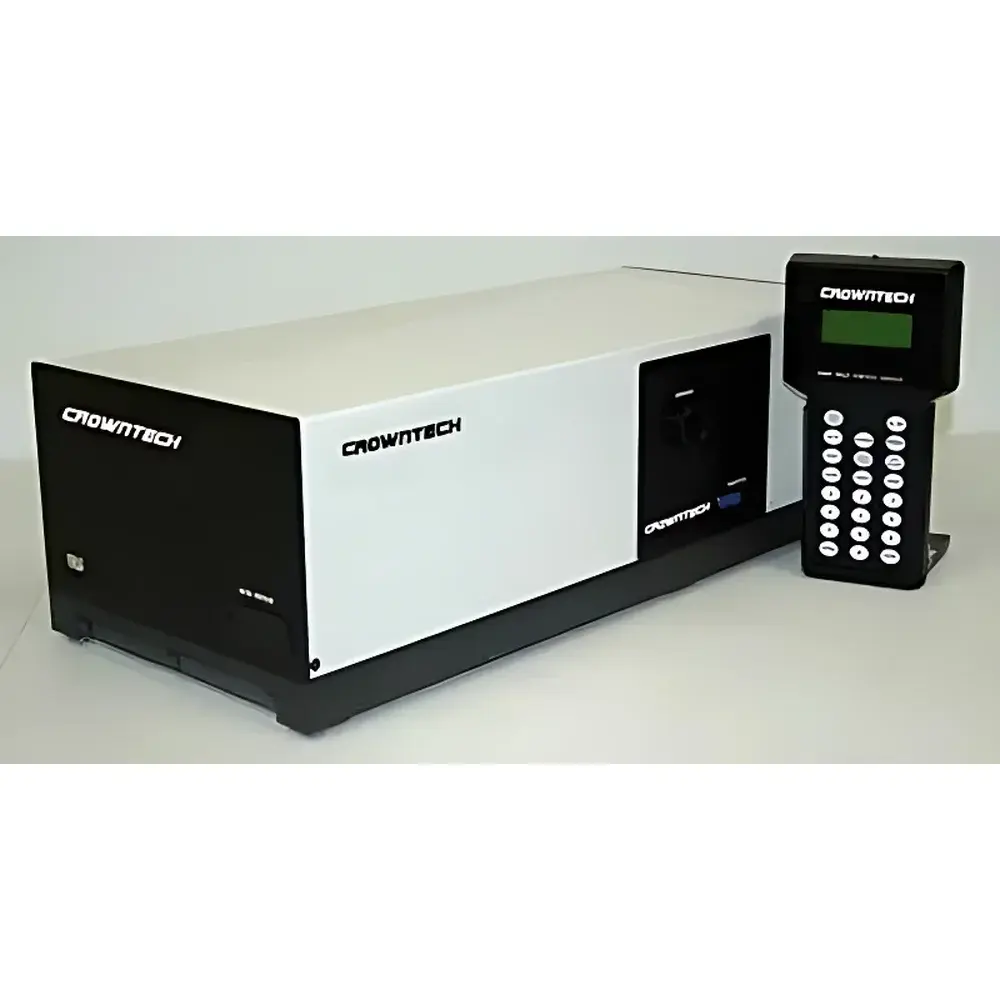
DK300 1/4-Meter Czerny-Turner Monochromator
| Origin | USA |
|---|---|
| Manufacturer Type | Authorized Distributor |
| Origin Category | Imported |
| Model | DK300 |
| Pricing | Available Upon Request |
Overview
The DK300 1/4-meter Czerny-Turner monochromator is a precision optical instrument engineered for high-fidelity spectral isolation in research and industrial laboratory environments. Based on the classical Czerny-Turner optical configuration, it employs collimated illumination of a diffraction grating followed by re-focusing onto an exit slit to deliver wavelength-selective output with minimal aberration and optimized throughput. With a focal length of 300 mm and an f/3.9 aperture, the DK300 achieves a balance between resolution, light-gathering capability, and compact mechanical footprint—making it suitable for integration into fluorescence spectrometers, absorption measurement systems, detector characterization setups, and thin-film optical analysis platforms. Its modular design supports factory configuration either as a standalone monochromator or as a spectrograph (with imaging-focused output), enabling flexible deployment across diverse photonic workflows.
Key Features
- Czerny-Turner optical layout with direct-drive grating rotation for mechanical stability and long-term wavelength reproducibility
- Triple-grating turret (standard 68 × 68 mm; optional 68 × 84 mm) enabling rapid switching between gratings optimized for UV, VIS, or NIR spectral ranges
- Computer-controlled motorized entrance and exit slits with programmable width adjustment (single-sided slit actuation)
- Constant Spectral Resolution (CSR) mode: real-time slit-width compensation during wavelength scanning to maintain fixed spectral bandwidth (e.g., 0.05 nm with 1200 g/mm grating)
- Bidirectional wavelength scanning via computer-controlled worm-gear drive, achieving scan speeds from 1 to 1200 nm/min (dependent on grating density and acceleration profile)
- Anodized and thermally stabilized housing to minimize thermal drift and maintain optical alignment under prolonged operation
- Stray light suppression < 0.01% at 220 nm (measured against NaI reference), critical for UV-sensitive applications including protein fluorescence and nucleic acid absorbance
- Wavelength accuracy ±0.10 nm and repeatability ±0.007 nm (calibrated with 1200 g/mm grating), traceable to NIST-traceable standards
Sample Compatibility & Compliance
The DK300 is compatible with standard optical breadboards, kinematic mounts, and fiber-coupled interfaces—including DK2PORT 1×2 fiber bundle for dual-device routing. Its optical path accommodates both free-space beam coupling and fiber input/output configurations. The instrument complies with IEC 61000-6-3 (EMC emission limits) and IEC 61010-1 (safety requirements for electrical equipment for measurement, control, and laboratory use). While not inherently GLP/GMP-certified, its calibration documentation, traceable wavelength verification reports, and audit-ready firmware logging (when used with DK-GPIB or LabVIEW-based control software) support compliance with ISO/IEC 17025-accredited testing laboratories. Optional IR240 gold-coated optics enhance reflectivity in the near-infrared (700–2500 nm), extending utility to semiconductor and photovoltaic characterization.
Software & Data Management
The DK300 operates via ASCII command protocol over RS-232 serial interface (standard) or IEEE-488 (GPIB) with DK-GPIB adapter. Native LabVIEW drivers are provided for seamless integration into NI-based data acquisition architectures. Third-party compatibility includes Python (pySerial, PyVISA), MATLAB Instrument Control Toolbox, and EPICS IOC support via custom TCP/IP wrappers. All firmware versions log timestamped calibration events, grating selection history, and slit position records—enabling full experimental traceability required under FDA 21 CFR Part 11 when paired with validated software environments. CSR mode parameters, wavelength scan profiles, and filter wheel sequencing (via AB300 interface) are scriptable and repeatable across sessions.
Applications
- Steady-state and time-resolved fluorescence spectroscopy (excitation/emission mapping)
- UV-Vis-NIR absorption and transmission measurements of solutions, thin films, and nanomaterials
- Photodetector spectral responsivity calibration (per ASTM E275, ISO 9022-18)
- Plasma emission line profiling and laser-induced breakdown spectroscopy (LIBS) pre-dispersion
- Optical filter characterization and bandpass verification
- Integration into custom Raman spectrometers as excitation or collection monochromator
FAQ
Can the DK300 be operated without a computer?
Yes—using the optional DK2400 handheld controller for manual wavelength selection, slit adjustment, and grating indexing.
Is NIST-traceable calibration included with purchase?
Each unit ships with a factory calibration certificate specifying wavelength accuracy, stray light performance, and resolution verification using certified reference sources (e.g., Hg/Ar lamps). Full recalibration services are available through authorized service centers.
What is the maximum grating groove density supported?
The turret accepts gratings up to 2400 g/mm; resolution and dispersion characteristics scale accordingly per the grating equation and system f-number.
Does CSR mode adjust both entrance and exit slits?
No—only the exit slit is motorized and dynamically adjusted in CSR mode; entrance slit remains fixed unless manually configured otherwise.
Can the DK300 be vacuum-purged or evacuated?
The standard housing is not rated for vacuum operation; however, custom O-ring sealed variants with CF flanges are available upon engineering consultation.






