
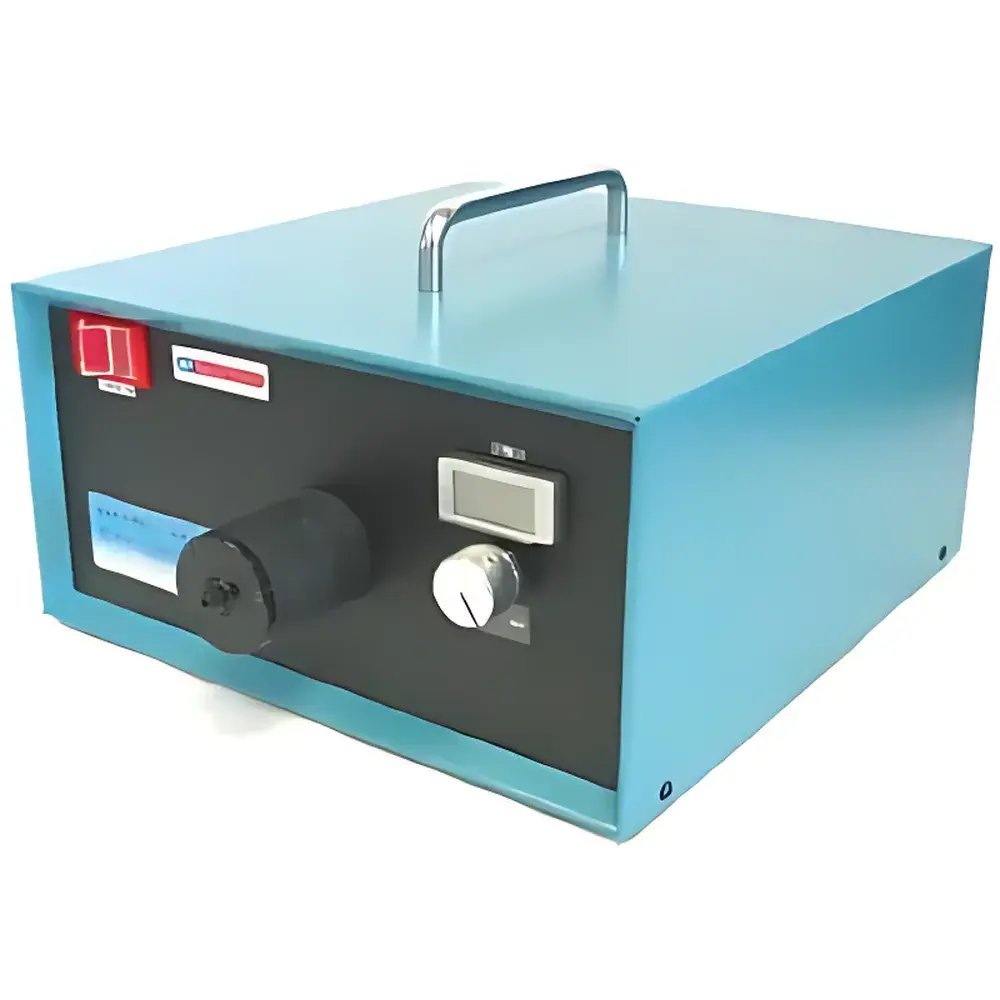
ASBN-D2-W Series Dual Deuterium and Tungsten-Halogen Hybrid Light Source
| Origin | USA |
|---|---|
| Manufacturer Type | Authorized Distributor |
| Origin Category | Imported |
| Model | ASBN-D2-W |
| Pricing | Available Upon Request |
| Component Category | Optical Element |
Overview
The ASBN-D2-W Series Dual Deuterium and Tungsten-Halogen Hybrid Light Source is an engineered broadband illumination system designed for demanding spectroscopic and optical metrology applications requiring stable, high-intensity output across the deep ultraviolet (DUV) to near-infrared (NIR) spectral range (190–2500 nm). Unlike single-source lamps, this hybrid architecture integrates two 30 W deuterium lamps—optimized for intense, continuous emission from 190 nm to ~400 nm—with a high-power tungsten-halogen lamp delivering robust irradiance from ~350 nm to 2500 nm. The system employs a collinear, transmission-based optical path in which both deuterium sources are precisely aligned along a common axis; a custom-designed dual-prism assembly ensures optimal spatial superposition, beam collimation, and maximal radiant flux coupling into downstream optics—critical for applications where photon budget and signal-to-noise ratio are limiting factors.
Key Features
- Hybrid spectral coverage: seamless DUV–VIS–NIR output (190–2500 nm) with no gaps or intensity discontinuities at the deuterium/tungsten transition region
- Dual 30 W deuterium lamps operating in parallel configuration—providing >2× the UV radiant power of conventional single-deuterium sources
- High-stability tungsten-halogen lamp with integrated thermal management and current-regulated power supply for <0.2% RMS intensity drift over 8 hours
- Collinear beam architecture with factory-aligned dual-prism coupler—enabling diffraction-limited beam overlap and minimal divergence (<1.5 mrad)
- Modular lamp housing with quick-change socket design compliant with IEC 61000-4-3 EMC standards and UL/CSA safety certification
- Integrated shutter and TTL-compatible external trigger interface for synchronized acquisition in time-resolved measurements
Sample Compatibility & Compliance
The ASBN-D2-W is compatible with standard 1/2″ and 1″ optical mounts and interfaces directly with spectrometers (e.g., Ocean Insight, Avantes), monochromators (e.g., Acton, Princeton Instruments), and fiber-coupled measurement systems via SMA 905 or FC/PC adapters. Its spectral stability and low temporal noise meet requirements for ASTM E275 (Standard Practice for Describing and Measuring Performance of UV–VIS Spectrophotometers) and ISO/IEC 17025-accredited calibration laboratories. The unit operates within Class 3R laser safety limits per IEC 60825-1 when used with appropriate beam containment; full compliance documentation—including RoHS 2, REACH, and CE marking—is provided with each shipment.
Software & Data Management
The light source supports analog voltage control (0–5 V) for intensity modulation and digital RS-232 communication for remote lamp status monitoring (lamp hours, ignition cycles, thermal sensor readings). Optional LabVIEW™ VI libraries and Python API wrappers enable integration into automated test benches adhering to GLP/GMP data integrity principles. All operational logs—including power-on events, lamp ignition attempts, and thermal excursion alerts—are timestamped and stored locally with optional export to CSV or SQLite for audit trail generation per FDA 21 CFR Part 11 requirements.
Applications
- UV–VIS–NIR absorbance and reflectance spectroscopy of thin-film semiconductors, photoresists, and optical coatings
- Calibration of radiometric and photometric reference standards traceable to NIST SRM 203x series
- In-situ monitoring of plasma etch processes using actinometry (e.g., Cl₂/Ar line-ratio analysis at 258 nm / 750 nm)
- Fluorescence excitation profiling for quantum dot characterization under controlled DUV excitation
- Accelerated aging studies of polymer degradation kinetics using polychromatic UV exposure per ISO 4892-3
- Multi-wavelength ellipsometry on high-k dielectrics and 2D material stacks
FAQ
What is the typical lifetime of the deuterium and tungsten-halogen lamps under continuous operation?
Deuterium lamps exhibit a rated lifetime of ≥2,000 hours at nominal current; tungsten-halogen lamps exceed 5,000 hours when operated within specified thermal envelope limits.
Can the ASBN-D2-W be fiber-coupled, and what is the recommended core diameter?
Yes—the output is optimized for coupling into 400 µm or 600 µm core multimode fibers with NA 0.22; coupling efficiency exceeds 75% with AR-coated SMA 905 terminations.
Is spectral recalibration required after lamp replacement?
No—factory spectral characterization is lamp-specific and stored in onboard EEPROM; automatic spectral correction is applied upon initialization post-replacement.
Does the system support simultaneous operation of both deuterium lamps and the halogen lamp?
Yes—full spectral overlap mode is enabled by default; independent lamp control is available via RS-232 for sequential or gated illumination protocols.
What cooling method is used, and what are ambient temperature constraints?
Forced-air convection with thermally isolated lamp chambers; operational range is 15–30 °C ambient with ≤70% non-condensing relative humidity.





