
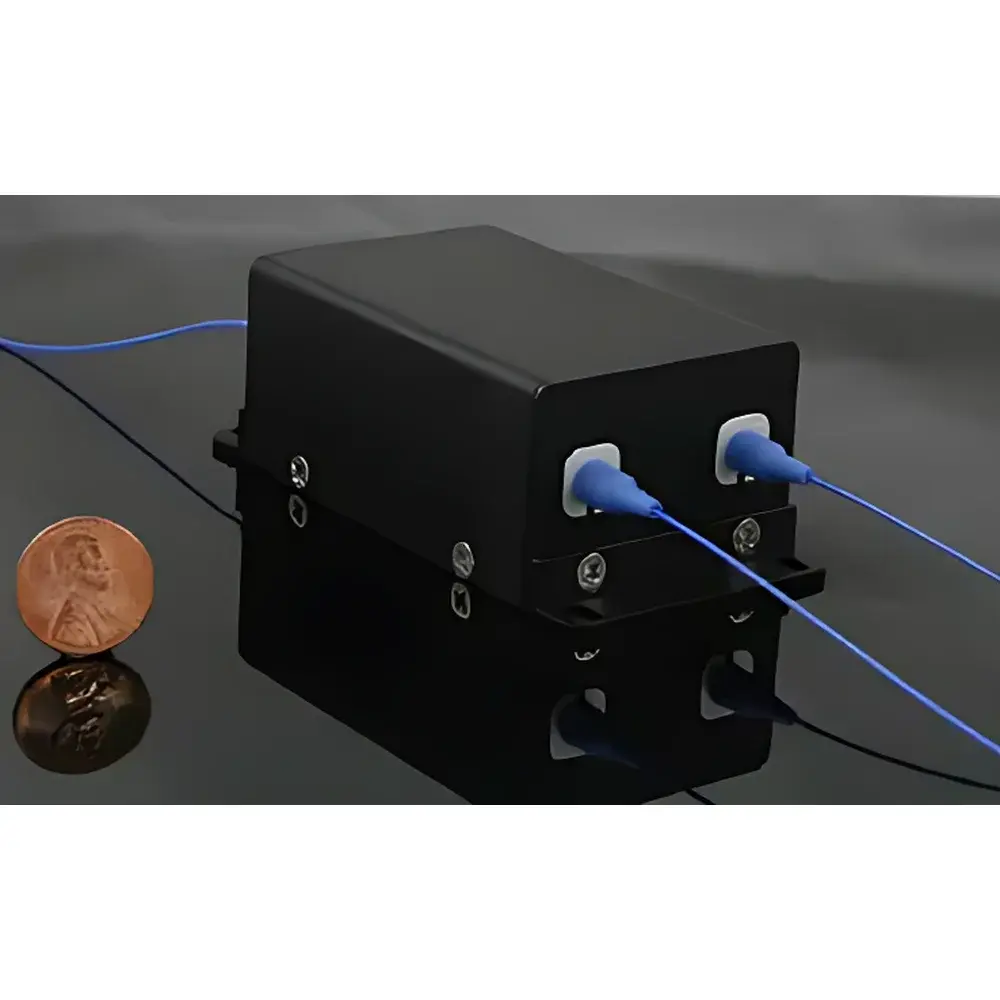
Taiwan HCP 2×0 SFG Mixer Module
| Brand | HCP (Longcai Technology) |
|---|---|
| Origin | Taiwan |
| Model | 2×0 SFG Mixer |
| Pump Wavelength | 632 nm |
| Pump Power | 3 W |
| Output Configuration | Dual-fiber input, free-space output |
| Harmonic Options | Selectable SHG/SFG dual-output mode |
| Mechanical Design | Compact, rigid monolithic housing |
| Channel Architecture | Single nonlinear mixing channel |
Overview
The Taiwan HCP 2×0 SFG Mixer Module is a precision-engineered optical frequency conversion device designed for coherent sum-frequency generation (SFG) and second-harmonic generation (SHG) in laboratory and industrial spectroscopic applications. Operating at a fundamental pump wavelength of 632 nm with up to 3 W average power handling capacity, the module leverages quasi-phase-matched nonlinear optics—typically implemented in periodically poled lithium niobate (PPLN) or similar birefringent crystals—to enable efficient, stable, and spectrally pure mid-IR or visible upconversion. Unlike broadband parametric devices, this single-channel mixer is optimized for high conversion efficiency under tightly controlled beam overlap and polarization alignment conditions, making it suitable for surface-sensitive vibrational sum-frequency generation (VSFG) spectroscopy, gas-phase nonlinear detection, and pump-probe experiments requiring phase-matched spectral synthesis.
Key Features
- Single-channel nonlinear mixing architecture engineered for high optical-to-optical conversion efficiency under 632 nm excitation
- Monolithic mechanical design with kinematic mounting interfaces ensures long-term alignment stability and thermal drift resistance
- Dual-fiber input ports accommodate independently controlled fundamental beams (e.g., visible + IR), enabling flexible SFG wavelength tuning via input wavelength selection
- Free-space collimated output facilitates direct coupling into spectrometers, interferometers, or vacuum chambers without fiber coupling losses
- Selectably configurable for either SHG-only (632 nm → 316 nm) or SFG operation (e.g., 632 nm + 1550 nm → 472 nm), supporting multi-modal experimental setups
- No active temperature control required for standard operation; compatible with passive heat-sinking or optional thermoelectric stabilization for extended spectral stability
Sample Compatibility & Compliance
The 2×0 SFG Mixer Module is compatible with standard polarization-maintaining (PM) single-mode fibers (e.g., PM630-HP or PM780-HP) and supports input beam diameters ranging from 0.8 mm to 1.5 mm (1/e²). It complies with IEC 60825-1:2014 Class 4 laser product safety requirements when integrated into properly interlocked optical enclosures. The optical path is sealed against dust and ambient humidity per IP52 specifications. While not certified to ISO/IEC 17025 for calibration traceability, the module’s mechanical repeatability and alignment retention support GLP-compliant documentation protocols when used within validated experimental workflows. No hazardous substances are employed in crystal bonding or housing fabrication, conforming to RoHS Directive 2011/65/EU.
Software & Data Management
This is a fully passive optical module with no embedded firmware, microcontroller, or digital interface. All operational parameters—including input polarization states, beam overlap geometry, and crystal temperature—are managed externally via standard lab instrumentation (e.g., motorized rotation stages, thermo-electric controllers, waveplate drivers). Experimental metadata (e.g., input powers, alignment timestamps, spectral acquisition logs) must be recorded using third-party data acquisition platforms such as LabVIEW, Python-based PyVISA frameworks, or MATLAB Instrument Control Toolbox. For regulatory environments requiring audit trails (e.g., FDA 21 CFR Part 11), integration with validated electronic lab notebooks (ELNs) or LIMS systems is recommended to document configuration changes and usage history.
Applications
- Vibrational sum-frequency generation (VSFG) spectroscopy for in situ analysis of molecular monolayers at solid–liquid and solid–gas interfaces
- Coherent anti-Stokes Raman scattering (CARS) pump source generation via SFG-derived narrowband visible pulses
- Mid-infrared light source synthesis for trace gas sensing (e.g., CO, CH₄, NO₂) through difference-frequency generation seeding
- Ultrafast pulse characterization where phase-matched sum-frequency cross-correlation is employed for intensity autocorrelation
- Nonlinear optical metrology requiring reproducible, alignment-insensitive harmonic generation in compact OEM systems
FAQ
Is temperature tuning required to achieve phase matching?
Phase matching is primarily achieved through crystal orientation and poling period selection at time of manufacture; fine-tuning via temperature adjustment (< ±2 °C) may improve conversion efficiency for specific wavelength combinations but is not mandatory for nominal 632 nm operation.
Can the module accept non-PM fiber inputs?
Yes, but polarization extinction ratio and conversion efficiency will degrade significantly without polarization-maintaining delivery; PM fiber input is strongly recommended for quantitative work.
What is the maximum permissible peak power for pulsed operation?
The module is rated for continuous-wave (CW) use at ≤3 W total input power; for pulsed sources, peak fluence must remain below 0.1 J/cm² to avoid optical damage—consult HCP’s application note AN-SFG-02 for pulse duration–energy derating guidelines.
Does the free-space output include collimation optics?
Yes, the output beam is pre-collimated to a 1/e² diameter of 1.0 ±0.1 mm with divergence < 1.5 mrad, optimized for coupling into standard 1/2″ optical mounts.
Is OEM integration support available?
HCP provides mechanical drawings, beam path schematics, and mounting torque specifications under NDA; custom flange configurations and vacuum-compatible variants are available upon engineering review.



