
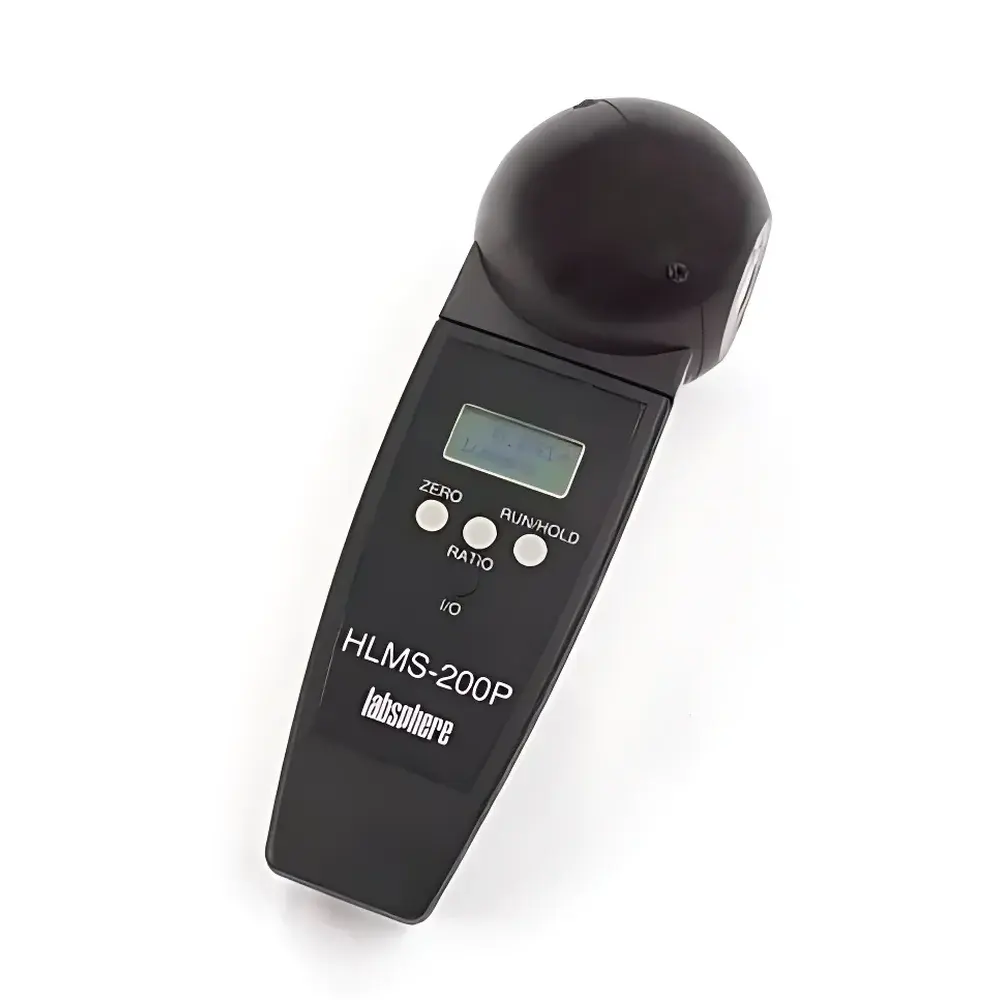
Labsphere HLMS-200P Handheld Photometer
| Brand | Labsphere |
|---|---|
| Model | HLMS-200P |
| Origin | USA |
| Instrument Type | Handheld Photometer |
| Photometric Range | 0.5–7000 lm |
| Calibration Traceability | NIST-traceable |
| Spectral Correction | Yes |
| Auto-ranging | Yes |
| Auto-zero | Yes |
| Display | 4-digit LCD |
| Power Supply | 9 V battery |
| Auto-power-off | Yes |
| Low-battery Indicator | Yes |
| Weight | Lightweight, ergonomic handheld design |
| Compliance | Designed for photometric compliance with CIE 1931 standard observer and ISO/CIE 8981, IES LM-79–2019 (where applicable) |
Overview
The Labsphere HLMS-200P Handheld Photometer is a precision-engineered, portable photometric instrument designed for rapid, field-deployable luminous flux measurements of LEDs, lamps, luminaires, and fiber-optic light sources. It operates on the principle of spectrally corrected V(λ)-weighted photometry—conforming to the CIE 1931 standard photopic luminosity function—to deliver accurate lumen readings across a wide dynamic range (0.5–7000 lm). Unlike broadband lux meters or uncorrected silicon photodiodes, the HLMS-200P integrates proprietary spectral correction algorithms that compensate for detector responsivity deviations relative to the ideal V(λ) curve, minimizing measurement errors—especially critical for narrow-band LED sources with non-standard emission spectra. Its compact, hand-held architecture enables direct in-situ testing without optical integration spheres or dark-room setups, making it suitable for production line verification, on-site lighting audits, and R&D prototyping environments where portability and traceable accuracy are equally essential.
Key Features
- NIST-traceable calibration: Factory-calibrated against primary standards at Labsphere’s A2LA-accredited photometry laboratory (ISO/IEC 17025:2017), with full calibration certificate including uncertainty budget and measurement traceability chain.
- Spectrally corrected photodetector: Optimized silicon photodiode with custom interference filter stack and firmware-based V(λ) correction ensures <±2.5% f1’ error per CIE S 023/E:2013 for typical white and monochromatic LED sources.
- Auto-ranging and auto-zero functionality: Eliminates manual range selection and zero-drift artifacts; adaptive gain switching maintains optimal signal-to-noise ratio across the full 0.5–7000 lm range.
- Ergonomic handheld form factor: Integrated grip, low mass (<350 g), and intuitive single-button interface enable one-handed operation under varied ambient conditions.
- Onboard microprocessor and real-time display: 4-digit LCD provides immediate readout of luminous flux (lm), with simultaneous indication of battery status and measurement mode.
- Low-power architecture: Powered by a single 9 V alkaline battery with >15 hours of continuous operation; automatic shutdown after 5 minutes of inactivity conserves power without compromising measurement readiness.
Sample Compatibility & Compliance
The HLMS-200P is validated for use with directional and omnidirectional light sources emitting within the visible spectrum (380–780 nm), including phosphor-converted white LEDs, RGB LED arrays, halogen lamps, and fiber-coupled illumination systems. It complies with the photometric measurement principles outlined in IES LM-79–2019 (Electrical and Photometric Measurements of Solid-State Lighting Products) for total luminous flux determination—when used in conjunction with appropriate auxiliary optics (e.g., integrating spheres for Lambertian sources) or calibrated reference fixtures. While not a standalone sphere system, the HLMS-200P meets the requirements for secondary standard transfer and routine verification under ISO/CIE 8981:2014 (Photometry — General requirements for photometers) and supports GLP-aligned documentation workflows via optional data logging accessories.
Software & Data Management
The HLMS-200P operates as a stand-alone instrument with no mandatory software dependency. However, optional RS-232 or USB-to-serial adapters enable connection to Labsphere’s Photometric Data Manager (PDM) v3.x software for time-stamped data export (CSV), batch reporting, and audit trail generation. PDM supports 21 CFR Part 11–compliant user authentication, electronic signatures, and immutable record retention—making it suitable for regulated quality control environments requiring documented measurement integrity. Calibration history, operator ID, and environmental metadata (e.g., ambient temperature, date/time stamp) can be embedded into exported datasets for full traceability.
Applications
- LED manufacturing: In-line lumen binning, post-assembly verification, and outgoing quality inspection.
- Lighting design validation: Field assessment of installed luminaires against photometric specifications (e.g., IESNA files, LM-79 reports).
- Fiber-optic system characterization: Quantification of output flux from endoscopic, dental, or industrial fiber bundles.
- Academic and teaching labs: Hands-on photometry training aligned with CIE and ISO foundational standards.
- Maintenance and retrofit auditing: Comparative luminous output tracking over time to assess lumen depreciation (L70/L50) in legacy or newly upgraded installations.
FAQ
Is the HLMS-200P suitable for measuring UV or IR sources?
No—the HLMS-200P is optimized exclusively for photopic (visible) luminous flux measurement (380–780 nm) and does not provide radiometric or extended-spectrum capability.
Does it require annual recalibration?
Yes—Labsphere recommends recalibration every 12 months or after any physical shock or exposure to extreme thermal cycling to maintain NIST-traceable accuracy.
Can it measure illuminance (lux) instead of luminous flux (lumens)?
No—it is configured specifically for total luminous flux measurement using a cosine-corrected input aperture; illuminance requires a separate lux meter with calibrated area-weighted response.
Is firmware upgradeable in the field?
Yes—via Labsphere-provided utility software and serial interface; updates include spectral correction refinements and compliance enhancements per latest CIE technical reports.
What accessories are required for compliant LM-79 testing?
For full LM-79–compliant total flux measurement, the HLMS-200P must be used with an A2LA-accredited integrating sphere (e.g., Labsphere UltraLite™ series) and temperature-controlled socket fixture—per Section 6.1 of LM-79–2019.





