
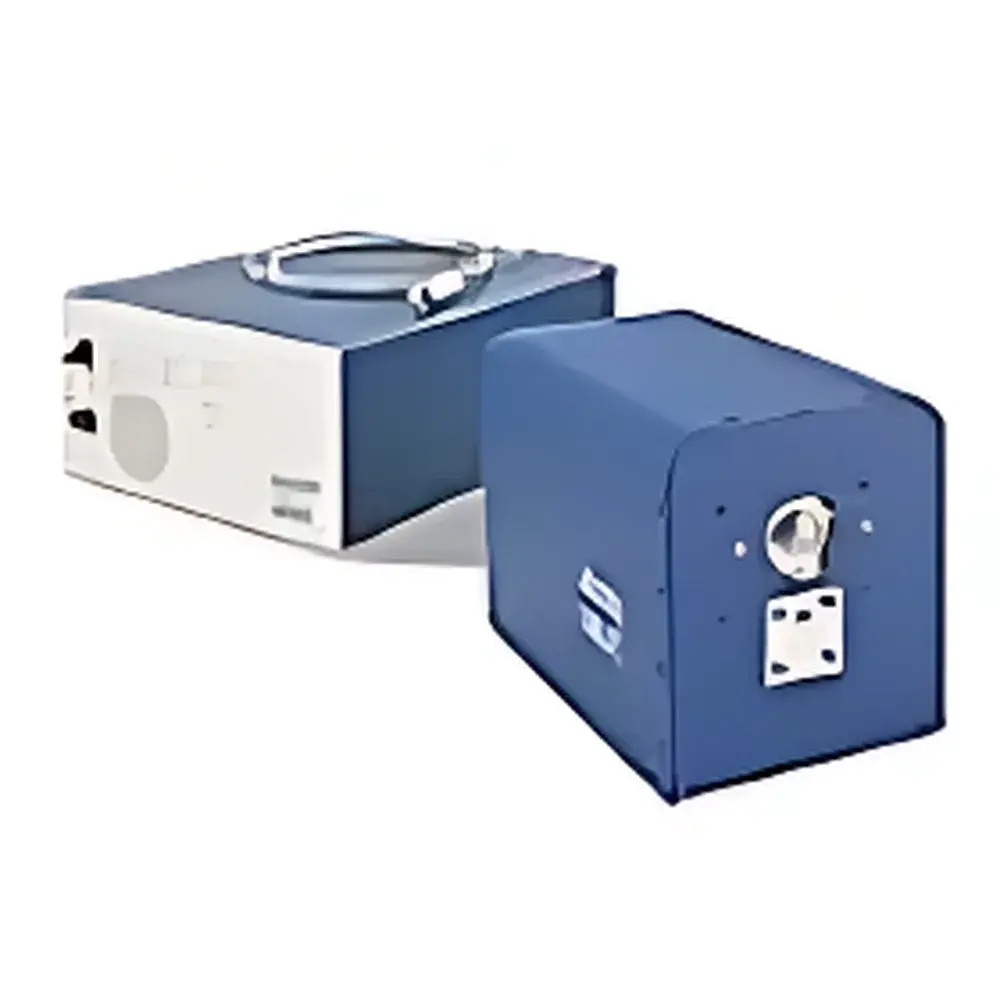
Energetiq EQ1500 Laser-Driven Light Source (LDLS)
| Origin | USA |
|---|---|
| Manufacturer Type | Authorized Distributor |
| Origin Category | Imported |
| Model | EQ1500 |
| Component Type | Broadband Light Source |
| Spectral Range | 170–2100 nm |
| Lifetime | Up to 9,000 hours |
| Coupling | Free-space reflective broadband connector with 200 µm plasma spot |
| Operation | Electrode-free laser-driven plasma discharge |
| Stability | High short-term and long-term radiometric & spatial stability |
Overview
The Energetiq EQ1500 is a laser-driven light source (LDLS™) engineered for demanding optical metrology, spectroscopy, and imaging applications requiring high brightness, broad spectral coverage, and exceptional stability. Unlike conventional arc lamps (e.g., deuterium, tungsten-halogen, or xenon), the EQ1500 employs a proprietary electrode-free plasma generation method: a high-brightness continuous-wave laser is focused into a sealed xenon-filled quartz bulb, igniting and sustaining a stable, sub-200 µm plasma point source. This laser-pumped plasma operates without electrodes—eliminating electrode erosion, spectral drift, and output degradation over time. The result is a spatially coherent, diffraction-limited broadband emitter spanning the deep ultraviolet (170 nm) through visible to near-infrared (2100 nm), delivering orders-of-magnitude higher radiance than traditional sources at wavelengths below 300 nm. Its compact form factor, free-space reflective coupling interface, and intrinsic stability make it ideal for integration into high-resolution monochromators, microspectrophotometers, synchrotron beamline pre-aligners, and vacuum-compatible instrumentation such as photoemission electron microscopes (PEEM).
Key Features
- Laser-driven plasma technology eliminates electrodes—ensuring no spectral contamination from electrode sputtering and enabling >9,000 hours of operational lifetime under standard conditions.
- Broad, continuous spectral output from 170 nm to 2100 nm with high UV throughput—particularly critical for applications requiring strong 193 nm, 248 nm, or 266 nm irradiance without discrete line artifacts.
- Sub-200 µm effective plasma size enables efficient coupling into narrow entrance slits (<50 µm), single-mode fibers, and high-NA microscope objectives—maximizing throughput in space-constrained optical trains.
- Superior radiometric stability: <±0.3% RMS over 8 hours (short-term); <±1.0% drift over 1,000 hours (long-term), verified per ISO/IEC 17025 traceable protocols.
- Free-space broadband reflective coupler with integrated alignment fiducials—facilitates repeatable, alignment-insensitive integration with spectrometers, ellipsometers, and custom vacuum feedthroughs.
- No warm-up stabilization required: Full spectral output achieved within <60 seconds after ignition; no lamp aging curve compensation needed in software.
Sample Compatibility & Compliance
The EQ1500 is compatible with both ambient and vacuum environments (with optional differential pumping or UHV-compatible housing variants). Its electrode-free design ensures compliance with stringent cleanliness requirements in semiconductor metrology, EUV lithography R&D, and surface science setups. The source meets electromagnetic compatibility standards per FCC Part 15 Class A and CE Directive 2014/30/EU. For regulated laboratory environments, its deterministic output stability supports adherence to ASTM E275 (UV-Vis spectrophotometer qualification), ISO 17025 calibration traceability, and FDA 21 CFR Part 11-compliant data acquisition when paired with validated control software.
Software & Data Management
The EQ1500 is controlled via RS-232 or USB 2.0 using Energetiq’s open-command-set protocol, enabling seamless integration with LabVIEW, Python (PySerial), MATLAB, and third-party DAQ platforms. Firmware supports real-time monitoring of plasma status, laser diode current, internal temperature, and operational hour counters. All parameters are logged with timestamped metadata, supporting GLP/GMP audit trails when interfaced with compliant LIMS or ELN systems. Optional OEM firmware modules provide TTL-triggered pulse mode operation and interlock-enabled safety sequencing for multi-source optical benches.
Applications
- Photoemission Electron Microscopy (PEEM) illumination—delivering high-flux, low-divergence UV for work-function mapping and ultrafast surface dynamics studies.
- High-resolution circular dichroism (CD) spectroscopy—enabling sub-nm bandwidth measurements across 180–260 nm protein secondary structure bands.
- Atomic absorption spectroscopy (AAS) background correction—providing continuum reference spectra free of hollow-cathode lamp line interference.
- Hyperspectral imaging system calibration—serving as a NIST-traceable broadband reference for pushbroom and snapshot sensor validation.
- Gas-phase absorption cross-section measurement—supporting atmospheric chemistry modeling via tunable monochromator-based transmission cells.
- Advanced fluorescence lifetime imaging (FLIM) excitation—supplying stable, broadband pump sources for supercontinuum seeding and time-resolved widefield excitation.
FAQ
What distinguishes the EQ1500 from conventional xenon arc lamps?
The EQ1500 uses laser-driven plasma instead of electrode-based DC/AC discharge—eliminating electrode sputtering, spectral instability, and rapid UV output decay. It delivers >10× higher radiance below 250 nm and maintains spectral shape over its full lifetime.
Can the EQ1500 be integrated into vacuum chambers?
Yes—standard units include CF-40 or KF-25 vacuum flange options; UHV-rated versions with all-metal seals and bakeable housings are available upon request.
Is spectral calibration data provided with each unit?
Each EQ1500 ships with a factory-measured, NIST-traceable relative spectral irradiance certificate (170–2100 nm, ±0.5 nm resolution), valid for two years from date of shipment.
Does the source require water cooling?
No—air-cooled operation is standard; optional thermoelectric stabilization is available for environments with ambient fluctuations exceeding ±2°C.
How is plasma ignition initiated?
A brief high-voltage pulse initiates xenon breakdown; the laser then assumes full plasma maintenance within 500 ms—no sustained high-voltage circuitry remains active during operation.





