
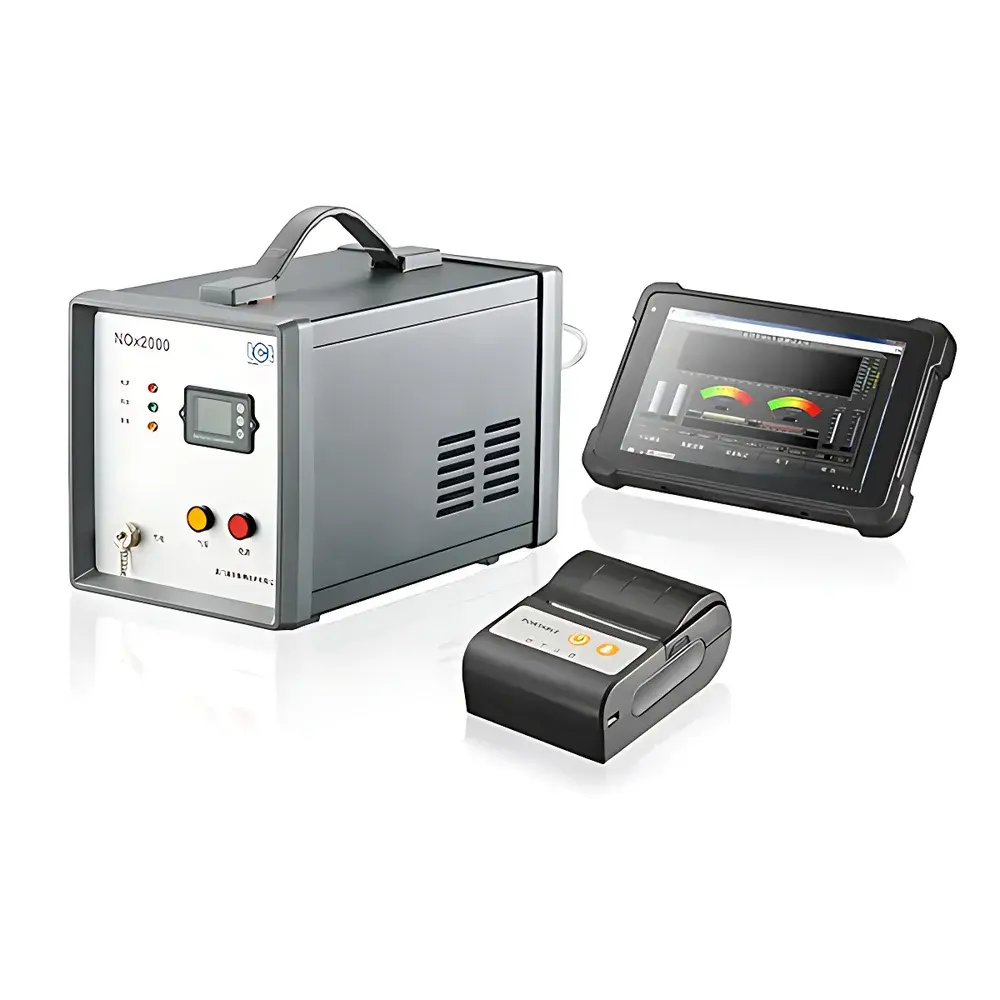
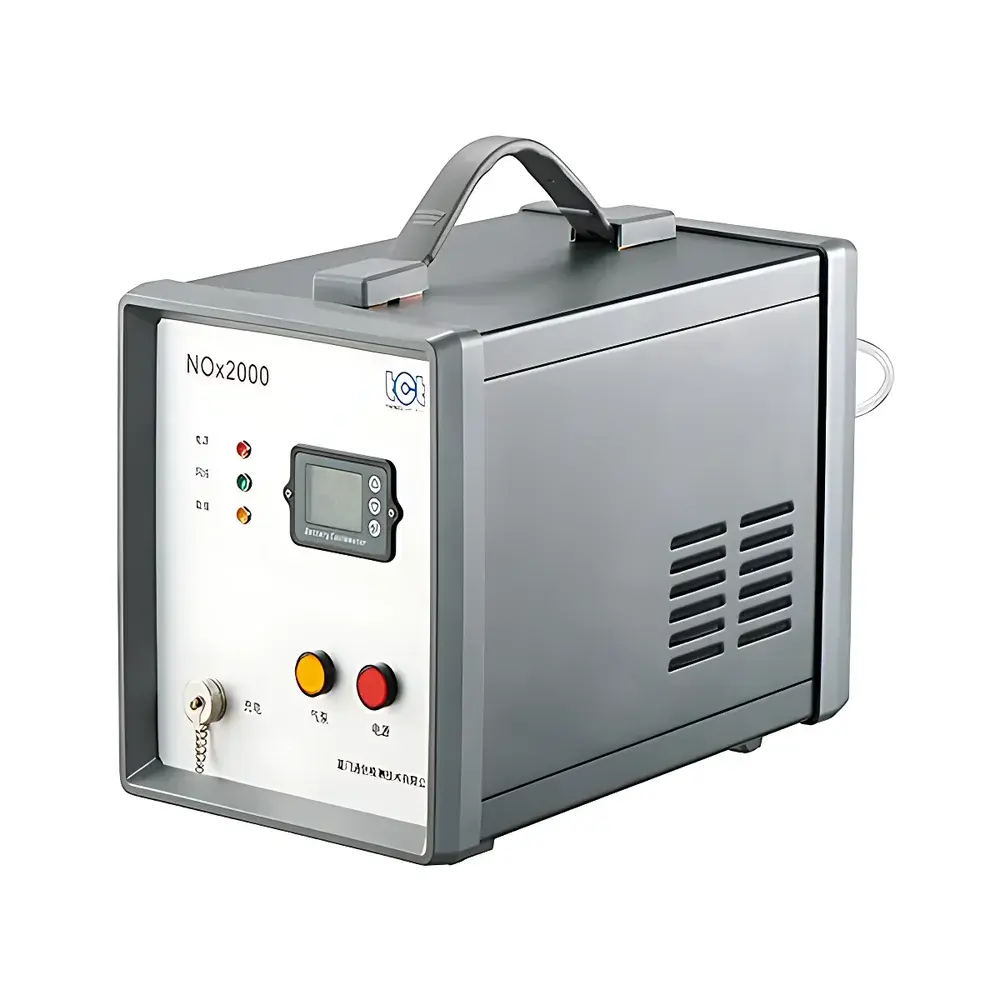
TCT NOX2000 Heavy-Duty Vehicle Nitrogen Oxides Rapid Emission Analyzer
| Brand | TCT (Xiamen Tongchuang) |
|---|---|
| Origin | Fujian, China |
| Model | NOX2000 |
| Measurement Principle | Zirconia-based electrochemical sensor array with integrated O₂/NOₓ/λ/AFR sensing |
| NOₓ Range | 0–3000 ppm |
| NOₓ Accuracy | ±10 ppm (0–100 ppm), ±10% of reading (100–1500 ppm) |
| O₂ Range | 0–21% vol |
| O₂ Accuracy | ±0.13% (λ = 1.00, new sensor), ±0.25% (λ = 1.00, aged) |
| λ Range | 0.75–∞ (air) |
| λ Accuracy | <±0.1 |
| Response Time (T₃₀–₉₀%) | <150 ms (O₂, λ), 750 ms (NOₓ) |
| Data Update Rate | 10 ms (NOₓ), 1 Hz (GPS, vehicle speed) |
| Vehicle Speed Range | 0–200 km/h, ±0.2 km/h |
| GPS Position Accuracy | <±5 m (horizontal), ±0.1 m/s velocity resolution |
| Sampling Temp. | 0–800 °C |
| Operating Temp. | −40 to +55 °C |
| Storage Temp. | −40 to +120 °C (2-year stability) |
| Power | 30 W |
| Battery | Rechargeable Li-ion with real-time SOC display |
| Wireless | Dual-mode Wi-Fi & Bluetooth 5.0 |
| Compliance | DB11/1476–2017, GB3847–2018 Annex E, GB17691–2017 (Stage VI), GB17691–2005 (Stages III–V) |
Overview
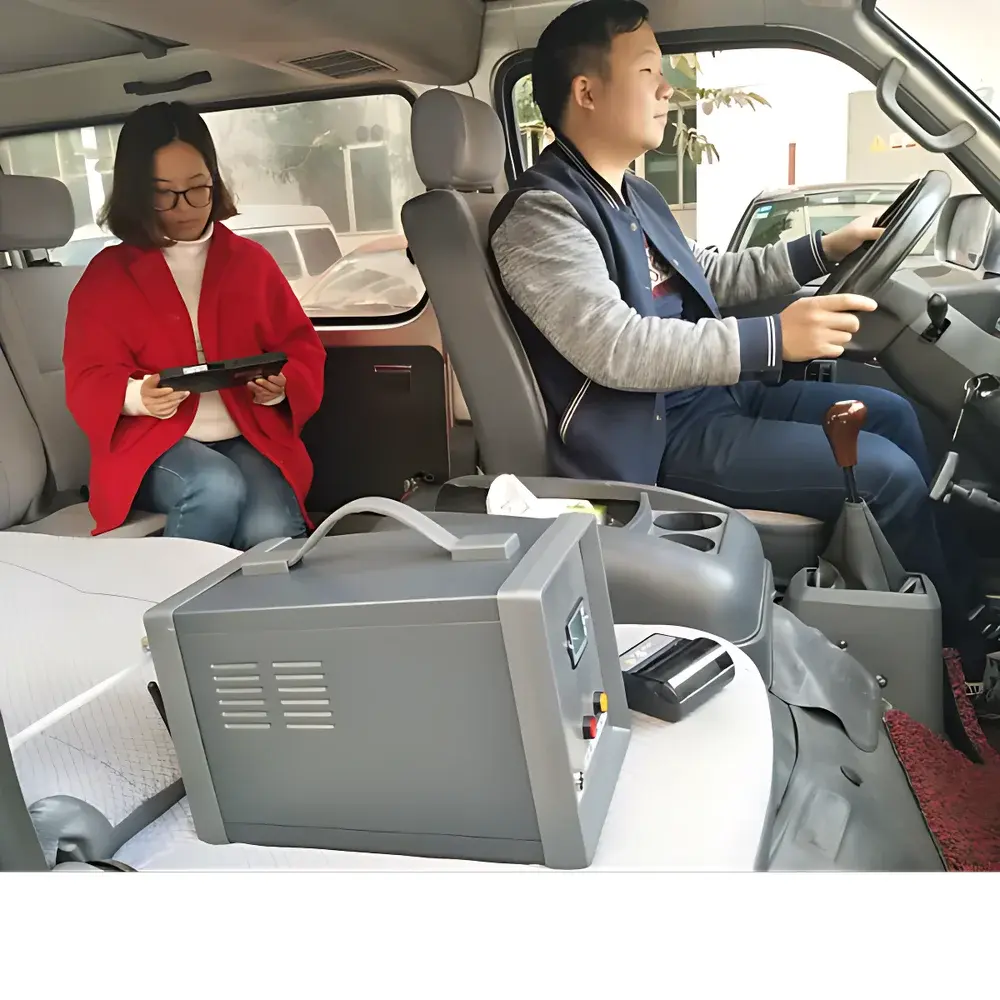
The TCT NOX2000 is a field-deployable, handheld-capable nitrogen oxides (NOx) rapid emission analyzer engineered for regulatory enforcement and in-service compliance verification of heavy-duty diesel and alternative-fuel vehicles. It operates on a dual-sensor zirconia ceramic platform—integrating electrochemical NOx, paramagnetic O2, and air–fuel ratio (AFR)/equivalence ratio (λ) measurement within a single high-temperature sampling probe. This architecture enables simultaneous, real-time quantification of gaseous pollutants without external dilution or catalytic conversion, satisfying the direct-insertion requirement stipulated in DB11/1476–2017. The instrument is explicitly validated against CLD (chemiluminescence detection) reference methods used in engine certification test benches, demonstrating strong correlation (r² > 0.98) across the full NOx range (0–3000 ppm). Designed for mobile source emissions enforcement, it supports both free-acceleration and loaded-mode testing per GB3847–2018 Annex E, and delivers traceable, auditable data streams compatible with provincial and national mobile emission supervision platforms.
Key Features
- Integrated zirconia-based multi-gas probe enabling concurrent NOx, O2, λ, and AFR measurement at exhaust temperatures up to 800 °C
- Sub-second dynamic response: T30–90% < 150 ms for O2/λ; 750 ms for NOx, supporting transient engine cycle capture
- Onboard GPS module with <±5 m positional accuracy and 0.1 m/s velocity resolution for geotagged test logging
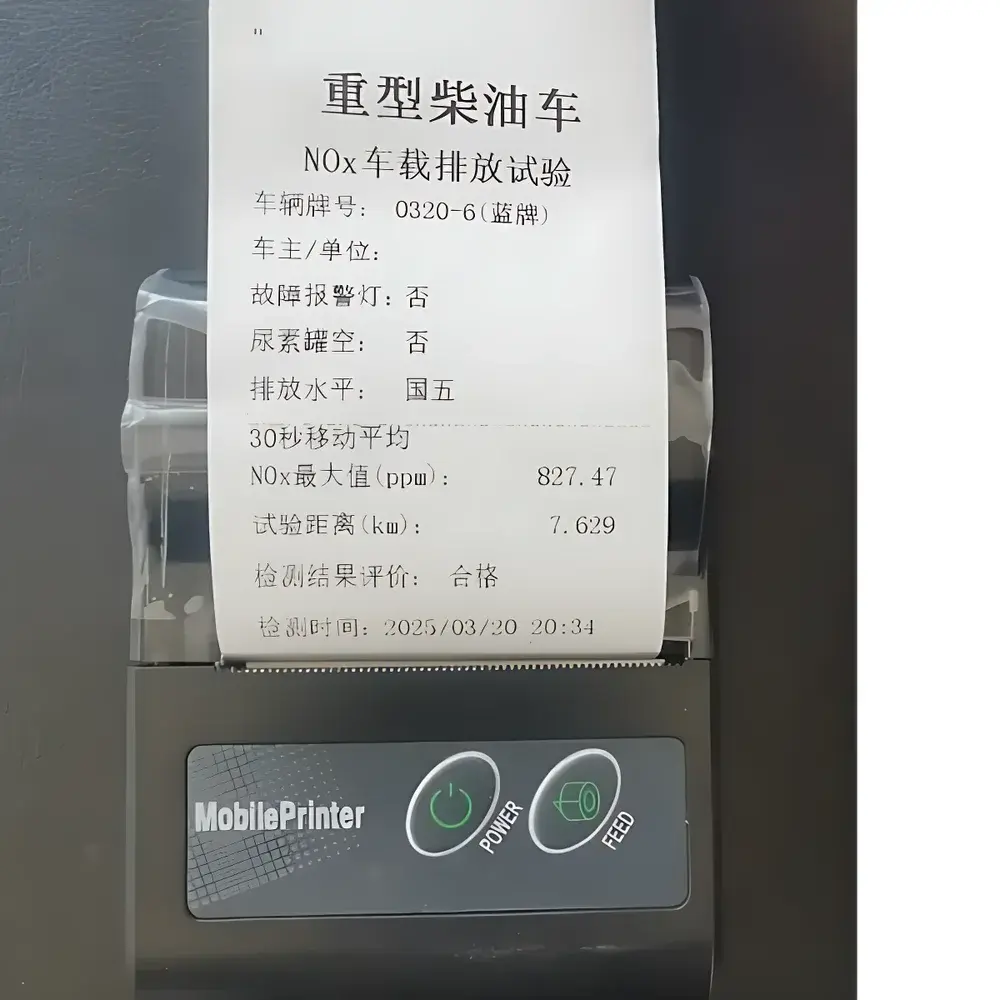
- Dual-band wireless interface (Wi-Fi 802.11n + Bluetooth 5.0) enabling seamless pairing with handheld terminals, thermal printers, and cloud gateways
- Rechargeable lithium-ion battery with state-of-charge (SOC) indicator and continuous 4.5-hour operation under nominal load (30 W)
- Real-time waveform visualization of NOx, O2, λ, vehicle speed, and GPS coordinates via embedded GUI or remote app
- Automated report generation compliant with DB11/1476–2017 formatting, including digital signature, timestamp, location stamp, and OBD-II fault code extraction
Sample Compatibility & Compliance
The NOX2000 is certified for use on compression-ignition (diesel), spark-ignition (gasoline), and alternative-fuel (CNG, LNG, LPG, biodiesel) heavy-duty vehicles meeting GB17691–2005 (Stages III–V) and GB17691–2017 (Stage VI) requirements. Its direct-insertion sampling design eliminates need for complex dilution tunnels or heated sample lines—reducing maintenance overhead and calibration drift. All measurement algorithms and uncertainty budgets are traceable to NIM (National Institute of Metrology, China) reference standards. The device satisfies data integrity requirements for regulatory enforcement under China’s “Mobile Source Emission Supervision Platform” architecture, including secure TLS 1.2 encrypted upload, immutable audit logs, and time-stamped metadata per test event. Firmware implements tamper-evident storage and read-only configuration lock for GLP-aligned field operations.
Software & Data Management
Firmware v3.2+ supports local SD card storage (up to 32 GB) with FAT32-formatted cyclic logging, retaining ≥10,000 test records with full parameter history. Data export formats include CSV (for Excel/Python analysis), PDF (print-ready reports), and XML (platform ingestion). Cloud synchronization uses HTTPS POST with OAuth2 authentication to provincial environmental bureaus’ backend systems. The companion Android/iOS application provides role-based access control (inspector, supervisor, administrator), offline test queuing, QR-code–based vehicle ID scanning, and real-time dashboard analytics—including fleet-level NOx trend mapping, outlier detection, and statistical pass/fail rate aggregation. All data handling conforms to China’s Personal Information Protection Law (PIPL) and environmental data security guidelines.
Applications
- Enforcement roadside inspections of heavy-duty trucks and buses under DB11/1476–2017 and GB3847–2018
- In-use compliance screening for SCR system functionality and urea dosing efficiency
- Verification of OBD-II readiness monitors and diagnostic trouble code (DTC) correlation with measured NOx excursions
- Pre– and post–emission control retrofit validation (e.g., DPF, SCR, EGR tuning)
- Field support for type-approval conformity-of-production (COP) audits per GB17691–2017 Annex C
- Research-grade transient emission profiling during urban driving cycles (e.g., WLTC, CHINA VI RDE)
FAQ
Does the NOX2000 require periodic calibration with span gases?
Yes—daily zero/span verification using certified NO and O2 standard gases (ISO 6141) is required prior to enforcement use. Factory calibration certificates are issued annually.
Can the device interface with third-party telematics or fleet management platforms?
Yes—via RESTful API (JSON over HTTPS) with documented endpoints for test result ingestion, firmware update status, and device health telemetry.
Is the zirconia sensor replaceable in the field?
Yes—the dual-element probe is user-replaceable without tools; replacement interval is 12 months under typical enforcement duty cycles (≤200 tests/month).
What cybersecurity protocols does the device implement?
Firmware enforces TLS 1.2 for all network communications, disables default credentials, supports certificate-based mutual authentication, and logs all configuration changes with SHA-256 hashed timestamps.
How is measurement uncertainty reported per test?
Each PDF report includes expanded uncertainty (k=2) calculated per GUM (JCGM 100:2008), incorporating sensor accuracy, GPS error budget, temporal alignment jitter, and environmental temperature drift coefficients.







