
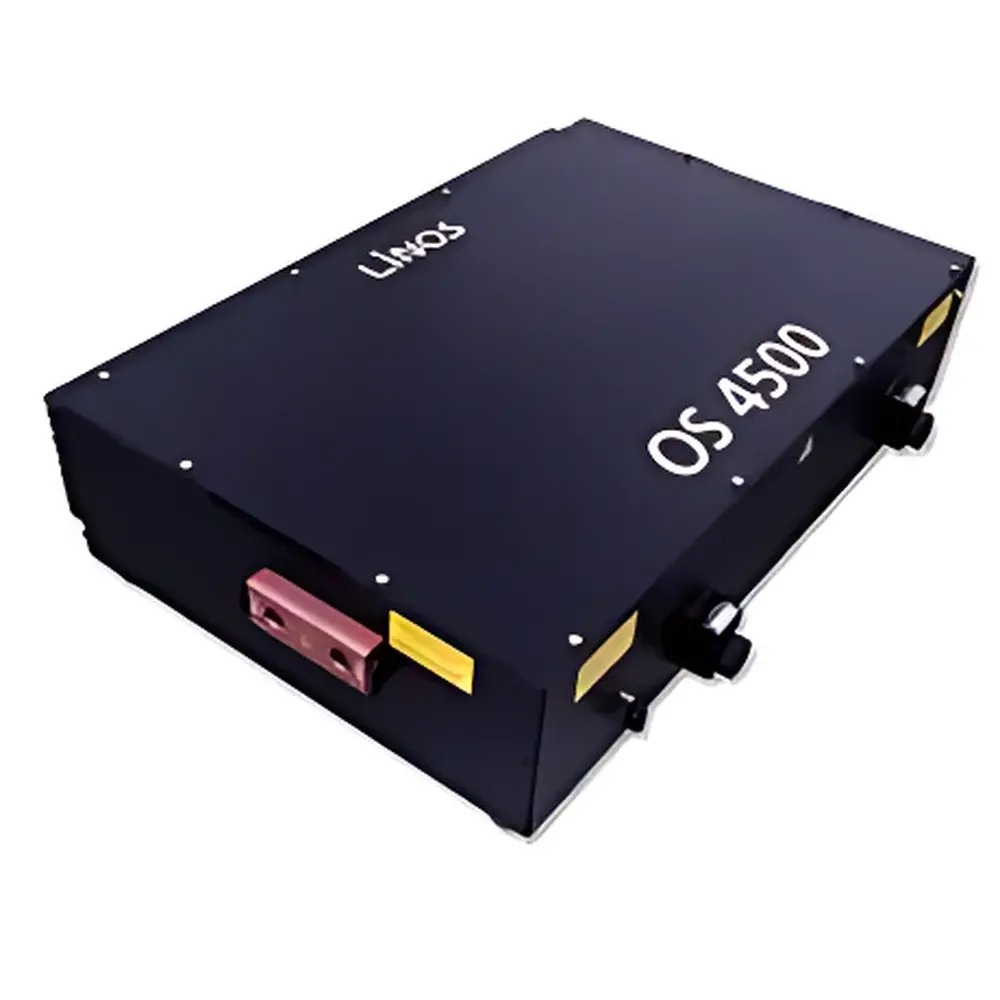
Linos OS4500 Optical Parametric Oscillator (OPO) Laser System
| Brand | Linos |
|---|---|
| Origin | USA |
| Manufacturer Type | Authorized Distributor |
| Origin Category | Imported |
| Model | OS4500 |
| Pricing | Contact for Quotation |
Overview
The Linos OS4500 Optical Parametric Oscillator (OPO) Laser System is a fully integrated, continuous-wave (CW), single-frequency laser source engineered for high-precision infrared spectroscopy and metrology applications. Based on the principle of optical parametric generation in nonlinear optics, the OS4500 utilizes second-order nonlinear susceptibility (χ⁽²⁾) in a periodically poled, MgO-doped lithium niobate (PPMgOLN) crystal to convert pump photon energy into signal and idler photons via energy conservation (ωp = ωs + ωi) and phase-matching constraints. The system incorporates a built-in diode-pumped solid-state (DPSS) pump laser, an intracavity etalon (ICE), thermally stabilized resonator cavity, and active electronic feedback for long-term frequency stability. Unlike tunable dye or quantum cascade lasers, the OS4500 delivers inherently narrow-linewidth (<100 kHz typical), low-amplitude-noise (<0.3% RMS, 10 Hz–10 MHz), diffraction-limited (M² < 1.1) output across two complementary infrared bands—making it suitable for demanding applications such as molecular fingerprinting, trace gas detection, and absolute frequency calibration.
Key Features
- Compact, turnkey CW OPO architecture with integrated pump laser, control electronics, and thermal stabilization subsystems
- Single-frequency operation enabled by intra-cavity etalon and Pound-Drever-Hall (PDH) locking capability
- Narrow spectral linewidth (<100 kHz) and exceptional amplitude stability (RMS noise <0.3% over 10 Hz–10 MHz bandwidth)
- Diffraction-limited beam quality (M² < 1.1) with TEM00 spatial mode and pointing stability <5 µrad/°C
- Continuous, mode-hop-free tuning via pump laser frequency modulation, complemented by coarse crystal translation and fine temperature adjustment
- Robust mechanical design compliant with ISO 10110 optical mounting standards and CE/IEC 61000-6-3 EMC requirements
Sample Compatibility & Compliance
The OS4500 is designed for use with standard optical tables, vacuum-compatible beam paths, and common IR detector interfaces (e.g., InGaAs, HgCdTe, and cryogenic bolometers). Its output wavelengths are compatible with standard silica-based fiber coupling (for signal band) and fluoride or chalcogenide fibers (for idler band). The system meets essential safety and regulatory requirements including IEC 60825-1:2014 (Class 4 laser product), FDA 21 CFR Part 1040.10/1040.11, and RoHS Directive 2011/65/EU. While not certified for GMP or GLP environments out-of-the-box, its analog/digital I/O ports support external audit-trail logging and integration into validated laboratory information management systems (LIMS) per FDA 21 CFR Part 11 guidelines when paired with compliant software infrastructure.
Software & Data Management
The OS4500 is operated via Linos’ proprietary OPO Control Suite—a Windows-based application supporting USB 2.0 and Ethernet communication. The suite provides real-time monitoring of crystal temperature (±0.01 °C resolution), cavity length actuation voltage, pump power, and RF lock status. All tuning parameters (crystal position, heater setpoint, etalon voltage, pump frequency offset) are logged with timestamped metadata in HDF5 format for traceability. Export options include CSV and MATLAB-compatible .mat files. Remote scripting is supported via TCP/IP API (SCPI-compliant), enabling seamless integration with LabVIEW, Python (PyVISA), or MATLAB-based automation frameworks used in metrology labs and national standards institutes.
Applications
- High-resolution absorption spectroscopy of greenhouse gases (CH₄, CO₂, N₂O) and volatile organic compounds (VOCs) in atmospheric science
- Frequency-comb-referenced calibration of mid-IR spectrometers and Fourier-transform infrared (FTIR) systems
- Coherent anti-Stokes Raman scattering (CARS) microscopy for label-free chemical imaging in biological tissues
- Development and validation of quantum cascade laser (QCL) and interband cascade laser (ICL) wavelength references
- Nonlinear optical studies requiring phase-matched parametric gain characterization in bulk and waveguide geometries
- Trace detection of explosives and narcotics via photoacoustic spectroscopy in security screening platforms
FAQ
What is the tuning mechanism of the OS4500, and how does it avoid mode hops?
The OS4500 employs a hierarchical tuning strategy: coarse selection via lateral crystal translation across multiple poling periods, fine wavelength adjustment via crystal temperature (0.1 nm/°C typical), and continuous, mode-hop-free scanning via pump laser frequency modulation (±5 GHz range), which preserves cavity resonance conditions.
Is the idler output usable without additional harmonic generation or upconversion?
Yes—the idler beam (2.28–4.67 μm) is directly accessible at the rear output port and optimized for free-space propagation; no external nonlinear stages are required for standard detection configurations.
Can the OS4500 be synchronized with femtosecond laser combs for absolute frequency measurement?
Yes—its narrow linewidth and low phase noise enable heterodyne beating with stabilized frequency combs; the system includes BNC-triggered sync outputs for pump laser and cavity lock signals.
Does the OS4500 support external cavity length control for active stabilization?
Yes—it provides analog voltage inputs (±10 V, 16-bit DAC) for piezoelectric transducer (PZT) drive and digital I/O for TTL-compatible lock acquisition and error signal routing.
What maintenance is required during routine operation?
No consumables or periodic alignment are needed; recommended preventive maintenance includes annual verification of thermal sensor calibration and pump laser output power drift (±2% tolerance per ISO 11551).




