
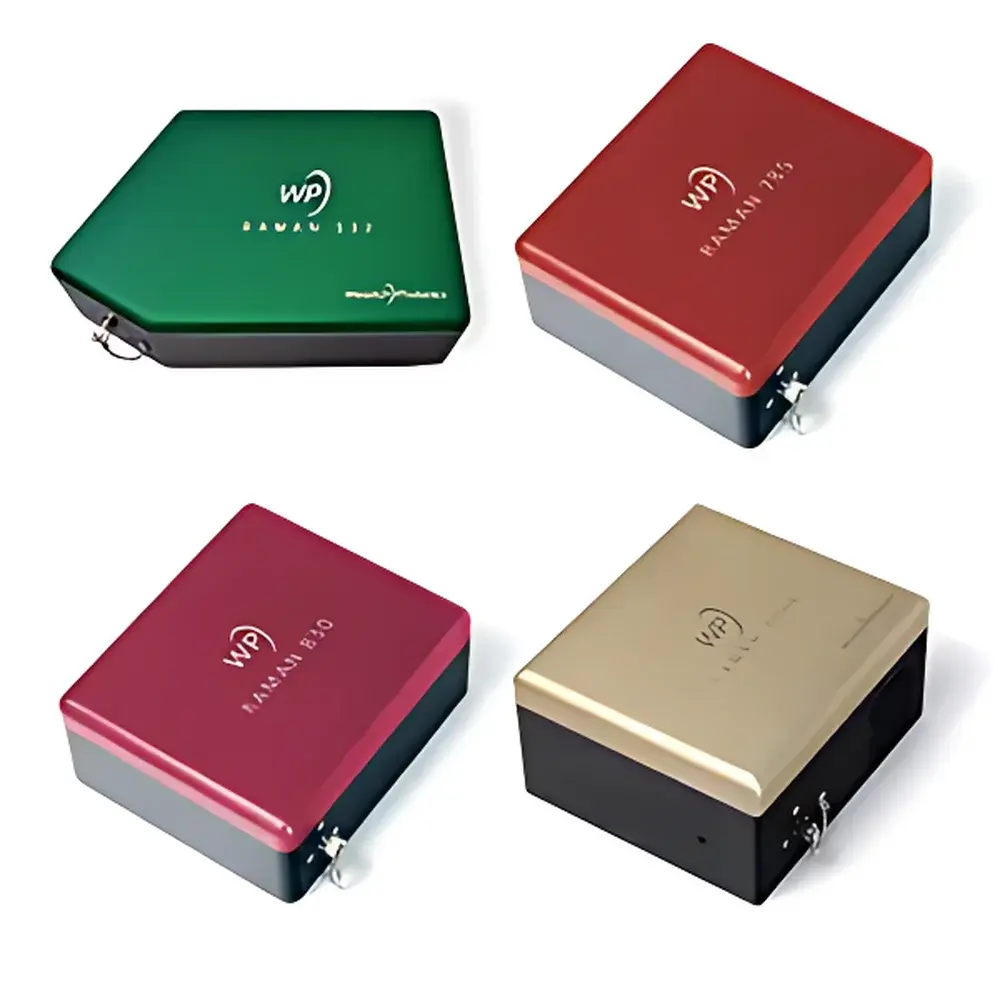
Wasatch Photonics WP785 Raman Spectrometer
| Brand | Wasatch Photonics |
|---|---|
| Origin | USA |
| Model | WP785 |
| Excitation Wavelength | 785 nm |
| Optical Throughput | f/1.3 |
| Grating Type | Patented Volume Phase Holographic (VPH) |
| Detector Options | TE-Cooled CCD or CMOS |
| Connectivity | USB 3.0, Gigabit Ethernet, Bluetooth |
| Form Factor | Compact, Ruggedized OEM-Ready Module |
| Spectral Range | Typically 200–3200 cm⁻¹ (configurable) |
| Spectral Resolution | < 4 cm⁻¹ (FWHM) |
| Stray Light Rejection | > 6 OD |
| Data Acquisition Rate | Up to 100 spectra/sec (depending on integration time and detector) |
Overview
The Wasatch Photonics WP785 Raman Spectrometer is a high-performance, compact dispersive Raman instrument engineered for quantitative molecular fingerprinting in research laboratories, industrial process monitoring, and embedded OEM applications. Operating at 785 nm excitation, the WP785 leverages low-fluorescence excitation to minimize interference from organic matrixes—making it especially suited for pharmaceuticals, polymers, biological tissues, food matrices, and carbon-based nanomaterials. Its core optical architecture employs a patented Volume Phase Holographic (VPH) transmission grating coupled with an f/1.3 all-transmissive lens system, delivering exceptional étendue and photon collection efficiency without sacrificing spectral fidelity. Unlike reflective grating spectrometers, the VPH design ensures high polarization insensitivity, minimal wavelength-dependent aberrations, and intrinsic stray light suppression (>6 OD), critical for detecting weak Raman signals buried beneath residual fluorescence or ambient background.
Key Features
- f/1.3 high-throughput optical design optimized for maximum signal-to-noise ratio in low-light conditions
- Patented VPH transmission grating enabling broadband spectral coverage with uniform efficiency and negligible ghosting
- TE-cooled scientific-grade CCD or back-illuminated CMOS detector options for dark-current suppression and extended dynamic range
- Modular architecture supporting both benchtop integration and embedded OEM deployment (e.g., handheld analyzers, inline reactors, or robotic platforms)
- Multi-interface connectivity including USB 3.0 (for plug-and-play operation), Gigabit Ethernet (for networked lab environments), and Bluetooth (for mobile device pairing)
- Ruggedized aluminum housing rated for stable performance across temperature fluctuations (15–35 °C) and mechanical vibration typical in manufacturing settings
- Factory-calibrated wavelength and intensity response traceable to NIST standards
Sample Compatibility & Compliance
The WP785 accommodates solid, liquid, gel, and powder samples via standard 1/4″ or SMA-coupled fiber probes (e.g., 200 µm core, NA 0.22), immersion probes, or custom optical interfaces. It supports common Raman sampling configurations including backscattering, transmission, and macro/micro-focusing setups. The system complies with IEC 61000-6-3 (EMC emissions) and IEC 61000-6-2 (immunity), and its firmware architecture supports audit-trail-enabled data capture required under FDA 21 CFR Part 11 for regulated environments. When integrated into GxP workflows, the WP785—paired with Wasatch’s SpectraWiz software—enables electronic signatures, user access controls, and versioned method storage aligned with GLP and GMP documentation practices.
Software & Data Management
Control and analysis are performed using Wasatch Photonics’ SpectraWiz platform—a cross-platform application (Windows/macOS/Linux) offering real-time spectral acquisition, baseline correction (Asymmetric Least Squares), peak fitting (Voigt/Gaussian models), multivariate analysis (PCA, PLS), and spectral library matching (NIST, KnowItAll, custom databases). Raw data is saved in HDF5 format ensuring long-term readability and metadata-rich archiving—including instrument configuration, calibration history, and environmental timestamps. API support (Python, MATLAB, LabVIEW) enables seamless integration into LIMS, MES, or automated QA/QC pipelines. All spectral processing algorithms are deterministic and fully scriptable, satisfying validation requirements for method transfer and regulatory submissions.
Applications
- Pharmaceutical raw material identification and counterfeit detection per USP and Ph. Eur. 2.2.48
- In-line monitoring of crystallization, polymorph conversion, and API stability during continuous manufacturing
- Non-destructive authentication of gemstones, pigments, and historical artifacts using spectral fingerprint libraries
- SERS substrate characterization and enhancement factor quantification for biosensor development
- Graphene layer counting, defect density mapping (D/G ratio), and strain analysis in 2D materials
- Food adulteration screening (e.g., melamine in milk, olive oil purity, honey authenticity)
- Process analytical technology (PAT) implementation compliant with FDA Guidance for Industry (2019)
FAQ
What excitation laser options are available for the WP785?
The WP785 is configured exclusively for 785 nm excitation; however, Wasatch offers parallel platforms at 405 nm, 532 nm, 633 nm, 830 nm, and 1064 nm for comparative fluorescence management and application-specific optimization.
Can the WP785 be used for quantitative analysis?
Yes—when paired with internal standardization, calibrated reference materials, and multivariate regression models, the WP785 achieves repeatability better than ±2% RSD for concentration measurements under controlled thermal and illumination conditions.
Is spectral calibration traceable to national standards?
Yes—each unit ships with factory-applied wavelength and intensity calibrations traceable to NIST SRM 2241 (neon emission lines) and SRM 2034 (quartz Raman line at 463.95 cm⁻¹).
Does the system support remote operation and automation?
Yes—via Ethernet or USB, the WP785 accepts SCPI-like command sets and exposes full functionality through Python bindings and RESTful endpoints for integration into automated test benches or Industry 4.0 architectures.
What maintenance is required for long-term stability?
No routine optical alignment is needed—the monolithic VPH grating and fixed-focus optics ensure drift-free operation over 5+ years. Recommended annual verification includes wavelength accuracy check and dark current assessment using built-in diagnostics.





