
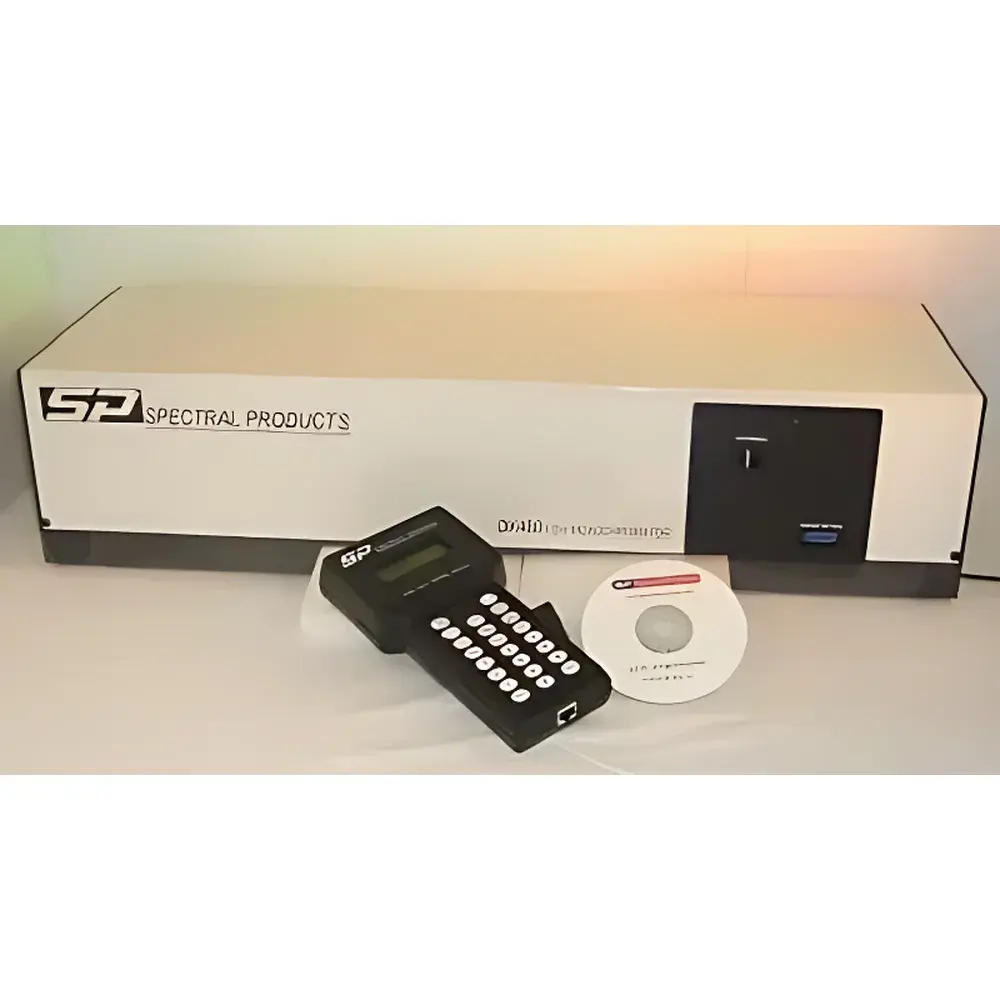
SP Spectral Products DK480 1/2-Meter Czerny-Turner Monochromator
| Brand | SP Spectral Products |
|---|---|
| Origin | USA |
| Model | DK480 |
| Focal Length | 480 mm |
| Optical Design | Czerny-Turner |
| f/# | 7.8 |
| Wavelength Accuracy | ±0.3 nm (with 1200 g/mm grating) |
| Wavelength Precision | 0.007 nm (with 1200 g/mm grating) |
| Spectral Resolution | ≤0.03 nm (with 1200 g/mm grating) |
| Stray Light | <0.01% at 220 nm |
| Slit Width Range | 10–3000 µm (motorized) |
| Slit Height Range | 2–20 mm |
| Scan Speed | 1–1200 nm/min (with 1200 g/mm grating) |
| Grating Capacity | Up to three 68 × 68 mm (or optional 68 × 84 mm) ruled or holographic gratings |
| Drive Mechanism | Computer-controlled bidirectional worm-gear drive |
| Interface Options | RS-232, IEEE-488 (GPIB), USB-to-serial adapter supported |
| Software Control | Native SP software + LabVIEW drivers |
| Power Supply | 100–240 VAC, 50/60 Hz, 60 W |
| Weight | 20.4 kg (45 lbs) |
| Calibration | Factory wavelength and intensity calibrated |
| Warranty | 12 months |
Overview
The SP Spectral Products DK480 is a high-performance, 480 mm focal length Czerny-Turner monochromator engineered for precision spectral isolation in demanding optical research and industrial metrology environments. Its optical architecture leverages symmetrical mirror alignment and optimized aberration correction to deliver exceptional throughput and minimal astigmatism across UV-VIS-NIR ranges (190–2500 nm, dependent on grating and detector selection). The instrument operates on the principle of angular dispersion: incident polychromatic light is collimated, diffracted by a ruled or holographic grating, and re-focused onto an exit slit—where selectable narrow bandwidths are extracted with high spectral purity. Designed for both monochromator and spectrograph configurations, the DK480 supports interchangeable optical modes without hardware modification. Its bidirectional grating drive ensures repeatable wavelength positioning, while motorized slits enable automated bandwidth control essential for quantitative absorption, fluorescence, and Raman spectroscopy applications requiring strict spectral fidelity.
Key Features
- Czerny-Turner optical layout with 480 mm focal length and f/7.8 beam geometry, optimized for low aberration and high signal-to-noise ratio
- Triple-grating turret accommodating up to three standard 68 × 68 mm (or optional 68 × 84 mm) diffraction gratings—enabling seamless switching between resolution, dispersion, and spectral range requirements
- Computer-controlled motorized entrance and exit slits (10–3000 µm width, 2–20 mm height) with programmable coupling to maintain constant spectral bandwidth during scanning
- Bidirectional worm-gear wavelength drive with 0.007 nm repeatability (1200 g/mm grating) and ±0.3 nm absolute accuracy—traceable to NIST-certified calibration standards
- Stray light suppression <0.01% at 220 nm, achieved through blackened internal surfaces, precision baffling, and optimized grating blaze matching
- Anodized aluminum housing with thermal stabilization treatment to minimize drift under extended operation; direct-drive grating mount eliminates backlash and hysteresis
- Factory-integrated calibration including wavelength mapping and relative intensity response—documented in delivered certificate of conformance
Sample Compatibility & Compliance
The DK480 interfaces seamlessly with a broad spectrum of detectors—including silicon photodiodes, PMTs, InGaAs arrays, and scientific CCD/CMOS sensors—via standardized fiber-optic (e.g., SMA905) or free-space coupling. Its modular design permits integration into vacuum-compatible enclosures (with optional quartz or MgF₂ windows) and cryogenic sample chambers. As a core optical engine, it complies with general laboratory safety standards (IEC 61010-1) and electromagnetic compatibility directives (CE, FCC Class A). While not a standalone analytical system, its optical performance supports method validation per ISO/IEC 17025 when deployed in accredited testing laboratories. Traceability of wavelength calibration aligns with ISO 17025 clause 6.4.10 and ASTM E275 for spectrophotometer verification protocols.
Software & Data Management
Control is provided via SP’s native Windows-based application featuring intuitive scan setup, real-time spectrum preview, and batch acquisition scripting. Full LabVIEW 2015+ driver support enables deep integration into custom test automation frameworks (e.g., NI TestStand). All communication occurs over RS-232 (standard) or optional IEEE-488 (DKGPIB module), with ASCII command protocol documentation supplied for third-party development. Audit-trail functionality—including timestamped parameter logs, user ID tagging, and configuration snapshots—is available via external data acquisition middleware compliant with FDA 21 CFR Part 11 requirements when paired with validated software layers. Firmware updates are performed via serial interface with checksum-verified binaries.
Applications
- Raman spectroscopy: High-resolution excitation line filtering and scattered light isolation using narrow slit settings and optimized grating selection
- UV-Vis absorption and transmission measurements: Quantitative analysis of thin films, solutions, and optical coatings with calibrated photometric accuracy
- Photoluminescence and electroluminescence characterization: Wavelength-resolved quantum efficiency mapping and decay kinetics studies
- Laser linewidth and mode structure analysis: Sub-picometer resolution capability with 2400 g/mm or higher groove density gratings
- Calibration source characterization: Reference lamp spectral irradiance validation against NIST-traceable standards
- Plasma diagnostics: Line identification and intensity ratio analysis in fusion and industrial plasma monitoring systems
FAQ
Can the DK480 operate in spectrograph mode?
Yes—the instrument can be configured at the factory for either monochromator (single-wavelength output) or spectrograph (simultaneous multi-wavelength detection) operation via fixed or removable exit slit and detector plane alignment.
Is vacuum compatibility available?
Standard units are air-filled; however, vacuum-housing variants (up to 10⁻⁶ Torr) with magnesium fluoride windows and stainless-steel construction are offered as custom options (lead time applies).
What grating options are supported?
Standard gratings include 300, 600, 1200, and 2400 grooves/mm in blazed configurations for UV, VIS, or NIR optimization; holographic master gratings are available for reduced ghosting in high-order applications.
Does the DK480 support automatic filter wheel synchronization?
Yes—when paired with the AB300 motorized filter wheel (sold separately), slit and filter position commands can be synchronized within the acquisition software to enforce order-of-magnitude optical density management during broadband scans.
How is wavelength calibration maintained over time?
Each unit ships with a NIST-traceable mercury-argon emission lamp calibration report; users may perform periodic recalibration using internal or external line sources—the software supports multi-point polynomial refinement and saves calibration coefficients non-volatilely.




