
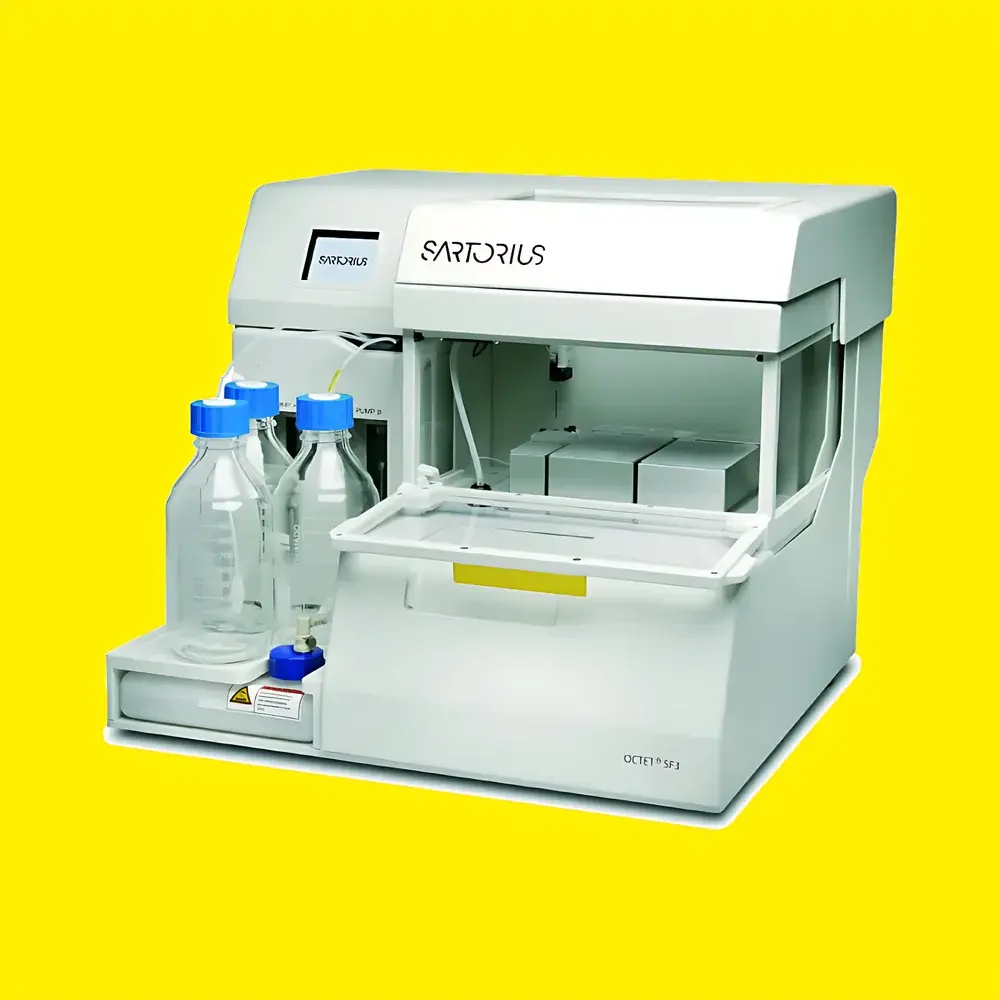
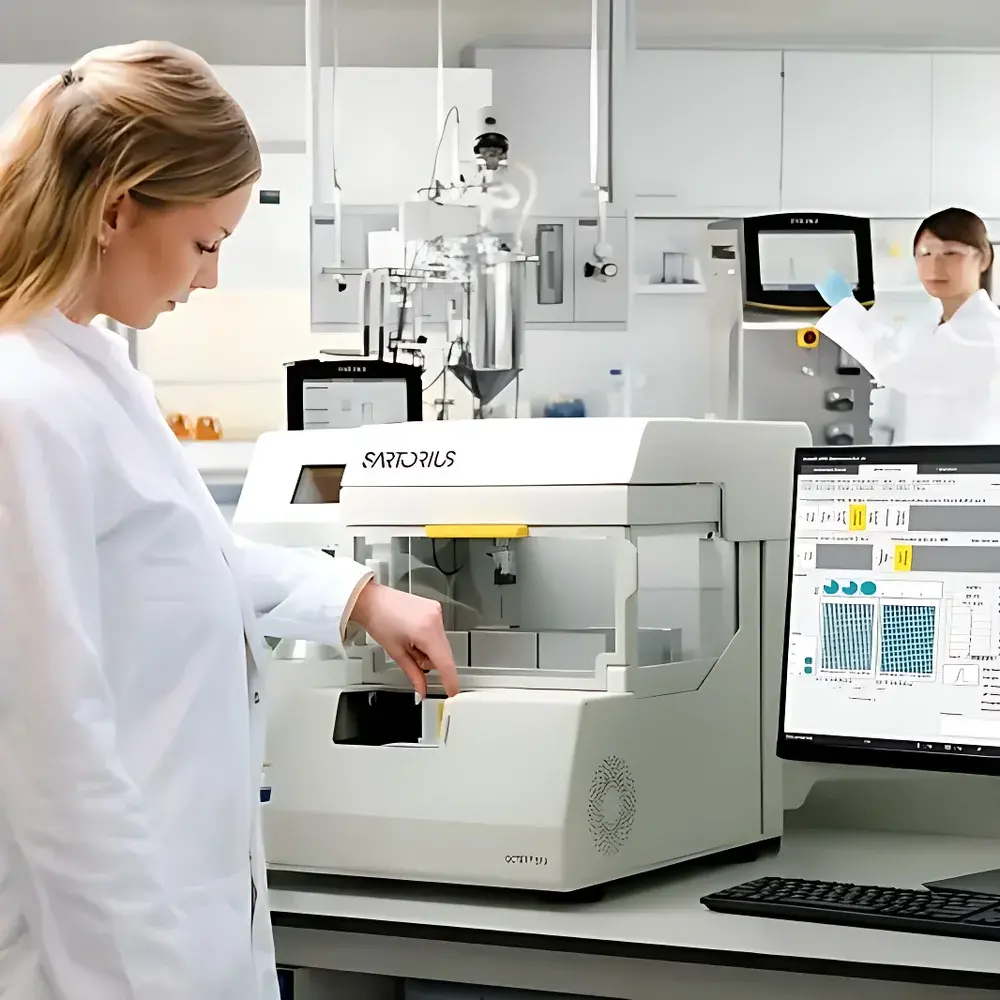
Sartorius Octet SF3 Molecular Interaction Analyzer
| Brand | Sartorius |
|---|---|
| Origin | Imported |
| Manufacturer Type | Authorized Distributor |
| Model | Octet SF3 |
| Pricing | Available Upon Request |
Overview
The Sartorius Octet SF3 Molecular Interaction Analyzer is a label-free, high-throughput biosensor platform engineered for precise, real-time quantification of biomolecular interactions using Fiber Optic-Based Interferometry (FOBI)—not surface plasmon resonance (SPR), as commonly mischaracterized. FOBI leverages white-light interferometry on disposable biosensor tips functionalized with capture ligands (e.g., anti-His, Protein A, Streptavidin) to detect minute changes in optical thickness upon analyte binding. This principle enables direct measurement of association (ka) and dissociation (kd) rate constants, equilibrium dissociation constants (KD), and stoichiometry—without immobilization onto a chip surface or microfluidic flow cells. Designed for demanding life science workflows—including antibody fragment characterization, epitope binning, vaccine antigen screening, and early-stage biologics lead optimization—the Octet SF3 delivers robust kinetic profiling under physiologically relevant conditions (4–40 °C), supporting both discovery and development phases compliant with ICH Q5E and USP guidelines.
Key Features
- OneStep® Gradient Generation Technology: Enables accurate determination of ka, kd, and KD from a single analyte concentration by dynamically diffusing that sample across a large volume of buffer—generating an in situ three-log concentration gradient without manual dilution series or multi-well plate consumption.
- NeXtStep™ Competitive Binding Mode: Supports simultaneous evaluation of analyte binding in the presence of one or more competing molecules—without pre-mixing competitors into the running buffer—enabling site-specific competition analysis, orthogonal epitope mapping, and functional neutralization assessment.
- 768-Well High-Throughput Capability: Fully automated operation supports unattended acquisition of complete kinetic datasets across up to 768 samples per run, with integrated tip handling, wash cycles, and regeneration protocols optimized for reproducibility and minimal carryover.
- Enhanced Fluidics Architecture: Dual independent buffer lines (plus dedicated water line) accommodate 1-L reagent reservoirs; online degassing prevents bubble formation; optimized flow paths minimize clogging and maximize uptime between maintenance cycles.
- Sample Recovery Functionality: Predefined recovery injection sequences allow retrieval of bound analyte from sensor tips post-assay—enabling downstream MS analysis, functional assays, or orthogonal validation without additional sample preparation.
- Physiological Temperature Control: Precise Peltier-based thermal regulation (4–40 °C) permits kinetic profiling at human physiological temperature (37 °C), critical for predicting in vivo behavior of therapeutic proteins and vaccines.
Sample Compatibility & Compliance
The Octet SF3 accommodates diverse biomolecular classes—including monoclonal antibodies, Fc-fusion proteins, antibody fragments (Fab, scFv, nanobodies), peptides, small-molecule binders (via conjugated carriers), viral antigens, and nucleic acid-protein complexes—without requiring covalent coupling or surface derivatization. All sensor tips are single-use, eliminating cross-contamination and simplifying method transfer. The system meets essential regulatory requirements for analytical method validation: data integrity aligns with FDA 21 CFR Part 11 through audit-trail-enabled software (Octet Data Acquisition v12+), electronic signatures, and secure user-role management. Instrument qualification documentation supports IQ/OQ/PQ execution in GLP and GMP environments, and assay protocols are compatible with ISO/IEC 17025 and ASTM E2500-17 standards for binding affinity determination.
Software & Data Management
Octet Data Acquisition Software (v12.x or later) provides intuitive workflow-driven experiment setup, real-time sensorgram visualization, global fitting algorithms (1:1, bivalent analyte, heterogeneous ligand models), and batch processing for high-throughput datasets. Built-in reporting templates generate PDF/Excel outputs compliant with internal SOPs and external regulatory submissions. Raw data files (.octet) are stored in vendor-neutral HDF5 format, ensuring long-term archival stability and third-party analysis compatibility (e.g., Scrubber, KinExA, or custom Python/R scripts). Audit trails record all user actions, parameter changes, and data modifications with timestamps and operator IDs—fully traceable for inspection readiness.
Applications
- High-throughput screening of antibody libraries for affinity maturation and developability assessment
- Epitope binning and competitive mapping for bispecific antibody design
- Vaccine antigen–neutralizing antibody interaction profiling under physiological conditions
- Characterization of protein–protein, protein–peptide, and protein–small molecule interactions in fragment-based drug discovery
- Binding kinetics of ADC payloads and linker-payload constructs to target receptors
- Quality control testing of biosimilars and comparability studies across manufacturing lots
FAQ
Is the Octet SF3 based on SPR technology?
No—the Octet SF3 uses fiber optic-based interferometry (FOBI), a label-free, non-microfluidic detection method distinct from SPR. It eliminates flow-cell fouling, reduces reagent consumption, and avoids mass transport limitations inherent in traditional SPR systems.
Can the system perform regeneration and reuse of biosensor tips?
Biosensor tips are designed for single-use only to ensure assay reproducibility and eliminate carryover risk. Regeneration is not supported or recommended.
What level of kinetic resolution does the Octet SF3 achieve?
The system reliably resolves association rates from 102 to 106 M−1s−1 and dissociation rates from 10−6 to 10−1 s−1, depending on analyte size, avidity effects, and signal-to-noise ratio—validated against reference standards per ICH Q5E Annex 2.
Does the software support automated data analysis for large-scale screening campaigns?
Yes—batch analysis modules enable parallel processing of hundreds of sensorgrams with consistent global fitting parameters, outlier detection, and pass/fail criteria based on user-defined thresholds.
How is instrument performance verified during routine operation?
Built-in system suitability tests include reference standard binding checks, baseline noise monitoring (<0.05 nm RMS), drift assessment (<0.1 nm/h), and temperature calibration verification—all documented in the electronic logbook.
Related Products



