
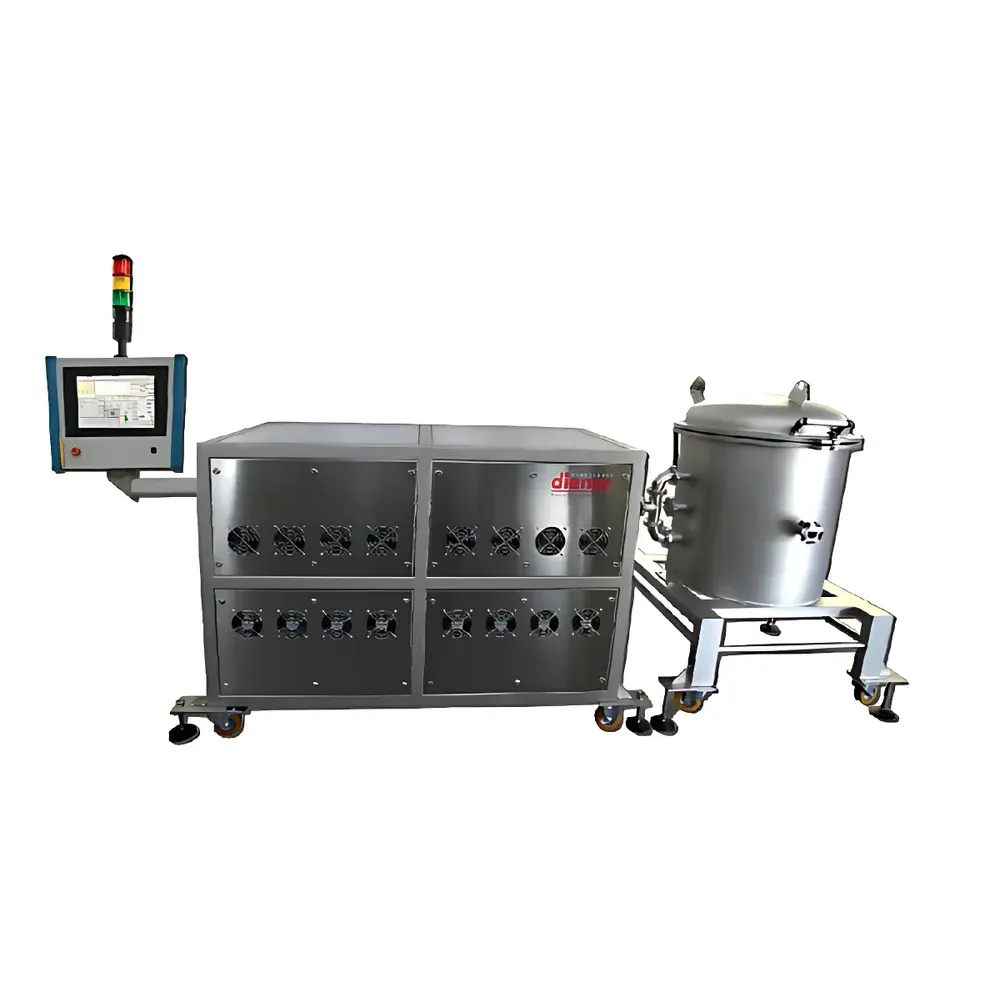
Diener P300 Parylene Coating System
| Brand | Diener |
|---|---|
| Origin | Germany |
| Model | P300 |
| Coating Materials | Parylene N, C, D |
| Coating Thickness Range | 0.05–100 µm |
| Pyrolysis Furnace Power | 4 kW, Max. Temp. 850 °C |
| Deposition Chamber | Ø700 × H720 mm |
| Gas Injection | Homogeneous Dispersal System |
| Carousel | Ø600 × H600 mm |
| Vacuum Pumping | Two-Stage Rotary Vane, 65 m³/h |
| Ultimate Vacuum | 1 × 10⁻³ mbar |
| Control System | Full PC-Based Windows Platform |
| Compressed Air Requirement | 6 bar, Oil-Free & Dry |
| Exhaust Port | 40 mm ID Tube |
| Dimensions (W×D×H) | 2700 × 2200 × 1600 mm |
| Electrical Supply | 3-Phase / 400 V / 16 A / 50–60 Hz |
Overview
The Diener P300 Parylene Coating System is a fully integrated, vacuum-based chemical vapor deposition (CVD) platform engineered for the precise, conformal, and pinhole-free application of Parylene polymer films—specifically Parylene N, C, and D—onto complex three-dimensional substrates. Unlike conventional liquid-phase coating methods, Parylene deposition proceeds via a thermally activated, gas-phase monomer generation process: solid p-xylene dimer is sublimed and pyrolyzed at ~680 °C to yield reactive para-xylylene diradicals, which travel under high vacuum into a cooled deposition chamber where they spontaneously polymerize on all exposed surfaces—including crevices, undercuts, and microfeatures—without line-of-sight limitations. This results in truly uniform, stress-free, ultra-thin polymeric coatings with exceptional dielectric integrity, barrier performance, and biocompatibility. The P300 system is designed for laboratory-scale R&D, pilot-line process development, and low-to-medium volume production environments requiring repeatable, GLP-compliant thin-film encapsulation.
Key Features
- Robust stainless-steel vacuum architecture with ultimate pressure capability of 1 × 10⁻³ mbar, ensuring high-purity monomer transport and minimized side reactions.
- Dual-zone thermal control: independent regulation of dimer sublimation temperature (up to 150 °C), pyrolysis furnace (up to 850 °C), and deposition chamber (typically −20 to +40 °C), enabling precise tuning of film morphology and adhesion.
- Homogeneous gas injection manifold optimized for laminar monomer flow distribution across the full cross-section of the deposition chamber.
- Motorized, vertically indexed carousel (Ø600 × H600 mm) accommodating up to 12 standard sample holders or custom fixtures—designed for consistent rotational exposure and thickness uniformity ±5% across batch loads.
- Full PC-based control system running on a Windows OS platform, supporting programmable multi-step recipes, real-time vacuum and temperature logging, and audit-trail-enabled operation per FDA 21 CFR Part 11 requirements.
- Integrated two-stage rotary vane vacuum pump (65 m³/h pumping speed) with oil mist filtration and optional cold trap for extended pump life and reduced maintenance intervals.
Sample Compatibility & Compliance
The P300 accommodates substrates ranging from silicon wafers and flex PCBs to medical implants, MEMS sensors, optical lenses, and aerospace-grade composites. Its conformal coating capability ensures complete coverage of high-aspect-ratio features down to <1 µm width without bridging or shadowing. All wetted components comply with ISO 10993-5 (cytotoxicity) and USP Class VI standards when processing Parylene C and N. The system supports traceable process documentation aligned with ISO 9001, IATF 16949, and ISO 13485 quality management frameworks. Vacuum and thermal profiles are fully recordable for GMP/GLP validation protocols and regulatory submissions.
Software & Data Management
The embedded Windows-based control interface provides intuitive recipe creation, real-time monitoring of chamber pressure, pyrolysis zone temperature, and substrate stage temperature, along with automated alarm handling and event logging. Data export is supported in CSV and XML formats for integration with LIMS or MES platforms. Optional software modules include remote diagnostics via secure VPN, electronic signature authentication, and automated report generation compliant with ASTM F1980 (accelerated aging of sterile barrier systems) and IPC-CC-830B (qualification of electrical insulating compounds).
Applications
- Electronics: Conformal insulation of printed circuit assemblies, protection of RF/microwave components against moisture ingress, encapsulation of MEMS accelerometers and pressure sensors.
- Medical Devices: Biostable coating of neurostimulator leads, stent crimping layers, sensor housings for implantable glucose monitors, and surface modification of catheter shafts to reduce thrombogenicity.
- Aerospace & Defense: Corrosion mitigation on avionics connectors, EMI shielding enhancement on composite airframe structures, and environmental sealing of inertial navigation units.
- Optoelectronics: Anti-reflective and hydrophobic topcoats for laser diode windows, hermetic passivation of OLED backplanes, and humidity-resistant encapsulation of photodetector arrays.
- Research & Development: Thin-film model studies for barrier property benchmarking (e.g., O₂ and H₂O vapor transmission rates), surface energy modulation for microfluidic channel functionalization, and low-temperature polymerization kinetics investigations.
FAQ
What Parylene variants are compatible with the P300 system?
The P300 supports full-process deposition of Parylene N, C, and D polymers using standardized dimer sources and calibrated thermal profiles.
Can the system be validated for ISO 13485-certified medical device manufacturing?
Yes—the hardware design, software audit trail, and process repeatability meet foundational requirements for IQ/OQ/PQ execution; Diener provides URS templates and FAT/SAT documentation support.
Is operator training included with installation?
Standard commissioning includes on-site operational training for up to two personnel, covering safety procedures, routine maintenance, basic troubleshooting, and recipe development.
What vacuum pump oil compatibility is required?
The integrated rotary vane pump uses ISO VG 100 synthetic hydrocarbon oil; an oil-free dry pump upgrade is available upon request for ultra-high-purity applications.
How is film thickness controlled and verified?
Thickness is primarily governed by dimer mass loading, deposition time, and chamber temperature; in situ quartz crystal microbalance (QCM) monitoring is available as an optional add-on, while post-deposition ellipsometry or stylus profilometry is recommended for metrology-grade verification.



