
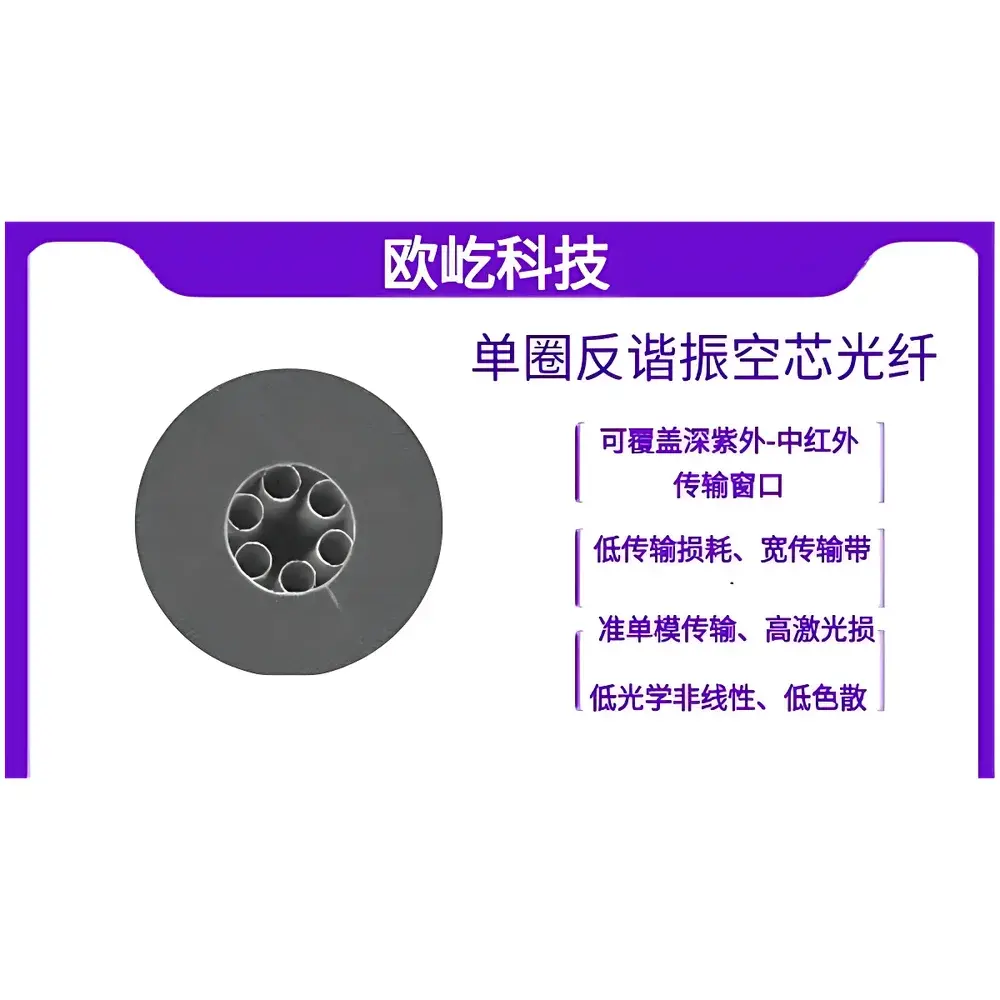
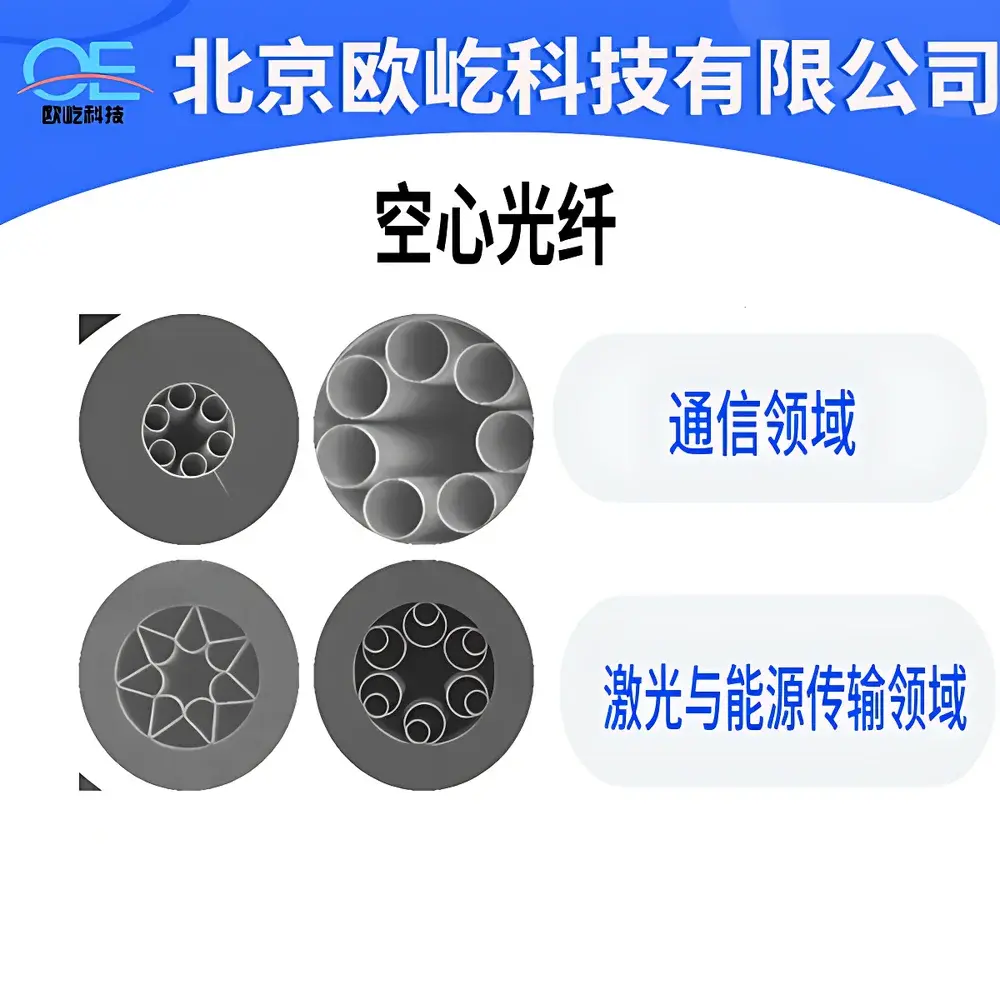
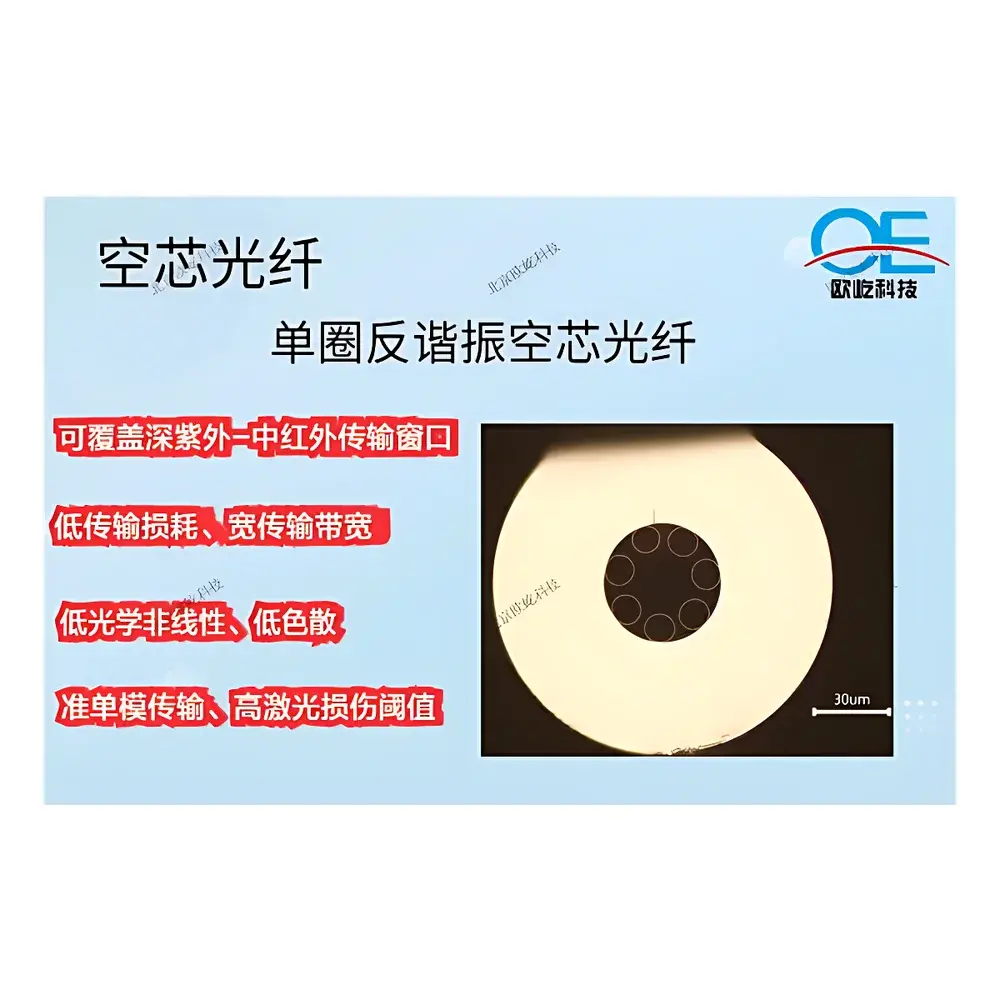
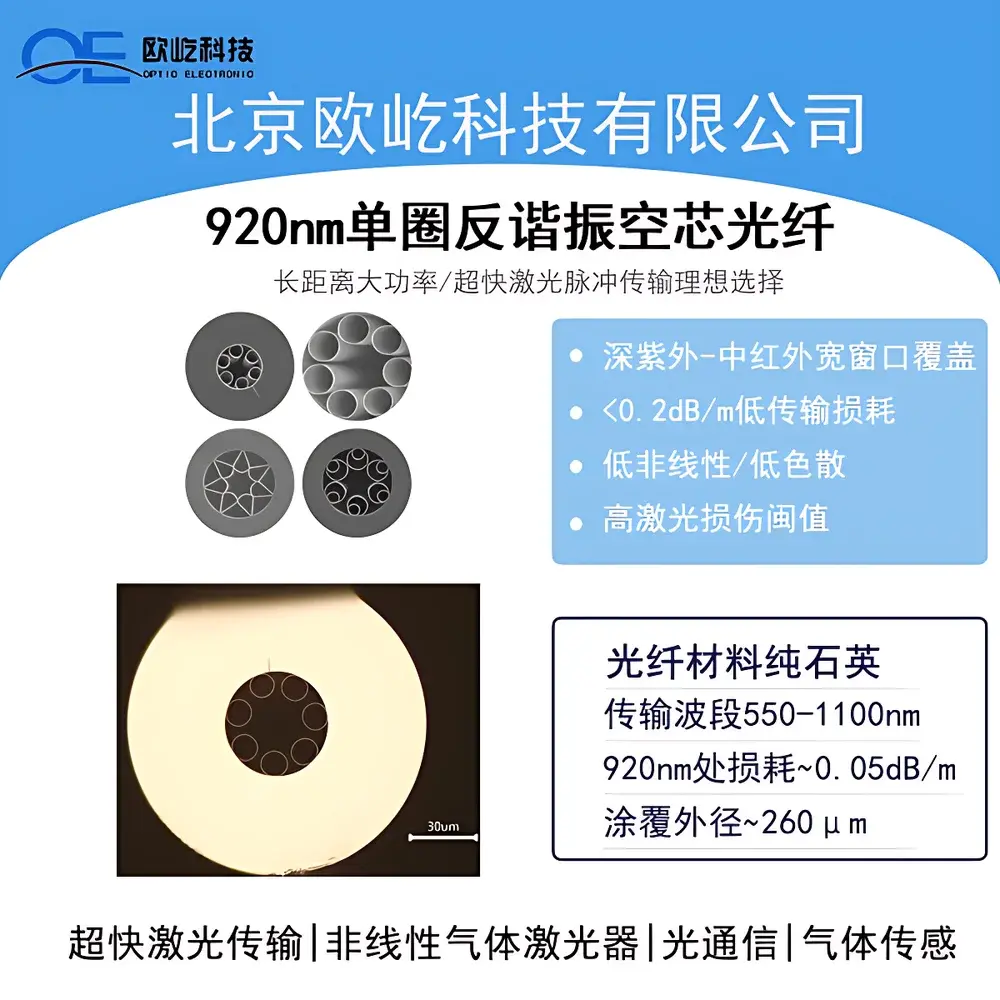
OETECH OBF-07-20230112 Single-Layer Anti-Resonant Hollow-Core Fiber
| Brand | OETECH |
|---|---|
| Origin | Beijing, China |
| Model | OBF-07-20230112 |
| Core Diameter | ~25 µm |
| Cladding Hole Diameter | ~12 µm |
| Bare Fiber OD | ~145 µm |
| Coated Fiber OD | ~260 µm |
| Transmission Band | 550–1100 nm |
| Transmission Loss | <0.2 dB/m |
| Minimum Loss | ~0.013 dB/m @ 655 nm |
| Loss @ 920 nm | ~0.05 dB/m |
| Fiber Material | Pure Fused Silica |
| Coating Material | Acrylate (Single-Coated) |
| Component Category | Optical Component |
Overview
The OETECH OBF-07-20230112 is a single-layer anti-resonant hollow-core fiber (AR-HCF), engineered for low-loss, high-fidelity optical guidance in the visible to near-infrared spectrum. Unlike conventional solid-core fibers relying on total internal reflection, this fiber operates on the principle of inhibited coupling via anti-resonant reflection from thin glass capillary walls surrounding a central air core. This mechanism suppresses higher-order mode propagation while enabling robust confinement of light within the hollow region—minimizing nonlinear effects, material absorption, and dispersion. Designed for demanding photonic applications, it delivers stable, scalable transmission performance across wavelengths from 550 nm to 1100 nm, with measured attenuation as low as 0.013 dB/m at 655 nm—a benchmark for high-purity fused silica-based AR-HCFs in this geometry.
Key Features
- Wide Transmission Window: Supports continuous guidance from deep visible (550 nm) through the telecom O-band and into the short-wavelength infrared (1100 nm), accommodating multi-laser sources including frequency-doubled Nd:YAG (532 nm), HeNe (633 nm), Ti:Sapphire (650–1000 nm), and InGaAs-based emitters.
- Ultra-Low Propagation Loss: Achieves sub-0.2 dB/m average attenuation across its operational band, with optimized spectral minima at key laser wavelengths—0.013 dB/m at 655 nm and 0.05 dB/m at 920 nm—enabling efficient power delivery over meter-scale lengths without active amplification.
- Suppressed Nonlinearities & Chromatic Dispersion: The dominant air-guiding mode reduces effective nonlinearity by >10⁴× compared to standard SMF-28, while group velocity dispersion remains intrinsically low and nearly flat across the band—critical for preserving femtosecond pulse integrity in ultrafast systems.
- High Laser Damage Threshold: With a pure fused silica structure and absence of dopants or polymer cores, the fiber withstands peak intensities exceeding 10 GW/cm² (for <100 fs pulses), making it suitable for high-peak-power delivery in CPA and OPCPA architectures.
- Quasi-Single-Mode Guidance: Engineered cladding geometry supports fundamental LP₀₁-like mode dominance with modal extinction ratio >25 dB over 1 m length, ensuring spatial stability and compatibility with free-space coupling optics and fiber-pigtailed components.
Sample Compatibility & Compliance
This AR-HCF is fully compatible with standard FC/PC and SMA-905 connectors when terminated using industry-standard fusion splicing or mechanical alignment techniques. Its acrylate primary coating meets Telcordia GR-20-CORE specifications for mechanical reliability under thermal cycling (−40 °C to +70 °C) and tensile stress (<0.5% strain). While not certified to IEC 60793-2-50 (for telecommunication fibers), its fabrication adheres to ISO 10110-7 surface quality standards for optical components. For regulated environments—including GLP-compliant gas sensing setups or laser safety-critical beam delivery—the fiber’s traceable batch documentation, refractive index profile characterization, and cut-off wavelength verification support audit-ready validation per ISO/IEC 17025 requirements.
Software & Data Management
As a passive optical component, the OBF-07-20230112 requires no embedded firmware or proprietary software. However, its integration into automated testbeds benefits from standardized optical characterization workflows. Users may employ vendor-agnostic tools—including Thorlabs’ APT, Newport’s WaveMeter Suite, or open-source Python libraries (e.g., PyOptica, LightPipes)—to model mode field diameter, bend-induced loss, and coupling efficiency. Spectral transmission data (550–1100 nm) and loss-vs-wavelength calibration files are provided in CSV format with each shipment, supporting traceable metrology in accordance with NIST-traceable reference standards. For system-level documentation, the fiber’s serial-numbered test report includes calibrated insertion loss, mode field diameter (MFD), and polarization-dependent loss (PDL < 0.05 dB) measurements.
Applications
- Ultrafast Laser Pulse Delivery: Enables dispersion-managed transport of sub-50 fs pulses from Ti:Sapphire and Yb-fiber oscillators to end-stations in attosecond science, pump-probe spectroscopy, and multiphoton microscopy—without pulse broadening or self-phase modulation artifacts.
- Gas-Phase Nonlinear Optics: Serves as the waveguide medium in hollow-core gas-filled Raman lasers and frequency converters, where long interaction lengths and high intra-core intensities enhance stimulated Raman scattering and four-wave mixing efficiency.
- Distributed Gas Sensing: Leverages the open-core architecture for evanescent-field-enhanced absorption spectroscopy; enables parts-per-trillion detection limits for CH₄, CO₂, NH₃, and H₂S using tunable diode lasers or quantum cascade lasers.
- Low-Latency Interconnects: Provides an alternative platform for short-reach, high-bandwidth optical links in RF-over-fiber and analog photonic signal distribution, particularly where EMI immunity and phase stability outweigh cost-per-meter constraints.
FAQ
What is the maximum recommended bending radius for this fiber?
The minimum bend radius is 35 mm for static installation and 50 mm for dynamic routing—exceeding these values risks increased higher-order mode coupling and localized loss spikes.
Can this fiber be spliced to standard SMF-28?
Yes, using core-aligned fusion splicing with optimized arc parameters (reduced current, extended time) and post-splice tapering; typical splice loss is 0.3–0.6 dB with mode-field adaptors.
Is the fiber compatible with UV wavelengths below 550 nm?
Transmission drops sharply below 550 nm due to silica absorption edge and anti-resonant condition mismatch; extended UV operation requires fluorine-doped or soft-glass variants not covered by this model.
Does the acrylate coating support high-humidity or vacuum environments?
The single acrylate layer is rated for RH ≤ 85% at 25 °C; for vacuum or corrosive atmospheres, optional hermetic metal-coated versions (e.g., Au/Cr) are available upon request.
How is chromatic dispersion characterized for this fiber?
Group delay dispersion (GDD) is measured interferometrically using white-light spectral interferometry; published data shows −20 to +15 fs²/mm across 650–950 nm, with zero-dispersion wavelength near 780 nm.




