
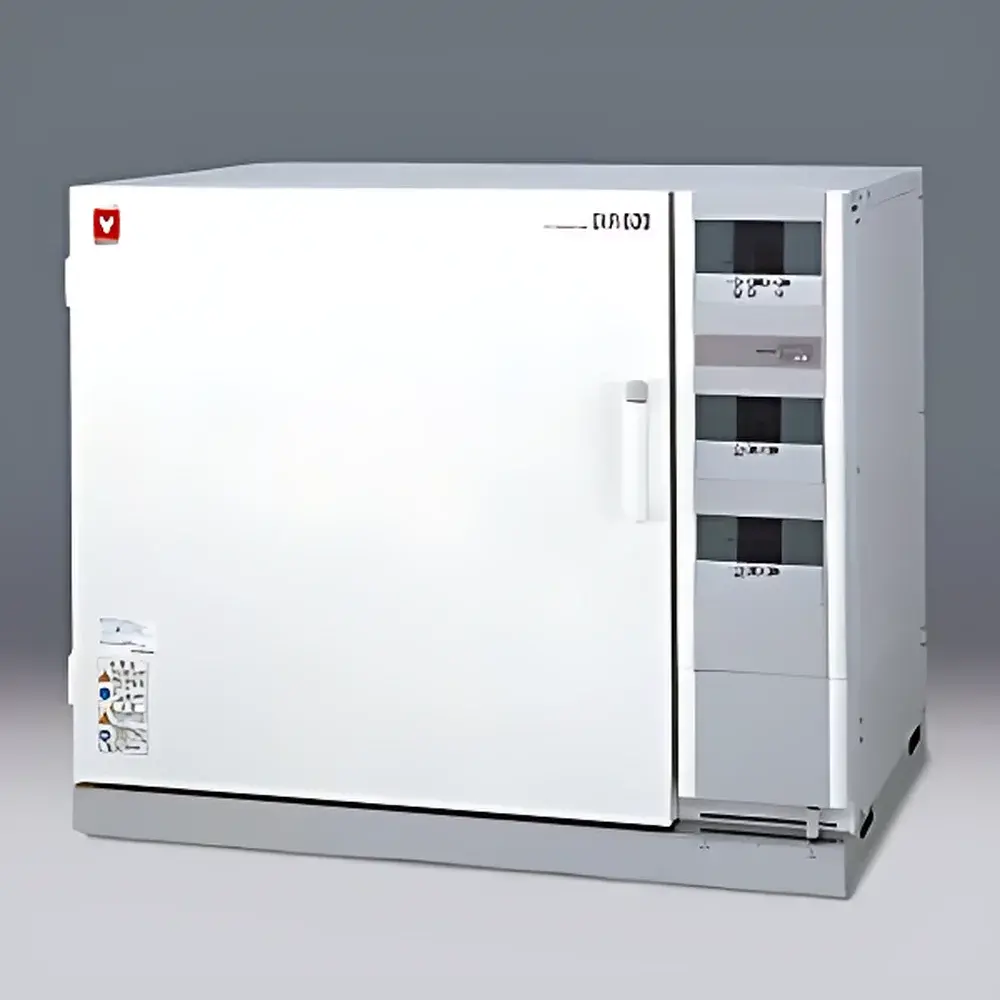
YAMATO DIR631 Far-Infrared Drying Oven
| Brand | YAMATO |
|---|---|
| Origin | Japan |
| Model | DIR631 |
| Instrument Type | Forced-Convection Far-Infrared Drying Oven |
| Temperature Range | Ambient +10°C to 360°C |
| Temperature Uniformity | ±3.0°C (at 360°C, IR heaters OFF) |
| External Dimensions | 1200 × 770 × 990 mm (W×D×H) |
| Internal Chamber Dimensions | 600 × 600 × 200 mm (W×D×H) |
| IR Heater Configuration | 16 × 0.2 kW ceramic far-infrared emitters (upper/lower arrays) |
| Total Heating Capacity | 6.4 kW (IR) + 3.75 kW (convection) |
| Power Supply | 3-phase 200 V, 50/60 Hz, 34 A |
| Net Weight | ~120 kg |
Overview
The YAMATO DIR631 Far-Infrared Drying Oven is an engineered thermal processing system designed for precision heat treatment of polymeric, composite, and organic materials in research, quality control, and pilot-scale manufacturing environments. Unlike conventional convection ovens, the DIR631 integrates dual-mode thermal delivery: high-efficiency far-infrared (FIR) radiation (5.6–1000 µm wavelength range) combined with forced-air circulation. This hybrid architecture leverages resonant molecular absorption—where materials such as resins, plastics, coatings, and medical polymers absorb FIR energy directly at vibrational frequencies—enabling rapid, volumetric heating with minimal thermal gradient across the sample volume. The oven operates within a validated temperature range of ambient +10°C to 360°C and maintains stable thermal conditions under dynamic load, making it suitable for ASTM D618 (conditioning of plastics), ISO 293 (hot-plate compression molding), and USP (sterile container drying validation) protocols.
Key Features
- Far-infrared ceramic emitter array (16 × 0.2 kW) mounted on upper and lower chamber walls, delivering uniform spectral irradiance with zero particulate shedding—critical for cleanroom-compatible thermal processing.
- Dual-sensor PID control architecture: one K-type thermocouple pair regulates chamber air temperature; two additional embedded K-type sensors monitor IR emitter surface temperature and central zone thermal profile independently.
- Stainless steel (SUS304) interior chamber with seamless welds and polished finish, providing corrosion resistance against acidic vapors, solvents, and residual cleaning agents per ISO 14644-1 Class 8 cleanroom compatibility requirements.
- Integrated axial fan (20 W capacitor-run motor) ensures laminar airflow distribution across the 200 mm effective height zone, minimizing convective stratification while supporting uniform FIR coupling.
- Comprehensive safety suite: independent overheat cutoff (dual-stage thermal limiter), earth-leakage circuit breaker (ELCB), SSR fault detection, heater open-circuit diagnostics, and real-time sensor integrity verification.
- Programmable operation modes including constant-temperature hold, timed auto-stop, power-fail recovery with memory retention, and user-configurable temperature offset correction for traceable calibration alignment.
Sample Compatibility & Compliance
The DIR631 is optimized for thermally sensitive substrates requiring non-contact, selective energy deposition. Its 5.6–20 µm dominant emission band aligns with strong absorption peaks of water, polyolefins, polyesters, epoxies, and silicone elastomers—enabling accelerated curing, solvent evaporation, and moisture removal without surface oxidation or charring. Applications span ISO 178 (flexural testing specimen conditioning), JIS K 6251 (rubber vulcanization), and IEC 60601-1 (medical device sterilization pre-drying). The unit complies with IEC 61010-1 (Safety Requirements for Electrical Equipment for Measurement, Control, and Laboratory Use) and meets CE marking requirements for electromagnetic compatibility (EN 61326-1) and low-voltage directive (2014/35/EU). Optional documentation packages support FDA 21 CFR Part 11-compliant audit trails when integrated with YAMATO’s optional data logger module.
Software & Data Management
While the DIR631 operates via an embedded microprocessor controller with tactile keypad interface, it supports analog voltage output (0–5 V DC) for external data acquisition systems. Real-time temperature signals from all four thermocouples are accessible via isolated analog outputs, enabling synchronization with third-party SCADA platforms (e.g., LabVIEW, Ignition) for GLP/GMP-aligned process recording. The controller logs operational history—including start/stop timestamps, temperature setpoints, and fault events—with non-volatile memory retention. For regulated environments, optional RS-485 Modbus RTU communication enables remote parameter readout and alarm status polling, satisfying Annex 11 (EU GMP) requirements for electronic record integrity and access control.
Applications
- Pre-drying of polymer films prior to tensile testing (ASTM D882)
- Curing of UV-resistant automotive trim coatings (SAE J2527)
- Moisture stabilization of pharmaceutical packaging components (ICH Q5C)
- Thermal aging of PTFE gaskets per ASTM D573
- Bake-out of printed circuit board laminates before solder mask application
- Heat-forming of biodegradable PLA sheets under controlled ramp profiles
- Drying of dialysis tubing and IV bag components under ISO 13485 clean processing conditions
FAQ
What distinguishes far-infrared heating from conventional convection heating?
Far-infrared radiation transfers energy directly to molecular bonds via resonant absorption, bypassing air-mediated conduction. This results in faster thermal penetration, reduced surface overheating, and improved energy efficiency—particularly for low-thermal-conductivity materials like foams and composites.
Can the DIR631 be used for moisture content analysis per AOAC 950.46?
Yes—the chamber’s ±3.0°C uniformity at 105°C and precise airflow management meet the thermal stability criteria for gravimetric moisture determination. However, dedicated moisture analyzers (e.g., halogen or NIR-based) are recommended for routine compliance testing.
Is the DIR631 compatible with inert atmosphere operation?
The standard model includes a manual exhaust valve (φ30 mm rear port) for purge gas introduction. For full inertization, users may integrate external nitrogen supply lines with flow regulators and pressure relief valves—configuration requires validation per OSHA 1910.1200 hazard communication guidelines.
How is temperature uniformity verified during IQ/OQ qualification?
Uniformity mapping is performed using a 9-point thermocouple probe array (per ISO 17025-accredited calibration) at three vertical levels within the 200 mm usable height zone. Acceptance criterion: ≤ ±3.0°C deviation from setpoint at 360°C, measured after 30 minutes of thermal soak.



