
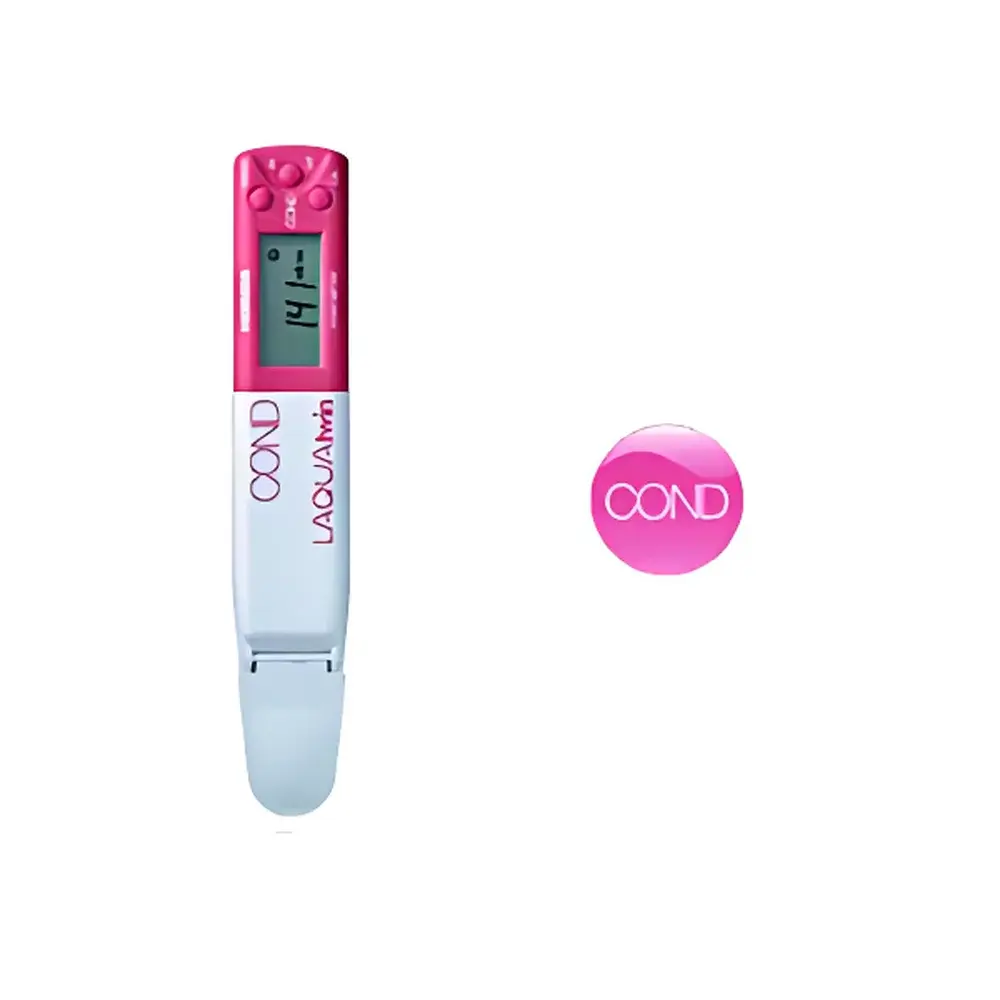
HORIBA B-771 Portable Conductivity/TDS/Salinity Meter
| Brand | HORIBA |
|---|---|
| Origin | Japan |
| Model | B-771 |
| Measurement Principle | AC Two-Electrode Method |
| Sample Volume | 0.12 mL |
| Conductivity Range | 0–9900 ppm (as NaCl) |
| Salinity Range | 0–1.1% (w/w) |
| TDS Range | 0–9900 ppm (as NaCl) |
| Calibration | Two-Point |
| Accuracy | ±2% of Full Scale ±1 digit |
| Temperature Compensation | Fixed 2%/°C |
| Operating Environment | 5–40 °C, ≤85% RH |
| Power Supply | Two CR2032 batteries |
| Dimensions | 164 mm × 29 mm × 20 mm |
| Weight | Approx. 50 g |
Overview
The HORIBA B-771 is a compact, handheld conductivity meter engineered for rapid, field-deployable water quality assessment in environmental monitoring, aquaculture, hydroponics, and routine laboratory screening applications. It operates on the AC two-electrode principle—applying a low-frequency alternating current across a stainless-steel electrode pair to minimize polarization effects and ensure stable readings in low-to-moderate ionic strength samples. Unlike four-electrode or inductive sensors, the B-771’s dual-electrode architecture delivers optimized sensitivity for freshwater and brackish matrices while maintaining robustness against minor surface fouling. Its measurement output is directly traceable to NaCl-based calibration standards, supporting standardized reporting of electrical conductivity (EC), total dissolved solids (TDS), and salinity—three interrelated parameters widely adopted in regulatory and operational water quality frameworks including ASTM D1125, ISO 7888, and EPA Method 120.1.
Key Features
- Ultra-portable form factor (164 × 29 × 20 mm; ~50 g) enables one-handed operation and integration into mobile sampling kits.
- Minimal sample requirement of only 0.12 mL supports analysis of limited-volume field samples or microcosm effluents.
- Simultaneous real-time display of conductivity (µS/cm or ppm as NaCl), TDS (ppm), and salinity (% w/w) with automatic unit conversion.
- Fixed temperature compensation at 2%/°C—aligned with industry-standard NaCl-based TDS conversion algorithms per USP and ISO 5667-3.
- Two-point calibration using standard NaCl solutions (e.g., 1413 µS/cm and 12.88 mS/cm) ensures traceable accuracy across the full operating range.
- Low-power design powered by two replaceable CR2032 coin cells, providing >10,000 measurements per battery set under typical usage conditions.
Sample Compatibility & Compliance
The B-771 is validated for use with natural waters (rivers, lakes, groundwater), treated effluents, nutrient solutions, and brackish estuarine samples. It is not intended for high-conductivity industrial process streams (>20 mS/cm) or viscous or particulate-laden suspensions without pre-filtration. The instrument complies with IEC 61010-1 for electrical safety in portable measuring equipment and meets IP67 ingress protection when the battery compartment is properly sealed. While not certified for GLP/GMP environments requiring audit trails, its calibration log (manual entry) and fixed compensation algorithm support consistent data recording in field notebooks or LIMS-integrated workflows adhering to ISO/IEC 17025 documentation practices.
Software & Data Management
The B-771 operates as a standalone, button-actuated device with no onboard memory or digital interface. All measurement data must be manually recorded or transcribed into external systems. This design prioritizes reliability and battery longevity over connectivity—making it suitable for remote deployments where Bluetooth interference, firmware updates, or software validation would introduce operational risk. Users integrating the B-771 into regulated workflows may document calibration events, operator ID, sample ID, and ambient temperature alongside each reading to satisfy basic traceability requirements under ISO 5667-1 and EPA QA/G-5.
Applications
- Field verification of drinking water treatment plant effluent compliance with WHO TDS guidelines (<500 ppm).
- Routine salinity checks in coastal aquaculture ponds to maintain optimal osmoregulatory conditions for shrimp or finfish.
- Hydroponic nutrient solution monitoring to prevent EC drift beyond crop-specific thresholds (e.g., 1.2–2.5 mS/cm for lettuce).
- Baseline characterization of stormwater runoff or agricultural drainage prior to discharge permitting under NPDES protocols.
- Educational demonstrations of ionic strength relationships in general chemistry and environmental science laboratories.
FAQ
What calibration standards are recommended for the B-771?
Use certified NaCl-based conductivity standards traceable to NIST SRM 3199: 1413 µS/cm (0.01 mol/kg) and 12.88 mS/cm (0.1 mol/kg). Avoid KCl-based standards unless explicitly converted per ISO 7888 Annex B.
Does the B-771 support user-adjustable temperature compensation coefficients?
No—the instrument applies a fixed 2%/°C linear compensation, consistent with standard NaCl-based TDS estimation methods. This eliminates configuration error but limits applicability to non-NaCl-dominated matrices.
Can the B-771 measure conductivity in seawater?
It covers up to 1.1% salinity (~18.5 mS/cm), which is sufficient for brackish estuaries but insufficient for full-strength seawater (~3.5% salinity; ~53 mS/cm). For marine applications, consider HORIBA’s LAQUA twin series with extended-range electrodes.
Is the electrode replaceable or serviceable?
The sensor is integrated and non-user-replaceable. Electrode performance should be verified quarterly via standard solution checks; degradation manifests as slow response, hysteresis, or calibration drift exceeding ±2% F.S.
How does the B-771 handle air bubbles during measurement?
Due to its minimal sample volume (0.12 mL), air entrapment significantly impacts readings. Users must ensure full immersion of the electrode tip and gentle agitation to displace bubbles before stabilization.







