
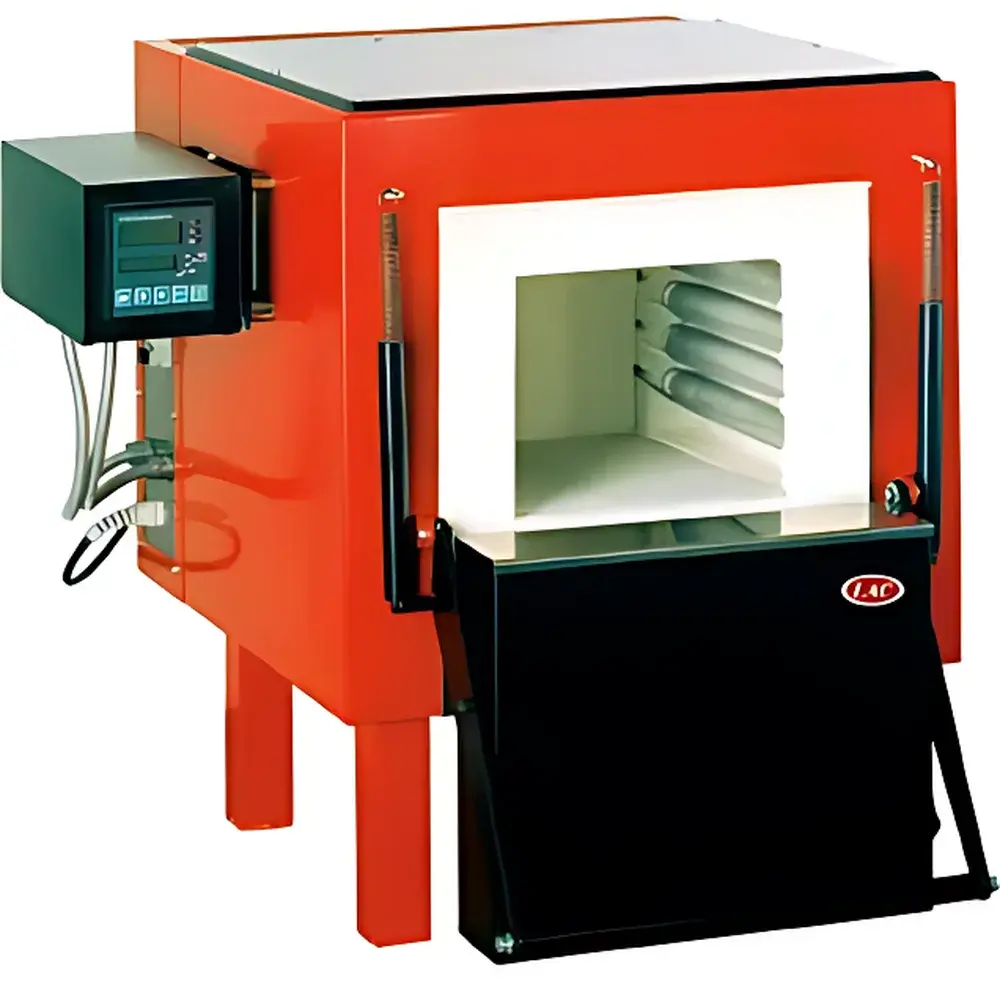
LAC PK Series Box-Type Heat Treatment Furnace
| Brand | LAC |
|---|---|
| Origin | Czech Republic |
| Type | Box Furnace |
| Max Temperature | 1280 °C |
| Temperature Uniformity | Compliant with DIN 17052-1 |
| Control Accuracy | ±1 °C |
| Heating Method | Resistance Wire (SiC-protected bottom & ceramic-tube side elements) |
| Internal Volume | 55–1400 L |
| Power Input | 13–95 kW |
| Ramp Time to Max Temp | ≤80 min |
| Controller | INDUSTRY Programmable Logic Controller (30 programs × 15 steps, real-time clock, non-contact semiconductor relays, S-type thermocouple) |
Overview
The LAC PK Series is a precision-engineered box-type heat treatment furnace designed for laboratory- and pilot-scale thermal processing requiring high reproducibility, stringent temperature uniformity, and robust process repeatability. Operating on the principle of resistive heating via high-stability Kanthal or similar alloy resistance wires—strategically mounted on ceramic insulators along the sidewalls and embedded within SiC-coated floor grooves—the PK furnace delivers exceptional thermal homogeneity across its entire working chamber. Its architecture conforms to DIN 17052-1 (industrial furnaces for heat treatment), ensuring validated temperature distribution (±3 °C or better at setpoint) throughout the specified load zone. The furnace is purpose-built for critical metallurgical and materials science applications including quenching, aging, stress relieving, preheating, and annealing of metallic alloys, ceramics, and composite substrates.
Key Features
- Side-and-bottom dual-zone resistive heating configuration ensures symmetrical thermal flux and minimizes vertical/horizontal gradients.
- SiC-reinforced furnace floor protection plate (6 mm thick) provides mechanical resilience against thermal cycling fatigue and accidental load impact.
- INDUSTRY-series programmable controller with integrated real-time clock supports up to 30 independent thermal profiles; each profile accommodates 15 sequential segments (ramp, soak, cooling) with user-defined rate limits and dwell times.
- Non-contact semiconductor relays eliminate mechanical wear and ensure silent, maintenance-free switching of high-power loads.
- S-type thermocouple (Pt/Pt–10%Rh) provides stable, NIST-traceable measurement in the 0–1280 °C range with inherent drift resistance.
- Robust low-carbon steel frame with lightweight refractory brick insulation achieves rapid thermal response while maintaining external surface temperatures below 60 °C under full-load operation.
- Manually operated downward-swinging door with safety interlock prevents inadvertent operation during access.
Sample Compatibility & Compliance
The PK series accommodates a broad spectrum of sample geometries and masses—from small crucibles and test coupons to large billets and tooling fixtures—within its scalable internal volumes (55 L to 1400 L). All models are constructed per CE Machinery Directive 2006/42/EC and comply with IEC 61000-6-2 (EMC immunity) and IEC 61000-6-4 (EMC emission) standards. Optional inert atmosphere integration (N₂, Ar, or forming gas via dedicated inlet ports) enables oxidation-sensitive treatments in semi-sealed mode, supporting ASTM E831, ISO 11358, and USP thermal stability protocols. The furnace’s thermal validation documentation package—including as-built drawings, calibration certificates, and uniformity mapping reports—facilitates GLP/GMP audit readiness and 21 CFR Part 11-compliant data integrity when paired with optional PC-linked logging hardware.
Software & Data Management
While the standard INDUSTRY controller operates autonomously via front-panel interface, optional RS485/USB or Ethernet communication modules enable bidirectional integration with laboratory information management systems (LIMS) or SCADA platforms. Third-party software (e.g., LabVIEW, MATLAB, or custom Python-based acquisition tools) can log real-time temperature, power draw, and program status with timestamped metadata. Audit trails—including operator ID, parameter changes, and alarm events—are retained onboard for ≥30 days and exportable in CSV or XML format. Firmware updates are performed via secure USB stick, preserving configuration integrity and cryptographic signature verification.
Applications
- Metallurgical phase transformation studies (e.g., austenitization prior to martensitic quenching)
- Aging treatments for aluminum, titanium, and nickel-based superalloys (T5, T6, etc.)
- Stress relief of welded assemblies and machined components per AWS D1.1 or EN 10204
- Preheating of molds, dies, and casting patterns prior to hot work
- Thermal cycling qualification of electronic packaging substrates and MEMS devices
- High-temperature sintering of technical ceramics and powder metallurgy compacts
- Reference furnace use in calibration laboratories supporting ISO/IEC 17025 accreditation
FAQ
What standards does the PK furnace meet for temperature uniformity?
It complies with DIN 17052-1 Class 2 requirements (±3 °C maximum deviation across the working zone at 1280 °C), verified during factory acceptance testing.
Can the furnace operate under protective atmosphere conditions?
Yes—optional gas inlet ports and semi-sealed construction support N₂, Ar, or reducing atmospheres; full vacuum capability requires retrofitting with compatible sealing and pumping systems.
Is the controller compliant with FDA 21 CFR Part 11 for electronic records?
The base controller is not Part 11–compliant; however, when interfaced with validated third-party data acquisition software and user-access controls, it supports Part 11–aligned workflows.
What is the expected service life of the heating elements?
Under normal operating conditions (≤1200 °C continuous, proper ramp/soak protocols), SiC-protected bottom elements and ceramic-mounted side elements typically exceed 8,000 hours of cumulative operation.
Does LAC provide IQ/OQ documentation packages?
Yes—factory-supplied Installation Qualification (IQ) and Operational Qualification (OQ) protocols, including test templates and pass/fail criteria, are available upon request for GxP-regulated environments.



