
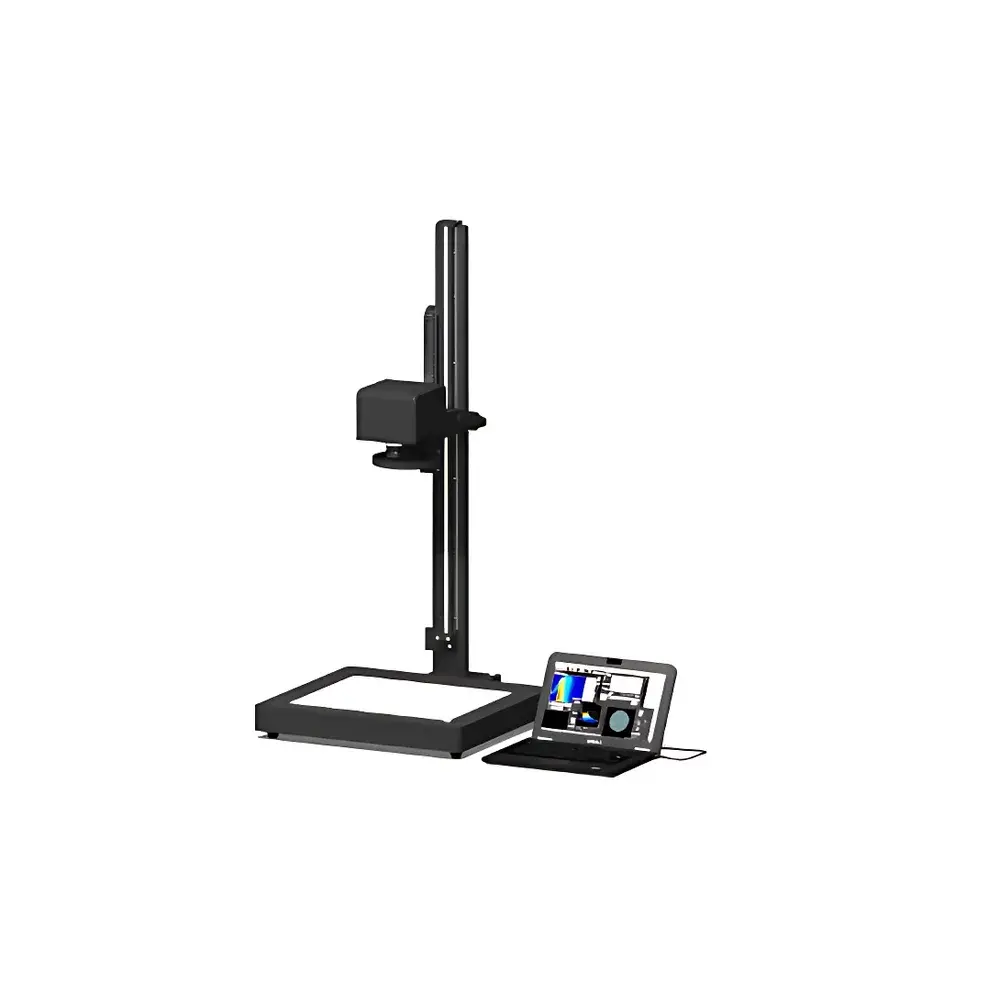
PHL WPA-200-L Full-Field Photoelastic Stress Analyzer
| Brand | Photonic Lattice |
|---|---|
| Origin | Japan |
| Model | WPA-200-L |
| Measurement Principle | Quantitative Full-Field Retardation Imaging via Polarized Light Interference |
| Max. Retardation Range | 0–3500 nm |
| Wavelength Options | 520 nm, 543 nm, 575 nm |
| Spatial Resolution (Retardation) | 0.001 nm |
| Repeatability (σ) | <1 nm |
| Standard FOV | 33 × 40 mm to 240 × 320 mm |
| Optional Micro-FOV Lenses | 3 × 4 mm to 12.9 × 17.2 mm |
| Output Data | Retardation (nm), Slow Axis Orientation (°), Stress Conversion (MPa, optional) |
| Software Modules | Real-Time Analysis, Lens-Specific Evaluation, Batch Data Processing, External Trigger Control |
| Compliance | Designed for ISO 11476 (Optical Elements — Birefringence Measurement), ASTM F2730 (Plastic Optical Components), and GLP-aligned data audit trails |
Overview
The PHL WPA-200-L Full-Field Photoelastic Stress Analyzer is an advanced quantitative birefringence measurement system engineered by Photonic Lattice Co., Ltd. (Japan) for non-contact, high-resolution stress mapping in transparent and semi-transparent materials. Based on the principle of polarized light interference and calibrated photoelastic response, the instrument measures optical retardation (phase difference) across the entire field of view in a single acquisition—enabling spatially resolved, two-dimensional visualization of internal residual stress distribution. Unlike point-scanning or rotating-waveplate systems, the WPA-200-L employs a fixed-optics architecture with high-sensitivity CCD imaging and multi-wavelength illumination (520 nm, 543 nm, 575 nm), eliminating mechanical drift and enabling sub-nanometer repeatability (<1 nm σ) over extended measurement sessions. Its design targets applications requiring full-field metrology compliance with international standards including ISO 11476 (birefringence of optical elements), ASTM F2730 (stress evaluation in plastic optical components), and FDA-aligned data integrity frameworks.
Key Features
- Full-field simultaneous acquisition: Captures retardation and slow-axis orientation across the entire sample area in one exposure—no scanning or mechanical rotation required.
- High dynamic range: Measures retardation from 0 to 3500 nm, suitable for both low-stress optical films and highly stressed polycarbonate (PC), cyclo-olefin copolymer (COC), and acrylic substrates.
- Sub-nanometer resolution: Achieves 0.001 nm minimum retardation resolution with statistical repeatability better than ±1 nm (1σ), validated per ISO/IEC 17025 traceable protocols.
- Modular optical configuration: Standard FOV spans 33 × 40 mm up to 240 × 320 mm; optional macro/micro lenses support high-magnification analysis of micro-lens arrays or thin-film edge regions.
- Fixed-optics robustness: No moving polarization filters or motorized stages—reducing maintenance intervals and long-term calibration drift.
- Real-time computational engine: Onboard processing delivers quantitative retardation maps, axis orientation fields, and optional stress conversion (MPa) using user-defined stress-optic coefficients (Cσ).
Sample Compatibility & Compliance
The WPA-200-L is optimized for planar, optically isotropic-to-anisotropic transition materials. Compatible specimen categories include precision optical components (lens blanks, prism substrates, light-guide plates), injection-molded transparent parts (automotive glazing, food-grade PET containers), and advanced polymer substrates (COP, APEL, PMMA, PVA, and crystalline thermoplastics). It supports direct measurement of glass, fused silica, sapphire, and single-crystal diamond wafers without surface coating or etching. All measurement outputs comply with ISO 11476 Annex B (data reporting format), ASTM F2730 Section 7 (uncertainty estimation), and support GLP/GMP audit requirements through timestamped, user-logged, and version-controlled data export (CSV, TIFF, HDF5). Optional stress conversion adheres to the stress-optic law: σ = Δ / (Cσ·t), where Δ is measured retardation (nm), t is thickness (mm), and Cσ is material-specific (e.g., 2.8 nm/MPa·mm for PC).
Software & Data Management
The integrated software suite provides three-tier functionality: real-time acquisition control, domain-specific analysis modules (e.g., lens distortion compensation, radial stress gradient profiling), and batch post-processing with comparative overlay tools. Data files embed EXIF-like metadata—including wavelength, exposure time, lens ID, calibration timestamp, and operator ID—enabling full traceability. Export formats support CSV (tabular retardation/axis data), 16-bit TIFF (false-color retardation maps), and HDF5 (multi-layer structured datasets for MATLAB/Python integration). The system supports external triggering via TTL or Ethernet (TCP/IP), allowing synchronization with environmental chambers or automated handling systems. Audit trail functionality meets FDA 21 CFR Part 11 requirements for electronic records, including user authentication, change logging, and electronic signature options.
Applications
- Quality assurance of molded optical lenses: Detection of flow-induced birefringence, cooling gradient artifacts, and demolding stress concentrations.
- Thin-film development: Mapping residual stress in AR/HR coatings deposited on polymer substrates under varying vacuum conditions.
- Display component validation: Quantifying stress distribution in touch-panel cover glasses and OLED encapsulation layers after lamination.
- Biomedical device manufacturing: Verifying stress uniformity in transparent polymer housings for endoscopic optics and diagnostic cartridges.
- Advanced packaging inspection: Assessing thermo-mechanical stress in multilayer food containers during sterilization cycle simulation.
- Research on polymer crystallinity: Correlating retardation patterns with spherulitic morphology in polyethylene and polypropylene films.
FAQ
What is the maximum sample thickness the WPA-200-L can measure?
The system measures bulk retardation (Δ), not absolute thickness. As long as the sample transmits sufficient intensity at the selected wavelength (≥5% transmission), thickness is unconstrained—measurements have been validated on 0.1 mm PET films and 25 mm thick PC blocks.
Can the WPA-200-L measure curved or non-planar surfaces?
Yes—when used with optional telecentric lenses and tilt-compensation algorithms, it supports convex/concave lenses up to ±15 D dioptric power. Surface curvature correction requires prior Z-map input or interferometric pre-characterization.
Is stress conversion included as standard?
Stress calculation is an optional module requiring user-input of material-specific stress-optic coefficient (Cσ) and physical thickness. Default output remains in nanometers of retardation and degrees of axis orientation.
How often does the system require recalibration?
Photonic Lattice recommends annual factory recalibration using NIST-traceable waveplate standards. In-house verification with reference quartz wedges is supported quarterly via the built-in calibration assistant.
Does the software support automated pass/fail thresholding?
Yes—customizable spatial masks and pixel-wise upper/lower limits can be defined per measurement region. Results generate color-coded overlays and summary reports compliant with IATF 16949 PPAP documentation requirements.



