
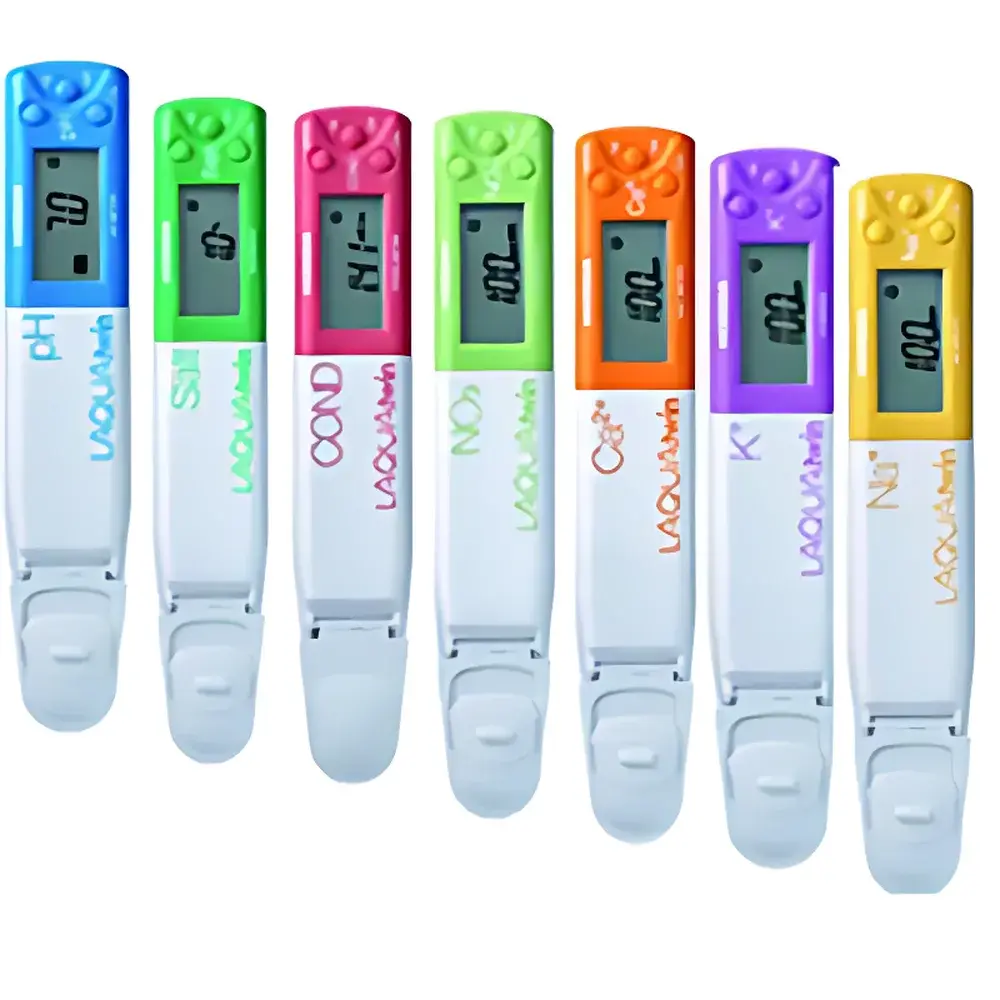
HORIBA B-Series Portable Pen-Type Water Quality Analyzer
| Brand | HORIBA |
|---|---|
| Origin | Japan |
| Model | B-Series |
| Type | Portable / Handheld Water Quality Analyzer |
| IP Rating | IP67 |
| Power | Two CR2032 batteries |
| Dimensions (L×W×H) | 164 mm × 29 mm × 20 mm |
| Weight | ~50 g (body only, excluding batteries |
| B-771 | ~45 g) |
| Operating Environment | 5–40 °C, RH <85% (non-condensing) |
| Sample Volume | 0.05–0.3 mL (model-dependent) |
| Measurement Principles | Glass electrode (pH), AC dual-electrode (EC/Conductivity), Ion-selective electrodes (Na⁺, K⁺, NO₃⁻, Ca²⁺), Density-based salinity compensation |
| Temperature Compensation | Automatic (2%/°C fixed for TDS/salinity), NIST-traceable reference standards supported |
| Calibration | 1-point or 2-point (user-selectable) |
Overview
The HORIBA B-Series Portable Pen-Type Water Quality Analyzer is a compact, field-deployable electrochemical measurement platform engineered for rapid, on-site assessment of critical water quality parameters in environmental monitoring, agricultural irrigation, aquaculture, and educational laboratory settings. Leveraging established potentiometric and conductometric principles—glass electrode pH sensing, AC dual-electrode conductivity measurement, and ion-selective membrane detection—the B-Series delivers laboratory-grade reproducibility in a rugged, pocket-sized form factor. Each model is purpose-configured for specific ion or parameter combinations (e.g., B-711 for pH + EC, B-751 for Na⁺ + K⁺ + NO₃⁻), enabling targeted deployment without cross-interference or unnecessary complexity. The instruments operate under ISO/IEC 17025-aligned measurement protocols, with calibration traceability to NIST-certified reference solutions and compliance with ASTM D1125 (pH), ASTM D5391 (conductivity), and ISO 7888 (electrical conductivity of water). Designed for real-world conditions, the B-Series meets IP67 ingress protection—withstanding immersion at 1 m depth for ≥30 minutes—while remaining strictly surface-operational per IEC 60529.
Key Features
- True pen-form factor: 164 mm × 29 mm × 20 mm, weighing ≤50 g—optimized for single-hand operation and field portability
- Low-volume sampling capability: As little as 0.05 mL (with optional sampling film B), minimizing reagent consumption and enabling analysis of limited or precious samples
- Integrated automatic temperature compensation (ATC): Fixed 2%/°C coefficient for TDS/salinity; thermistor-based real-time correction for pH and conductivity measurements
- Dual-mode calibration flexibility: User-selectable 1-point or 2-point calibration across all electrochemical channels; dedicated high-range conductivity standard (12.9 mS/cm) available for B-771 validation
- Robust electrochemical architecture: Platinum black-coated conductivity electrodes; low-drift glass pH electrodes with Ag/AgCl reference system; solid-contact ion-selective membranes for Na⁺, K⁺, NO₃⁻, and Ca²⁺
- Stable data retention: Auto-hold function freezes stable readings; no internal memory or Bluetooth—ensuring regulatory compliance in GLP/GMP environments where uncontrolled data transmission is prohibited
Sample Compatibility & Compliance
The B-Series accommodates aqueous matrices including freshwater, wastewater effluent, hydroponic nutrient solutions, soil extracts (1:5 w/v dilution), and plant sap (via B-741/B-742 accessory kits). Particulate-laden samples require pre-filtration using supplied filter membranes to prevent electrode fouling. All models comply with CE marking requirements for electromagnetic compatibility (EMC Directive 2014/30/EU) and RoHS 2011/65/EU restrictions on hazardous substances. While not FDA 21 CFR Part 11–certified (due to absence of audit trail or electronic signature functionality), the devices support ALCOA+ data integrity principles when used within documented SOPs—particularly in environmental field surveys governed by EPA Method 150.1 (pH), Method 120.1 (conductivity), and ISO 10523 (water quality—pH determination). IP67 certification satisfies IEC 60529 for temporary submersion, though underwater operation remains prohibited per manufacturer safety guidance.
Software & Data Management
The B-Series operates as a standalone, firmware-controlled instrument with no embedded software stack, cloud connectivity, or proprietary desktop applications. Measurement data are displayed in real time on a high-contrast LCD and must be manually recorded—ensuring full traceability, eliminating software validation burdens, and aligning with ISO/IEC 17025 Clause 7.7 (control of data management). No firmware updates are provided post-manufacture; calibration constants and sensor diagnostics are factory-programmed and immutable. This design eliminates cybersecurity risks, avoids obsolescence from OS dependency, and supports long-term method equivalence in regulated monitoring programs where software change control would otherwise necessitate re-validation. For laboratories requiring digital data capture, external logging via calibrated analog output interfaces (available on select OEM variants) may be implemented under validated third-party DAQ systems.
Applications
- Environmental field screening: Rapid pH, EC, and nitrate assessment in rivers, lakes, and wetlands per EPA Region 10 protocols
- Agricultural water management: On-the-spot verification of irrigation water salinity (NaCl %), TDS, and nutrient ion concentrations (K⁺, NO₃⁻–N) to prevent soil degradation
- Aquaculture health monitoring: Daily tracking of pH stability and ionic balance in recirculating aquaculture systems (RAS)
- Educational labs: Student-level experiments in electrochemistry, ion equilibrium, and water chemistry—fully compliant with AP Chemistry and IB Environmental Systems curricula
- Soil and plant tissue analysis: Paired with B-741 (plant sap) and B-742 (soil extract) accessories for precision agronomy workflows
FAQ
What sample volume is required for accurate measurement?
Minimum sample volume ranges from 0.05 mL (with optional sampling film B and closed light shield) to 0.3 mL depending on model and parameter—always verify compatibility with your specific B-Series unit’s technical sheet.
Can the B-Series be used underwater?
No. While IP67-rated for 1-meter immersion up to 30 minutes, the instruments are designed exclusively for surface-level operation. Submerged use voids calibration integrity and violates safety specifications.
Is calibration traceable to international standards?
Yes. Calibration employs NIST-traceable reference standards (e.g., pH 4.01/7.00/10.01 buffers, KCl conductivity standards). Certificate of Analysis is provided with each standard solution batch.
How is temperature compensation applied for salinity and TDS?
A fixed 2%/°C coefficient is applied per ASTM D1125 Annex A1, consistent with seawater-derived conversion algorithms used in environmental reporting frameworks.
Does the device support GLP-compliant audit trails?
No—data must be manually transcribed into bound lab notebooks or validated LIMS. The absence of electronic storage ensures inherent compliance with paper-based GLP workflows where digital audit trails are not mandated.







