
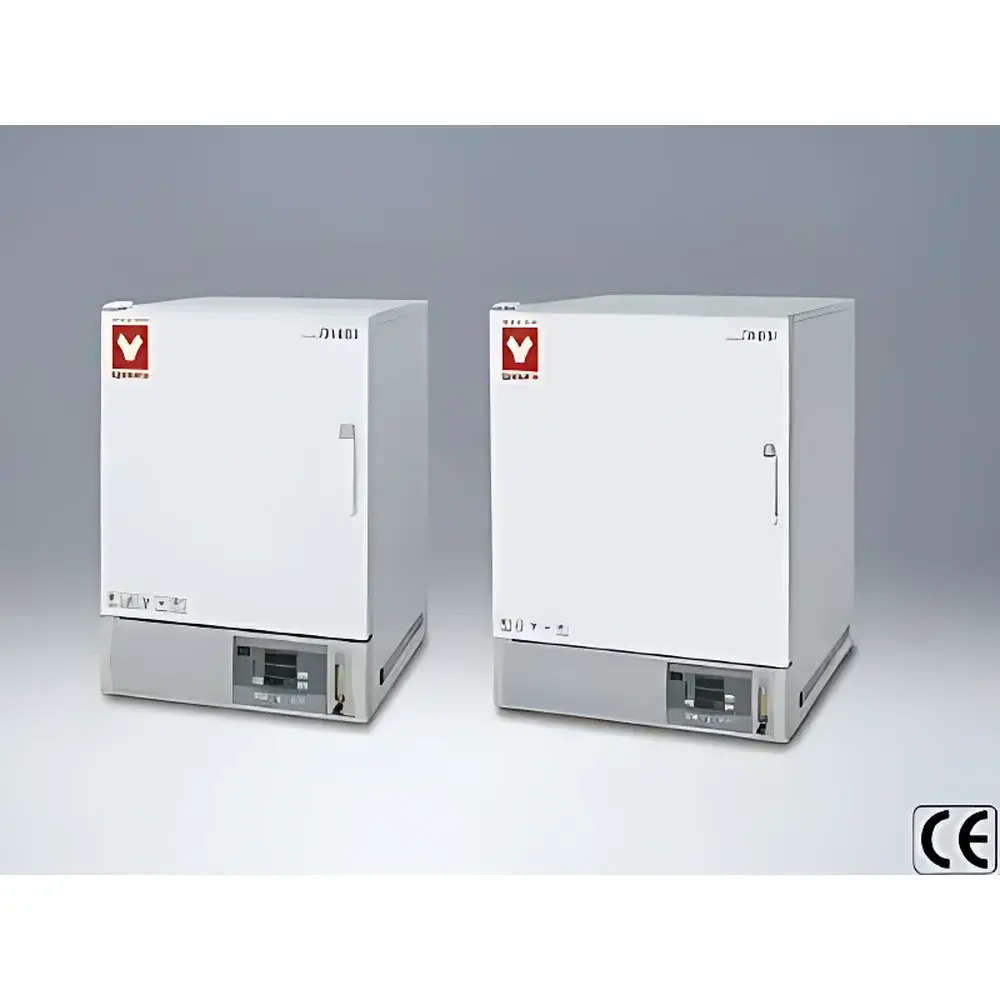
YAMATO DN410HC / DN610HC Forced-Convection High-Temperature Drying Oven
| Brand | YAMATO |
|---|---|
| Origin | Japan |
| Model | DN410HC / DN610HC |
| Temperature Range | Ambient +10°C to 360°C |
| Temperature Control Accuracy | ±0.2°C (at 360°C) |
| Temperature Uniformity | ±3.0°C (at 360°C) |
| Heating Power | 3.0 kW (DN410HC) / 4.0 kW (DN610HC) |
| Interior Volume | 95 L (DN410HC) / 223 L (DN610HC) |
| Chamber Construction | Stainless Steel Interior / Cold-Rolled Steel Exterior with Chemical-Resistant Coating |
| Insulation | Rock Wool |
| Fan | Centrifugal Impeller with High-Temperature Self-Cooling Motor (30 W) |
| Controller | 3-Stage PID with Digital LED Display (Green for Actual, Red for Setpoint) |
| Programmable Logic | 3-Phase, 30-Step Profile (Configurable as 30×1, 15×2, or 10×3) |
| Safety Systems | Dual Independent Over-Temperature Protection (Electronic Overshoot Prevention + Mechanical Overheat Cut-Off), Heater Break Detection, SSR Short-Circuit Monitoring, Leakage Current Circuit Breaker, Keypad Lock, Power Failure Recovery |
| Input Power | AC 220 V, 50/60 Hz (14 A for DN410HC |
Overview
The YAMATO DN410HC and DN610HC are precision-engineered forced-convection high-temperature drying ovens designed for rigorous thermal processing applications in research laboratories, quality control environments, and industrial R&D facilities. These ovens operate on the principle of uniform air circulation via a high-efficiency centrifugal blower system, ensuring consistent heat distribution across the entire chamber volume—critical for repeatable thermal treatments such as polymer curing, ceramic sintering pre-baking, catalyst activation, moisture analysis sample conditioning, and accelerated aging studies. With a maximum operating temperature of 360°C, the DN series exceeds standard Class B oven specifications and meets the thermal stability requirements defined in ISO 17025-accredited calibration protocols. The dual-layer safety architecture—including independent electronic and mechanical over-temperature protection—ensures compliance with IEC 61010-1 for laboratory electrical equipment safety.
Key Features
- Forced-air convection system with high-temperature self-cooling motor (30 W) and centrifugal impeller, delivering stable airflow at elevated temperatures without thermal degradation of fan components.
- Precision 3-stage PID temperature controller with digital LED readouts: green 4-digit display for actual chamber temperature and red 4-digit display for setpoint—enabling real-time verification during GLP/GMP audits.
- Programmable operation mode supporting up to 30-step thermal profiles across three segments, configurable as 30 steps × 1 cycle, 15 steps × 2 cycles, or 10 steps × 3 cycles—ideal for multi-stage annealing, ramp-soak-cool sequences, and ASTM E1530-compliant thermal stress testing.
- Comprehensive self-diagnostic circuitry continuously monitors K-type thermocouple integrity, heater continuity, SSR functionality, and power supply anomalies—logging fault codes for traceable maintenance records.
- Robust chamber construction featuring SUS304 stainless steel interior lining and cold-rolled steel exterior with chemical-resistant epoxy-polyester coating—resisting corrosion from solvents, acids, and residual volatiles encountered in pharmaceutical or materials synthesis workflows.
- Standard features include keypad lock, power failure recovery with resume-from-interrupt capability, deviation correction function, and timer with dual-range setting (1 min–99 h 59 min and 100–999 h 50 min), supporting long-duration stability tests per USP <1211> and ISO 11358.
Sample Compatibility & Compliance
The DN410HC (95 L) and DN610HC (223 L) accommodate a broad range of sample formats—from Petri dishes and crucibles to stacked trays and custom fixtures—thanks to standardized shelf spacing (30 mm pitch) and load capacity of 30 kg per shelf. Stainless steel wire mesh shelves (included) provide optimal air permeability while minimizing thermal mass interference. The ovens conform to key international standards including JIS B 7751 (Japanese Industrial Standard for Laboratory Ovens), CE marking under EU Machinery Directive 2006/42/EC, and RoHS-compliant material declarations. Optional RS485 interface enables integration into centralized facility monitoring systems compliant with FDA 21 CFR Part 11 when paired with validated data acquisition software.
Software & Data Management
While the base unit operates via embedded firmware without external PC dependency, optional RS485 communication allows connection to SCADA platforms or YAMATO’s proprietary data logging software (sold separately). Temperature output terminals (4–20 mA) support analog recording via chart recorders meeting ISO/IEC 17025 traceability requirements. All operational events—including start/stop commands, alarm triggers, and program step transitions—are timestamped and retained in non-volatile memory for audit-ready reporting. External alarm outputs and time-arrival signals facilitate interlocking with fume hoods, exhaust dampers, or safety interlock circuits in regulated environments.
Applications
- Thermal gravimetric analysis (TGA) sample preparation and pre-drying per ASTM D2290 and ISO 293.
- Ceramic and metallurgical powder processing: binder burnout, oxide reduction, and sintering preheating.
- Pharmaceutical stability testing under ICH Q1A(R2) conditions requiring precise dry-heat exposure.
- Electronics component baking prior to conformal coating or encapsulation.
- Calibration lab use for reference standard conditioning and humidity chamber equilibration support.
- Materials science research involving thermal aging of composites, elastomers, and adhesives per ASTM D573 and ISO 188.
FAQ
What is the maximum allowable ambient temperature for safe operation?
The ovens are rated for installation in environments up to 35°C ambient temperature with adequate ventilation clearance (≥100 mm rear/side, ≥300 mm top).
Can the oven be used under inert gas atmosphere?
No—the standard configuration lacks gas inlet/outlet ports or pressure-rated seals; however, optional purge kits with flow-controlled N₂/Ar inlets are available upon request for controlled-atmosphere modifications.
Is validation documentation provided with the instrument?
Factory-installed temperature mapping reports (per IQ/OQ templates) and calibration certificates traceable to JCSS standards are available as optional add-ons—not included by default but fully supported through YAMATO’s global service network.
How does the dual over-temperature protection system function?
The primary control loop uses a K-type thermocouple feeding the PID controller; a secondary independent over-temperature cut-off device—mechanically isolated and powered separately—triggers immediate power disconnection if chamber temperature exceeds user-defined limits by >5°C, satisfying EN 60519-2 requirements for industrial heating equipment.
Are spare parts and service support available outside Japan?
Yes—YAMATO maintains authorized service centers in North America, Europe, and Asia-Pacific regions, with guaranteed 72-hour response time for critical field service requests and online access to technical bulletins, firmware updates, and exploded-view schematics.



