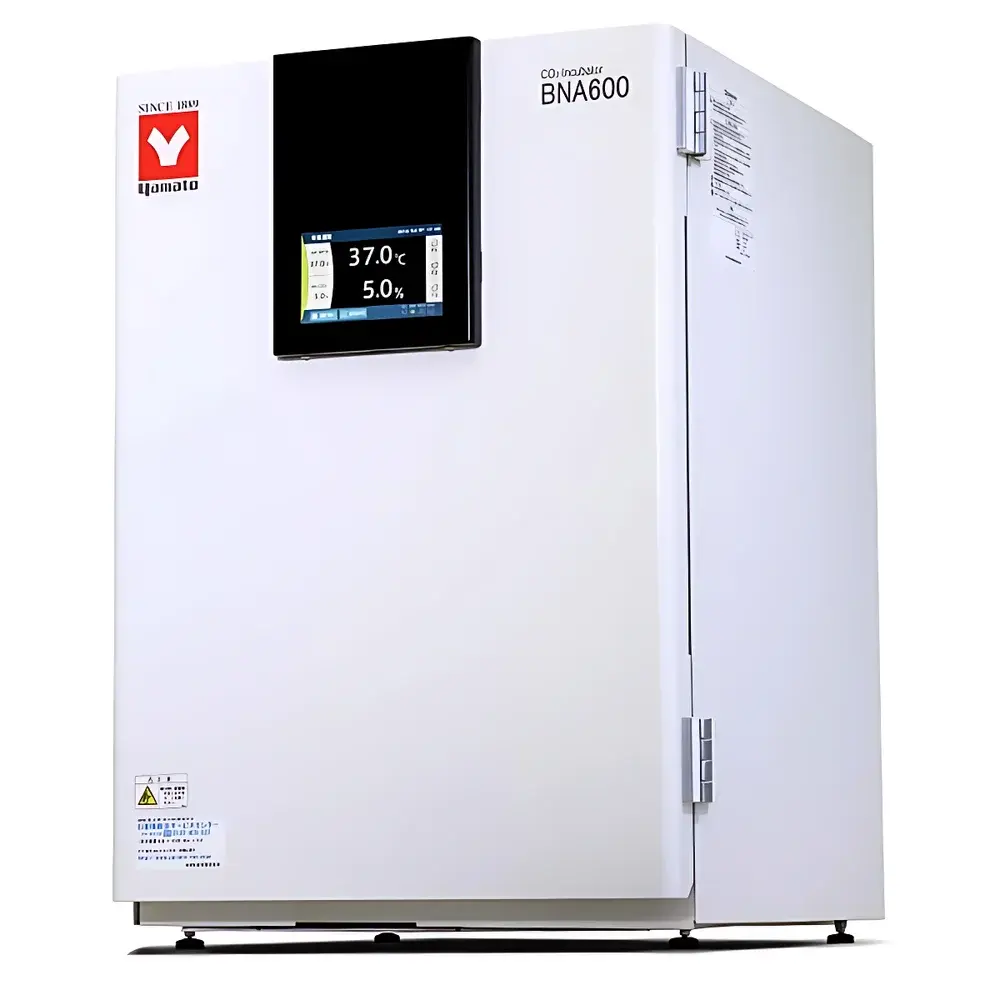
YAMATO BNA610 Water-Jacketed Carbon Dioxide Incubator
| Brand | YAMATO |
|---|---|
| Origin | Japan |
| Model | BNA610 |
| Temperature Range & Accuracy | Ambient +5°C to 50°C |
| Temperature Uniformity | ±2.5°C |
| Humidity Control | Up to 95% RH (non-condensing) |
| Chamber Capacity | 167 L |
| Heating Method | Water-jacketed |
| CO₂ Control | Infrared (IR) sensor-based feedback loop |
| Construction | Stainless steel interior, double-door design with heated inner glass door |
Overview
The YAMATO BNA610 is a precision-engineered water-jacketed carbon dioxide incubator designed for long-term, high-fidelity cell culture applications in academic research laboratories, biopharmaceutical development facilities, and clinical diagnostic settings. Its thermal architecture relies on a fully enclosed water jacket surrounding the stainless steel chamber, providing exceptional thermal inertia and minimizing temperature fluctuations during door openings or ambient environmental shifts. The system employs an infrared (IR) CO₂ sensor with automatic zero-point calibration and closed-loop proportional-integral-derivative (PID) control to maintain setpoint accuracy within ±0.1% CO₂ (typically 5% v/v), ensuring physiological gas composition stability across the full operating range. Unlike forced-air units, the water-jacketed design delivers superior temperature homogeneity—validated at ±2.5°C throughout the 167 L working volume—critical for sensitive primary cultures, stem cell expansion, and co-culture experiments where microenvironmental consistency directly impacts phenotypic expression and reproducibility.
Key Features
- Water-jacketed thermal system with independent heater control and integrated water level monitoring to prevent dry-run operation
- Electropolished 316L stainless steel interior chamber and shelving—fully autoclavable and resistant to corrosion from repeated ethanol or hydrogen peroxide decontamination cycles
- Heated, low-emissivity inner glass door with anti-fog coating minimizes condensation and maintains stable internal humidity (up to 95% RH) without active humidification hardware
- Dual-stage CO₂ supply regulation with solenoid valve and mass flow controller ensures precise gas dosing and eliminates overshoot during recovery after door opening
- Microprocessor-based controller with real-time display of chamber temperature, CO₂ concentration, relative humidity, and system status alarms
- Independent over-temperature safety cut-off (OTS) and CO₂ high-limit protection circuitry compliant with IEC 61010-1 requirements for laboratory equipment safety
Sample Compatibility & Compliance
The BNA610 accommodates standard tissue culture formats including T-flasks (up to T225), multi-well plates (6–96-well), Petri dishes, roller bottles, and custom bioreactor vessels up to 15 cm in diameter. Its uniform thermal and gaseous environment supports adherent and suspension mammalian cell lines (e.g., HEK293, CHO-K1, A549), human induced pluripotent stem cells (iPSCs), primary neurons, and organoid cultures requiring strict pH regulation via bicarbonate-buffered media. The incubator meets ISO 13485 design control requirements for medical device manufacturing environments and supports GLP-compliant workflows through configurable audit trail logging (via optional RS-232/USB data export). While not FDA 21 CFR Part 11–certified out-of-the-box, its deterministic control logic and non-volatile parameter storage enable validation-ready documentation for GMP-aligned QC laboratories.
Software & Data Management
The embedded controller records time-stamped operational data—including temperature, CO₂ %, door-open events, and alarm triggers—at user-defined intervals (1 min to 24 h). Logged data exports as CSV files via USB flash drive for integration into LIMS or ELN platforms. Optional YAMATO DataLink software (v3.2+) provides remote monitoring via Ethernet connection, enabling real-time dashboard visualization, email alerting for deviations, and trend analysis of environmental parameters across multiple incubators. All configuration changes are timestamped and attributable to operator ID when paired with external authentication systems—supporting traceability requirements under ISO/IEC 17025 and CAP accreditation standards.
Applications
- Long-term maintenance of low-passage primary cells under physiologically relevant CO₂ and humidity conditions
- High-throughput screening assays requiring consistent metabolic activity across multi-day kinetic readouts
- Preparation of feeder layers and conditioned media for regenerative medicine protocols
- Embryonic stem cell differentiation studies where minor pH drift induces lineage bias
- Microbial co-culture models simulating host-pathogen interactions in controlled O₂/CO₂ gradients
- Stability testing of therapeutic proteins expressed in mammalian hosts under defined environmental stressors
FAQ
What type of CO₂ sensor does the BNA610 use, and how often does it require recalibration?
The BNA610 utilizes a factory-calibrated non-dispersive infrared (NDIR) sensor with automatic baseline correction during idle periods; no manual recalibration is required under normal operation.
Is the water jacket filled manually, and what is the recommended maintenance interval?
Yes—the jacket is filled via a dedicated port using deionized water; YAMATO recommends quarterly visual inspection and annual replacement of jacket fluid to prevent microbial growth or mineral deposition.
Can the BNA610 operate in hypoxic conditions (e.g., 1–5% O₂)?
No—this model is configured exclusively for CO₂ regulation in normoxic air; for hypoxia work, consider YAMATO’s tri-gas (O₂/CO₂/N₂) series such as the BNA-310S.
Does the unit include HEPA filtration for airborne particulate control?
No—air circulation is unfiltered; however, the sealed chamber design and positive internal pressure minimize ingress, and optional external laminar flow hoods may be integrated upstream.
What is the power requirement and typical warm-up time to reach 37°C/5% CO₂?
Rated at 230 V AC, 50/60 Hz, 1.8 kW; average stabilization time from ambient to 37°C with CO₂ equilibration is approximately 45 minutes.