
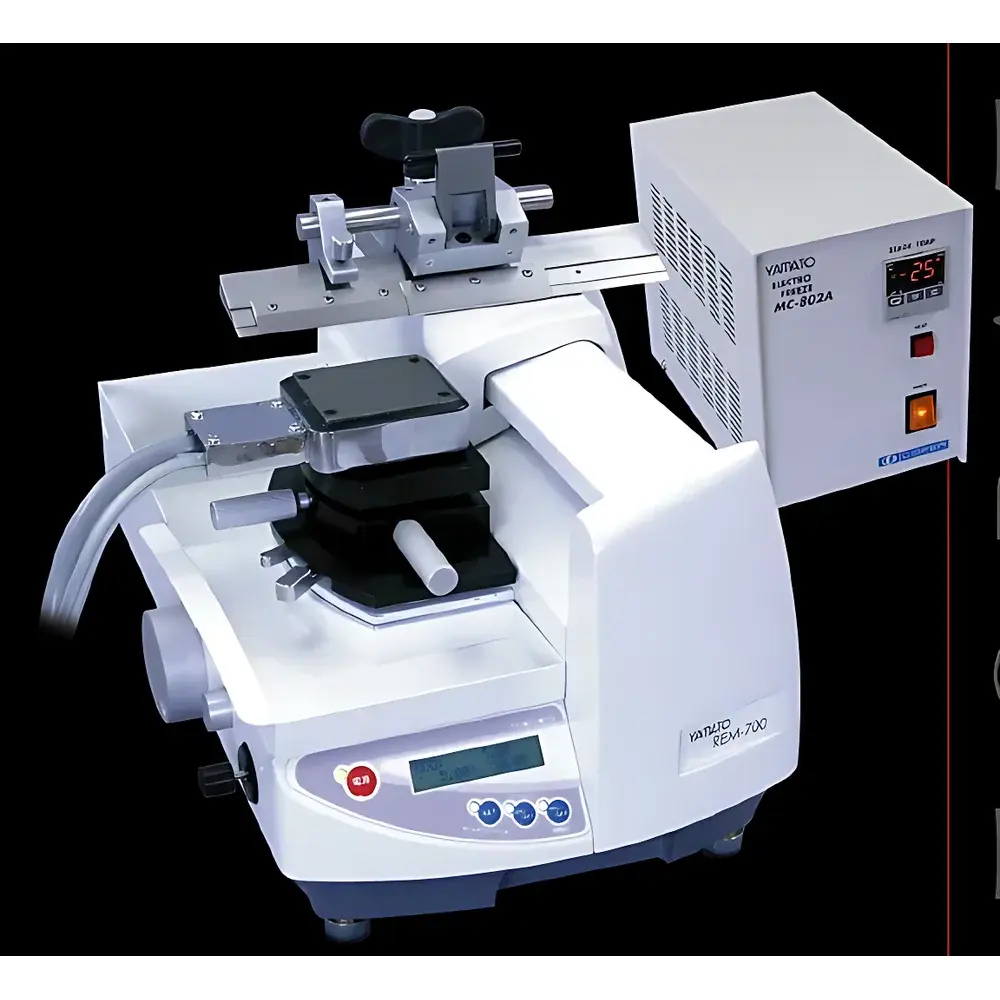
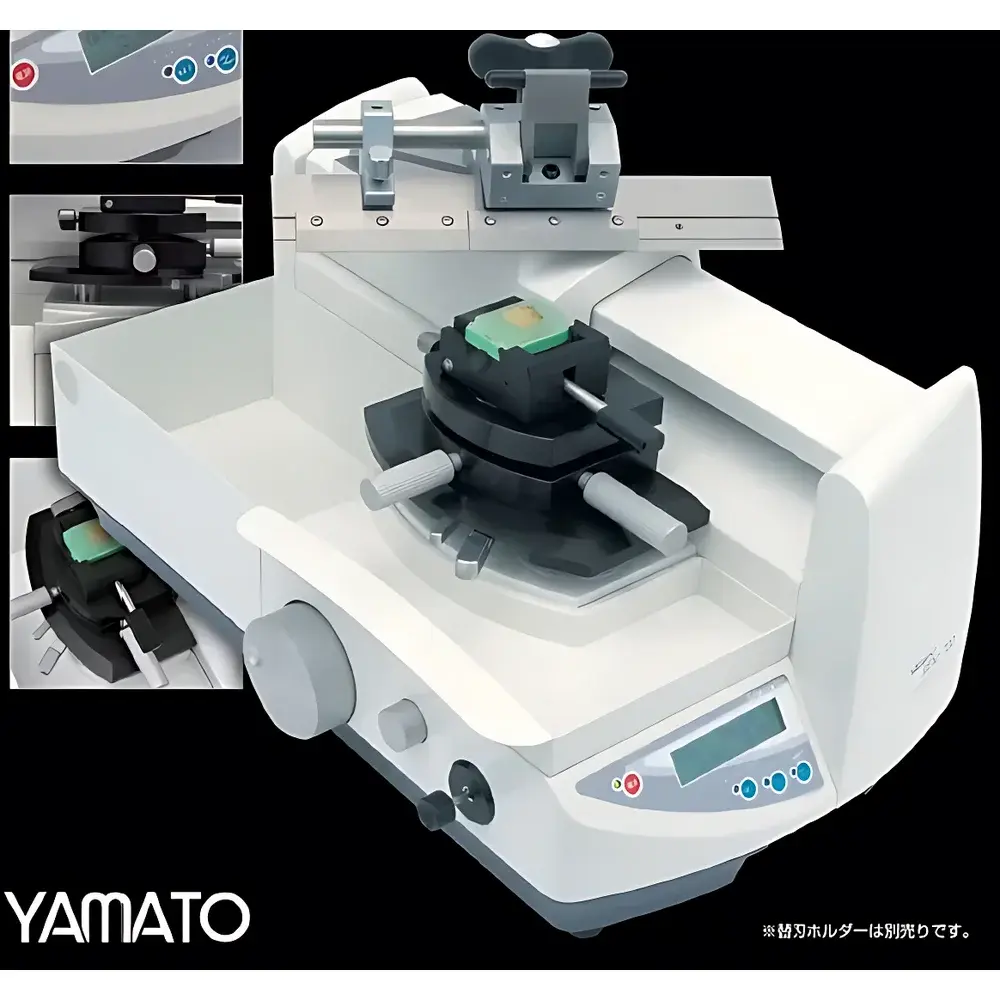
YAMATO REM710 Cryostat Microtome with MC-802A Cooling Unit
| Brand | YAMATO |
|---|---|
| Origin | Japan |
| Model | REM710 |
| Cooling Unit | MC-802A |
| Vertical Travel | 40 mm |
| Section Thickness Range | 0.25–120 µm (adjustable in 0.25 µm increments) |
| Minimum Operating Temperature | −25 °C (at ambient 15 °C, coolant inlet 10 °C) |
| Coolant Flow Rate | 1.5–2.0 L/min |
| Power Supply | AC 100 V, 50/60 Hz, 50 W (REM710), 160 W (MC-802A) |
| Operating Environment | 10–40 °C, 20–80 % RH |
| Net Weight | 32 kg (REM710), 9 kg (MC-802A) |
| Dimensions (W×D×H) | 340 × 440 × 300 mm (REM710), 160 × 294 × 277 mm (MC-802A) |
| Specimen Clamp Opening | Max. 40 mm |
| Return Stroke Adjustment | ON/OFF, programmable from 1–50 µm |
| Motorized Feed | ON/OFF |
Overview
The YAMATO REM710 Cryostat Microtome is a precision-engineered, motorized freezing microtome system designed for reproducible sectioning of biological and soft tissue specimens at cryogenic temperatures. Integrated with the dedicated MC-802A Peltier-based cooling unit, the REM710 maintains stable specimen temperatures down to −25 °C under controlled environmental conditions (ambient 15 °C, coolant inlet 10 °C), enabling high-fidelity sectioning of unfixed, non-embedded, or lightly fixed tissues without structural distortion. Its core mechanism employs a linear stepper-driven feed system coupled with a rigid vertical translation stage (40 mm travel), ensuring consistent slice geometry across serial sections. Unlike rotary microtomes, the REM710 operates on a sliding (sled-type) principle—where the specimen advances toward a stationary knife—optimized for thermal stability and minimal vibration during low-temperature cutting. This architecture meets fundamental requirements for histopathology, neuroscience, and preclinical research workflows where morphological integrity and section flatness are critical for downstream staining, immunohistochemistry (IHC), and digital slide scanning.
Key Features
- Motorized section thickness control with adjustable step resolution of 0.25 µm across a full range of 0.25–120 µm, supporting both ultra-thin (e.g., 3–5 µm for H&E) and semi-thick (e.g., 20–50 µm for fluorescence microscopy) sectioning protocols.
- Dual-mode return stroke function: user-selectable ON/OFF with programmable retraction distance (1–50 µm), minimizing knife contact time and extending blade life while preserving specimen surface integrity between cuts.
- Integrated MC-802A thermoelectric cooling unit delivering precise, vibration-free temperature regulation; features real-time coolant flow monitoring (1.5–2.0 L/min) and automatic thermal compensation based on ambient and inlet water temperature inputs.
- Rigid aluminum alloy frame with precision-ground linear guides and backlash-free gear transmission, engineered for long-term dimensional stability and mechanical repeatability over thousands of cutting cycles.
- Intuitive touch-enabled control panel with dedicated parameter presets, real-time feed position feedback, and error logging compliant with GLP documentation practices.
Sample Compatibility & Compliance
The REM710 accommodates standard OCT-embedded tissue blocks and unmounted specimens up to 40 mm wide in the specimen clamp. Its open-face design and large working clearance support rapid block exchange and manual trimming under stereomicroscopic guidance. The system complies with IEC 61010-1:2010 for electrical safety in laboratory equipment and meets essential performance criteria outlined in ISO 15195:2018 (Clinical laboratory testing — Requirements for reference measurement systems). While not FDA-cleared as an IVD device, its operational parameters and traceable calibration pathways align with internal quality assurance frameworks required for CAP-accredited histology laboratories and preclinical GLP studies (OECD Series on Principles of Good Laboratory Practice).
Software & Data Management
The REM710 operates via embedded firmware with no external PC dependency; however, all user-defined parameters—including section thickness, return stroke, feed mode, and temperature setpoints—are stored in non-volatile memory with timestamped audit trails. Optional RS-232 or USB-C interface enables integration into centralized lab equipment management platforms for automated log export (CSV/TSV) and remote status polling. Data records include operator ID (via optional RFID badge reader), session start/end timestamps, total cut count, and thermal deviation alerts—supporting 21 CFR Part 11-compliant electronic record retention when deployed with validated third-party LIMS middleware.
Applications
- Routine frozen section diagnosis in surgical pathology, including intraoperative margin assessment and rapid tumor typing.
- Neuroanatomical sectioning of rodent and primate brain tissue for tract-tracing, in situ hybridization (ISH), and multiplexed immunofluorescence.
- Preparation of plant tissue sections for starch, lignin, or suberin localization studies requiring minimal artifact introduction.
- Quality control of biopolymer scaffolds and hydrogel-based tissue engineering constructs where hydration state must be preserved during sectioning.
- Correlative light-electron microscopy (CLEM) sample preparation, where sequential cryo-sectioning enables precise registration of optical and ultrastructural domains.
FAQ
What is the minimum achievable section thickness, and how is resolution maintained at sub-micron levels?
The REM710 achieves a minimum section thickness of 0.25 µm through closed-loop stepper motor control and zero-backlash feed mechanics. Resolution is sustained via dynamic load compensation and real-time position verification using optical encoders integrated into the feed drive train.
Does the MC-802A cooling unit require external chilled water or is it self-contained?
The MC-802A is a self-contained Peltier-based cooler; it requires only a standard tap-water supply (1.5–2.0 L/min) at ≤15 °C inlet temperature. No recirculating chiller is needed.
Can the REM710 be used for paraffin-embedded specimens?
While optimized for cryosectioning, the REM710 may accommodate room-temperature paraffin blocks using optional ambient-stage adapters—but this configuration is not validated for routine diagnostic use and voids warranty coverage for thermal subsystems.
Is firmware update capability available, and how is version control managed?
Firmware updates are delivered via encrypted USB key with SHA-256 checksum verification. Each update includes a revision log, compatibility matrix, and rollback provision—fully traceable per ISO/IEC 17025 clause 5.9.4.
What maintenance intervals are recommended for optimal long-term performance?
Daily: knife cleaning and coolant line inspection. Quarterly: guide rail lubrication and feed mechanism torque verification. Annually: full calibration against NIST-traceable micrometer standards and thermal sensor validation using certified dry-block calibrators.



