
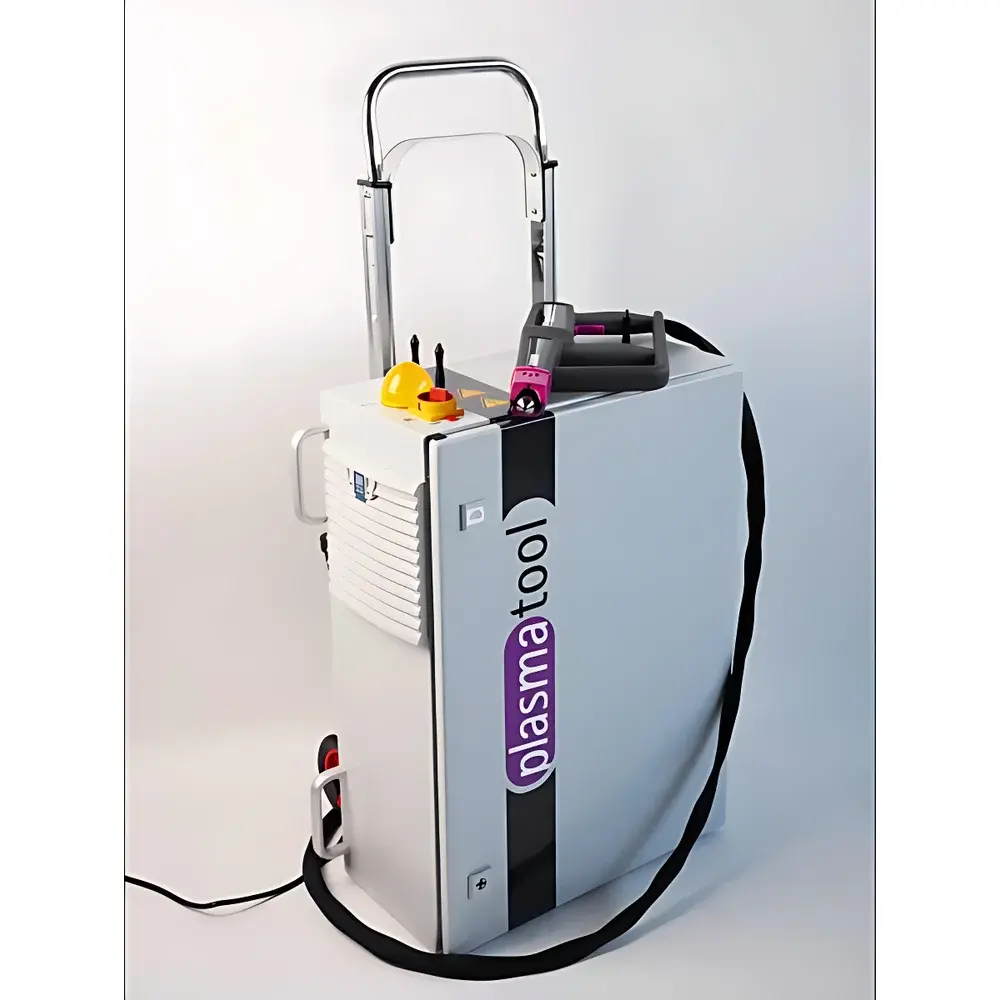
Relyon PlasmaTool Handheld Atmospheric-Pressure Plasma Generator
| Brand | Relyon |
|---|---|
| Origin | Germany |
| Model | PlasmaTool |
| RF Frequency | 40 kHz |
| Output Power | 1300 W |
| Dimensions | 800 × 540 × 430 mm |
| Weight | ~60 kg |
| Supply Voltage | 220–240 V AC, 50–60 Hz |
| Max. Current Draw | 6 A |
| Plasma Treatment Distance | 5–20 mm |
| Treatment Width | 10–25 mm |
| Operating Gas | Ambient Air (integrated air compressor) |
| Control Method | Manual Dual-Hand Activation |
| Safety Features | Integrated Warning Light, Interlocked Start Logic |
| Sound Pressure Level | <60 dB(A) at 1 m |
| Plasma Temperature Range | Several hundred to over 1000 °C (non-thermal, kinetically activated species dominant) |
| Application Mode | Open-air, non-contained surface treatment |
Overview
The Relyon PlasmaTool Handheld Atmospheric-Pressure Plasma Generator is an engineered solution for on-demand, localized plasma surface activation and cleaning under ambient conditions. Unlike low-pressure vacuum plasma systems, the PlasmaTool operates at atmospheric pressure using ionized ambient air—eliminating the need for vacuum chambers, gas cylinders, or external compressed air infrastructure. Its core principle relies on dielectric-barrier discharge (DBD) generated by a 40 kHz radiofrequency power supply, producing a stable, non-thermal plasma plume rich in reactive oxygen and nitrogen species (ROS/RNS), UV photons, and energetic electrons. This chemically active effluent modifies surface energy by introducing polar functional groups (e.g., –OH, –COOH, C=O) onto polymer, metal, composite, and elastomeric substrates—enhancing wettability, adhesion promotion, and contaminant removal without substrate ablation or thermal damage. Designed for industrial laboratory integration and field deployment, it serves as a bridge between benchtop surface science and production-line process validation.
Key Features
- Integrated self-contained air compression system—no external air lines or oil-free compressors required
- Dual-hand activation with interlocked start logic and visual warning light ensures operator compliance with IEC 61000-6-4 and EN 60204-1 safety directives
- Compact trolley-mounted chassis (800 × 540 × 430 mm; ~60 kg) enables single-operator mobility across workshops, cleanrooms, or outdoor maintenance sites
- Stable 40 kHz RF excitation delivers consistent plasma density and uniform treatment across variable surface topographies
- Adjustable treatment distance (5–20 mm) and effective width (10–25 mm) allow precise spatial control for edge-sensitive components
- Low acoustic emission (<60 dB(A) at 1 m) supports use in shared laboratory or QA/QC environments without noise mitigation infrastructure
- Robust industrial-grade enclosure rated IP54 for resistance to dust ingress and incidental water splashing
Sample Compatibility & Compliance
The PlasmaTool treats substrates regardless of geometry, size, or mounting constraints—including oversized automotive body panels, aircraft fuselage sections, wind turbine blades, and in-situ repair zones. Compatible materials include polypropylene (PP), polyethylene (PE), polyamide (PA), PTFE, aluminum alloys, stainless steel, CFRP, rubber, and painted or coated surfaces. It meets essential requirements of ISO 14644-1 (cleanroom compatibility), ASTM D257 (surface resistivity pre/post-treatment verification), and ISO 8501-1 (visual assessment of surface cleanliness). While not a medical device, its repeatable surface modification output supports GLP-aligned documentation workflows when paired with calibrated contact angle goniometry (e.g., ASTM D7334) for adhesion readiness qualification.
Software & Data Management
As a manually operated, analog-controlled instrument, the PlasmaTool does not incorporate embedded firmware, digital interfaces, or data logging capabilities. Process repeatability is ensured through mechanical consistency—fixed RF power output (1300 W), regulated gas flow dynamics, and standardized operator training protocols. For audit-trail compliance in regulated environments (e.g., aerospace MRO per EASA Part 145 or FAA AC 120-98), users are advised to document treatment parameters (duration, distance, pass count) via paper-based or LIMS-integrated SOP checklists. No FDA 21 CFR Part 11 electronic signature functionality is provided, consistent with its classification as a Class I general-purpose surface preparation tool.
Applications
- Pretreatment prior to adhesive bonding of thermoplastic composites in automotive lightweighting programs
- Surface activation of silicone rubber seals prior to coating or encapsulation in medical device assembly
- Removal of organic contaminants and weak boundary layers from metal weld zones before NDT inspection
- Enhancement of ink adhesion on HDPE packaging substrates in packaging R&D labs
- In-field restoration of aged fiberglass boat hulls by improving gelcoat adhesion during repair cycles
- Pre-paint conditioning of aluminum extrusions to eliminate primer dependency in architectural finishing
- Plasma-assisted descaling and oxide reduction on stainless steel surfaces prior to electropolishing validation
FAQ
Does the PlasmaTool require external compressed air?
No. It integrates a dedicated, oil-free diaphragm air compressor delivering consistent airflow for stable plasma generation.
Can it be used inside a fume hood or laminar flow cabinet?
Yes—its open-air operation and low noise profile make it suitable for controlled laboratory enclosures, provided adequate ventilation is maintained for ozone dispersion.
What safety certifications does it hold?
It complies with CE marking requirements under the EU Machinery Directive 2006/42/EC and EMC Directive 2014/30/EU, including EN 60204-1 (electrical safety) and EN 61000-6-2/6-4 (EMC immunity/emission).
Is plasma treatment depth measurable or controllable?
Plasma effects are confined to the topmost 1–10 nm of the surface layer; treatment depth is not adjustable but is inherently shallow and non-destructive—verified by XPS and AFM studies on standard reference materials.
How frequently does maintenance occur?
Recommended preventive maintenance includes quarterly inspection of electrode integrity, air filter replacement every 500 operating hours, and annual calibration of RF power output using a calibrated RF power meter traceable to national standards.



