
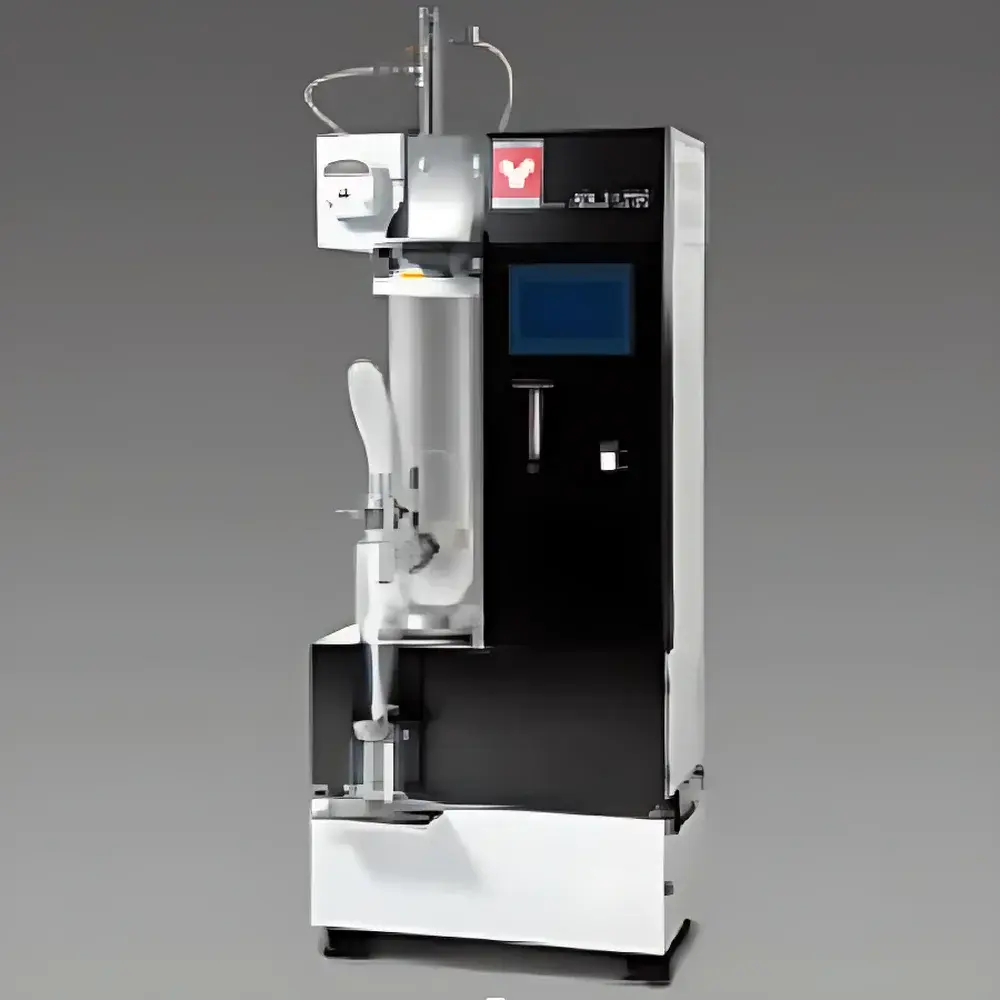
Yamato ADL312SC-A Benchtop Spray Dryer
| Brand | Yamato |
|---|---|
| Origin | Japan |
| Model | ADL312SC-A |
| Sample Types | Aqueous & Organic Solvent Solutions/Suspensions |
| Max. Feed Rate | 1500 mL/h |
| Inlet Temperature Range | 40–240 °C |
| Outlet Temperature Range | 0–100 °C |
| Inlet Temp. Control Accuracy | ±1 °C |
| Drying Air Flow | 0–1.0 m³/min |
| Atomizing Air Flow | 0–30 L/min |
| Atomizing Air Pressure | 0–0.6 MPa |
| Heater Power | 3.2 kW |
| Dimensions (W×D×H) | 580 × 420 × 1150 mm |
| Weight | 80 kg |
| Power Supply | AC 200–230 V, 50/60 Hz, 16–18 A |
Overview
The Yamato ADL312SC-A is a precision-engineered benchtop spray dryer designed for reproducible, solvent-compatible powder production in research and quality control laboratories. It operates on the principle of rapid flash evaporation: liquid feed—whether aqueous solution, colloidal suspension, or organic solvent-based formulation—is atomized into fine droplets via a two- or three-fluid nozzle system and exposed to a controlled stream of heated drying air. Within milliseconds, solvent volatilizes, yielding free-flowing, low-moisture microparticles with minimal thermal degradation. Its dual-mode airflow architecture (suction-intake or forced-exhaust) enables optimization for heat-sensitive biomolecules, pharmaceutical actives, or volatile organic formulations. The system’s modular design supports seamless integration with the optional GAS411C solvent recovery unit—critical for safe, compliant handling of flammable solvents under OSHA and IEC 61000-6-4 regulatory frameworks.
Key Features
- 7-inch capacitive touchscreen HMI with tri-language support (English, Japanese, Chinese), enabling intuitive PID-controlled operation of inlet/outlet temperature, airflow, atomization pressure, and feed rate.
- Dual-configuration drying air circuitry: selectable suction-intake or forced-exhaust mode for enhanced process adaptability across viscosity and volatility ranges.
- Integrated cooling jacket on the two-fluid nozzle (optional automatic cooled nozzle available) mitigates thermal clogging during prolonged operation with high-solids suspensions.
- Pulse-jet nozzle cleaning mechanism and manual de-clogging needle ensure uninterrupted atomization stability—even with viscous or particulate-laden feeds.
- Detachable cyclone separator and drying chamber with quick-lock couplings reduce cross-contamination risk and simplify cleaning validation per ISO 22000 and GMP Annex 1 requirements.
- Onboard 2 A AC outlet for external magnetic stirrer synchronization—enabling continuous homogenization of unstable suspensions during feeding.
- Comprehensive safety suite: overheat cutoff (inlet/outlet), pump reverse rotation detection, earth-leakage circuit breaker, atomizer connection monitoring (when linked to GAS411C), and static-dissipative grounding interface.
Sample Compatibility & Compliance
The ADL312SC-A accommodates both water-based and organic solvent systems—including ethanol, acetone, chloroform, and ethyl acetate—when coupled with the GAS411C solvent recovery module. Its stainless-steel wetted parts (316L-grade contact surfaces in optional configurations), HEPA-class exhaust filtration, and sealed solvent-handling pathways meet ASTM E2915-22 criteria for laboratory-scale solvent processing. The system supports IQ/OQ documentation packages and complies with electrical safety standards IEC 61010-1 and electromagnetic compatibility per IEC 61326-1. When configured with audit-trail-enabled data logging (optional), it satisfies FDA 21 CFR Part 11 requirements for electronic records in regulated pharmaceutical development.
Software & Data Management
While the base unit operates via embedded firmware with real-time parameter display and curve logging (temperature, airflow, pressure), optional data acquisition modules enable CSV export of time-stamped process variables at user-defined intervals (1–60 s resolution). Analog 4–20 mA outputs permit integration with SCADA or LIMS platforms for centralized monitoring. Multi-PID control loops independently regulate heater power, blower speed, peristaltic pump RPM, and pulse-cleaning timing—ensuring stable setpoint adherence under dynamic load conditions. Remote operation via Ethernet or RS-485 (Modbus RTU) allows supervised unattended runs during off-shift hours—subject to local network security policies.
Applications
This spray dryer serves analytical and formulation labs engaged in: lyophilization alternative screening for protein therapeutics; nanoparticle synthesis (e.g., PLGA, chitosan, lipid nanoparticles); excipient dry-blend optimization; catalyst precursor powder preparation; food-grade encapsulant development (e.g., β-carotene, omega-3 oils); and ceramic precursor powder synthesis. Its ability to generate sub-10 µm median particle sizes—without post-grinding—reduces batch variability in dissolution testing (USP ) and improves aerosol dispersion efficiency in inhalation product development.
FAQ
Can the ADL312SC-A handle heat-labile biologics such as monoclonal antibodies?
Yes—via precise inlet temperature control (±1 °C), rapid residence time (<2 s), and optional cooled-nozzle configuration, it minimizes denaturation risk while achieving residual moisture <2% w/w.
Is the GAS411C solvent recovery unit required for all organic solvents?
Mandatory for Class I flammable solvents (flash point <60 °C); recommended for all volatile organics to meet workplace exposure limits (ACGIH TLV) and reduce VOC emissions.
What maintenance intervals are recommended for the peristaltic pump tubing?
Tubing replacement every 200 operational hours or after processing abrasive suspensions—validated via flow calibration against gravimetric feed measurement.
Does the system support GLP-compliant data archiving?
With the optional data logger and password-protected user roles, it provides electronic signatures, change history, and tamper-evident audit trails aligned with OECD GLP Principles.
Can particle size distribution be tuned without hardware modification?
Yes—through coordinated adjustment of atomizing air pressure, feed rate, inlet temperature, and drying air flow—empirically mapped using Design of Experiments (DoE) methodology.



