
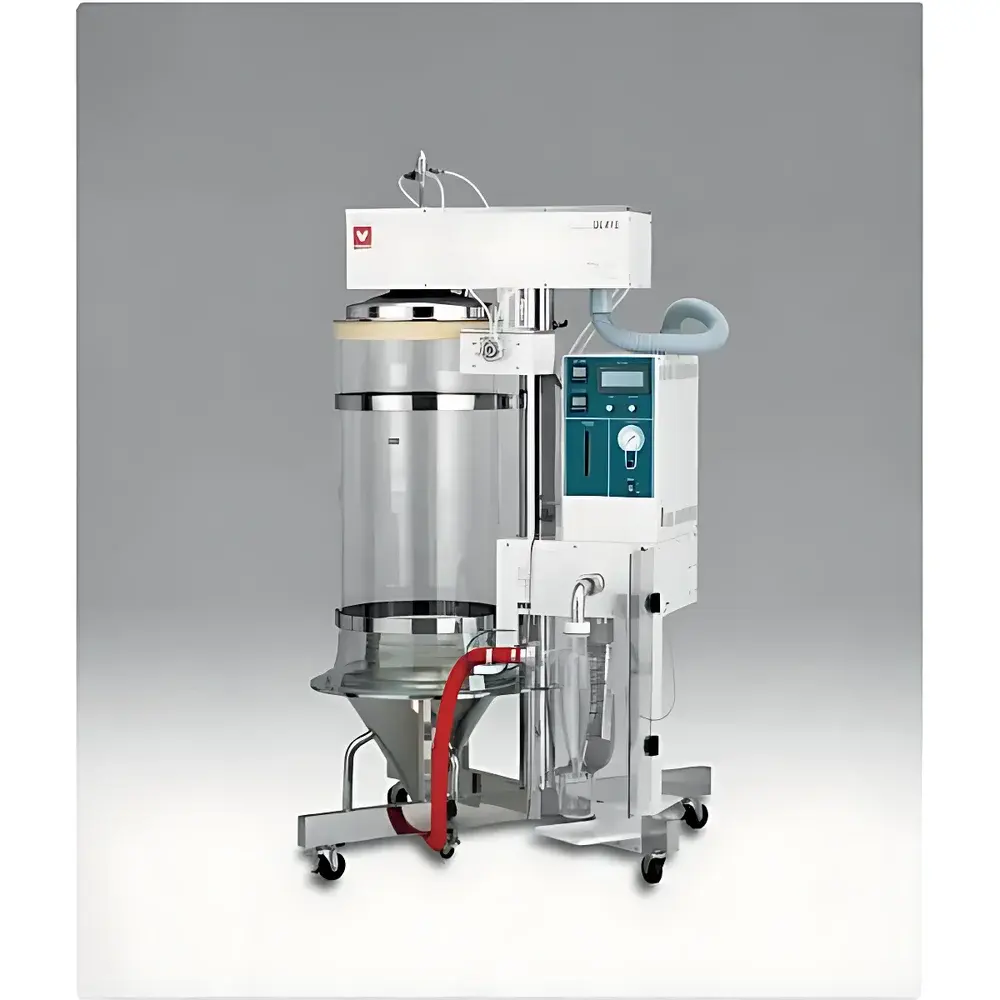
Yamato DL410 Pilot-Scale Spray Dryer
| Brand | Yamato |
|---|---|
| Origin | Japan |
| Model | DL410 |
| Price | USD 60,000 |
| Sample Compatibility | Aqueous, Organic, and Mixed Solvent Systems |
| Maximum Feed Rate | 3 L/h |
| Inlet Temperature Range | 40–300 °C |
| Outlet Temperature Control | PID-regulated |
| Particle Size Output | 40–100 µm |
| Evaporation Capacity | Up to 3000 mL/h |
| Atomization | Two-Fluid Nozzle (Orifice Diameter: 0.7 mm) |
| Drying Configuration | Co-Current Downward Spray |
| Airflow Range | 0.3–1.0 m³/min |
| Heating Power | 2 × 2.0 kW Stainless Steel Heaters |
| Drying Chamber Dimensions | Ø457 mm × H975 mm (Borosilicate Glass) |
| Construction Materials | Ultra-Hard Borosilicate Glass (Chamber, Cyclone, Collection Vessel), Stainless Steel & Silicone Tubing |
| Nozzle Features | Automatic Orifice Cleaning (Timer-Controlled Probe Tapping), Nozzle Tip Purge Air |
| Head Assembly | Motorized Vertical Adjustment for Maintenance |
| Safety Systems | Independent Over-Temperature Cut-Off, Pump Reverse Rotation Detection, Earth Leakage & Overcurrent Protection |
| Electrical Supply | AC 220 V, 50/60 Hz, 24 A |
| Dimensions (W×D×H) | 1060 × 880 × 1770 mm |
| Weight | ~180 kg |
| Standard Accessories | Silicone Feed Tubing (Ø6.4/Ø3.2 mm, 2 m), Intake Hose (ID 7.9 mm, 3 m), Exhaust Hose (ID 50 mm, 3 m) |
| Optional Accessory | Organic Solvent Recovery System (GAS410) |
Overview
The Yamato DL410 Pilot-Scale Spray Dryer is an engineered platform for reproducible, scalable powder synthesis under controlled thermal and fluid-dynamic conditions. It operates on the principle of co-current downward two-fluid atomization—where liquid feed is pneumatically dispersed into fine droplets via a 0.7 mm orifice nozzle, then rapidly dried by heated air in a large-diameter borosilicate glass chamber. This configuration ensures uniform residence time (optimized via chamber volume design), minimal wall deposition, and high particle yield—critical for bridging lab-scale formulation development to production-grade powder specifications. The system is calibrated to consistently produce spherical, free-flowing particles within the 40–100 µm range—matching industrial requirements for ceramic green bodies, pharmaceutical granules, functional food ingredients, and catalyst supports. Its inlet temperature control (±1 °C accuracy), real-time outlet temperature monitoring, and integrated airflow regulation enable precise thermal history management—essential for thermolabile actives and solvent-sensitive formulations.
Key Features
- Two-fluid nozzle with automated orifice cleaning: Timer-triggered mechanical probe tapping and purge-air jet prevent clogging during extended runs with viscous or particulate-laden feeds.
- Motorized head assembly: Enables programmable vertical retraction of the nozzle and hot-air duct for safe, residue-free chamber cleaning and visual inspection.
- Borosilicate glass process train: Entire drying chamber, cyclone separator, and collection vessel are fabricated from ultra-hard, low-thermal-expansion glass—enabling direct observation of spray pattern, droplet trajectory, and particle agglomeration behavior without compromising structural integrity at up to 300 °C inlet temperatures.
- DC brushless blower: Delivers stable, low-vibration airflow (0.3–1.0 m³/min) with extended service life and reduced maintenance intervals compared to AC induction motors.
- Integrated electrostatic mitigation: Standard-fit antistatic brush on the collection vessel base minimizes charge accumulation—improving powder recovery efficiency and reducing handling hazards in low-conductivity organic systems.
- PID-controlled dual-zone heating: Two independent 2.0 kW stainless steel heating elements with dedicated K-type thermocouples ensure rapid thermal response and stable setpoint maintenance across the full 40–300 °C operating range.
Sample Compatibility & Compliance
The DL410 accommodates aqueous solutions, water-miscible organics (e.g., ethanol, acetone), and heterogeneous mixtures—including suspensions containing nanoparticles or microcrystalline APIs. Its inert glass-wetted path and silicone-free sealing options (upon request) support GMP-aligned processes per USP and . The system complies with IEC 61000-6-2 (EMC immunity) and IEC 61000-6-4 (EMC emission) standards. Optional GAS410 solvent recovery module enables closed-loop operation with flammable solvents, meeting OSHA 1910.106 and NFPA 30 requirements when installed with appropriate ventilation and explosion relief. All electrical safety systems—including independent overtemperature cut-off, earth leakage protection, and pump rotation monitoring—are certified to UL 61010-1 and EN 61010-1.
Software & Data Management
Operation is fully managed via a 10.1-inch capacitive touchscreen interface supporting English, Japanese, and Simplified Chinese language modes. The HMI provides real-time visualization of inlet/outlet temperatures, airflow rate, feed pump speed, atomizing air pressure, and nozzle cleaning cycle status. Analog 4–20 mA outputs for inlet and outlet temperatures allow integration with external SCADA or LIMS platforms. While the DL410 does not include embedded data logging firmware, its analog outputs and discrete I/O ports support third-party acquisition systems compliant with FDA 21 CFR Part 11 when paired with validated software (e.g., LabVIEW with audit-trail-enabled drivers). Process parameters are stored in non-volatile memory and survive power interruption—ensuring repeatable startup conditions.
Applications
- Pharmaceutical development: Production of inhalable dry powders, amorphous solid dispersions, and excipient-engineered granules for direct compression.
- Advanced materials: Synthesis of spherical ceramic precursors (e.g., alumina, zirconia), battery cathode active materials (NMC, LFP), and metal oxide catalysts.
- Food & nutraceuticals: Encapsulation of heat-sensitive bioactives (vitamins, probiotics, omega-3 oils) using maltodextrin or gum arabic matrices.
- Agrochemicals: Formulation of water-dispersible granules (WDGs) and controlled-release pesticide carriers.
- Academic research: Fundamental studies of droplet evaporation kinetics, particle morphology evolution, and solvent–polymer phase separation dynamics under defined gas-phase residence times.
FAQ
What is the minimum recommended batch volume for method development on the DL410?
For robust parameter optimization and representative particle size distribution, a minimum feed volume of 500 mL is advised—ensuring sufficient residence time and thermal equilibrium stability.
Can the DL410 be used with chlorinated solvents such as chloroform or dichloromethane?
Yes—when equipped with the optional GAS410 solvent recovery unit and operated under nitrogen inerting, the system supports Class B flammable solvents per NFPA 30 Table 2.5.1.
Is the glass drying chamber resistant to hydrofluoric acid-containing formulations?
No—standard borosilicate glass is etched by HF. For such applications, consultation with Yamato Engineering is required to evaluate quartz-lined or PFA-coated alternatives.
Does the system meet GLP documentation requirements for regulatory submissions?
The DL410 itself is not GLP-certified; however, its analog outputs, deterministic control logic, and traceable calibration points (via NIST-traceable thermocouples) support validation protocols aligned with OECD GLP Principles when integrated into a documented quality system.
What maintenance intervals are specified for the two-fluid nozzle assembly?
Yamato recommends inspecting the nozzle orifice and purge-air fittings every 200 operational hours; ultrasonic cleaning in isopropanol is advised if residue buildup is observed during visual inspection through the chamber viewport.



