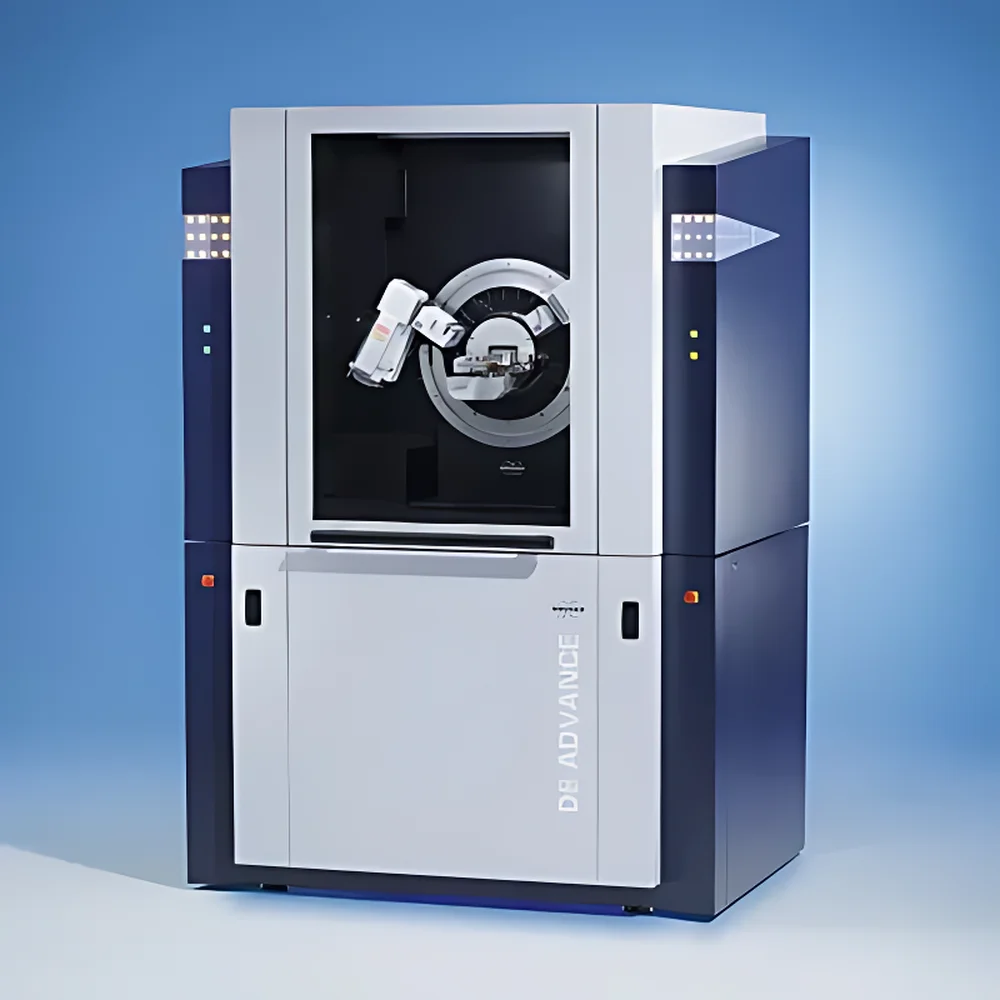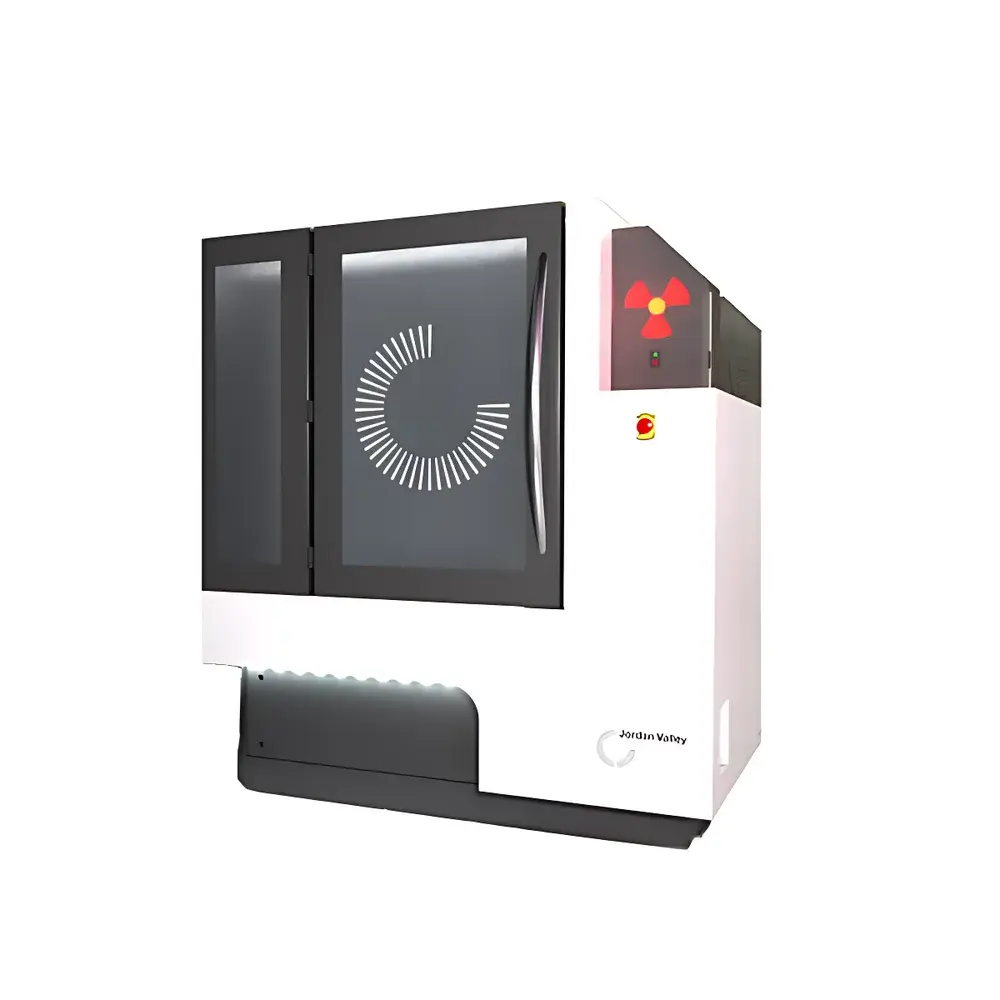
Bruker JV-DX X-ray Diffractometer (XRD)

| Brand | Bruker |
|---|---|
| Origin | USA |
| Manufacturer Type | Authorized Distributor |
| Origin Category | Imported |
| Model | JV-DX |
| Instrument Type | High-Resolution X-ray Diffractometer |
| Power Supply Requirement | 0.0001 kW (standby) |
| Sample Stage | Horizontal 300 mm wafer mount |
| Angular Range | Chi tilt up to 100°, Phi rotation continuous |
| Optical Configuration | Motorized parallel-beam multilayer mirror + auto-switchable high-resolution crystal optics (Ge 004 to Ge 111) |
| Software Platform | JV-RADS v5.x with HRXRD, XRR, and reciprocal space mapping modules |
| Compliance | ASTM E975, ISO 21367, IEC 61000-6-3, GLP/GMP-ready audit trail & user access control |
Ask about pricing, availability and specifications.
Overview
The Bruker JV-DX X-ray Diffractometer is a fully automated, high-resolution X-ray diffraction (HRXRD) and X-ray reflectivity (XRR) platform engineered for advanced thin-film and epitaxial structure characterization in semiconductor R&D, compound semiconductor manufacturing, and advanced materials development. Built upon the legacy of Jordan Valley’s Delta-X architecture and integrated into Bruker’s global instrumentation ecosystem, the JV-DX employs Bragg-Brentano and parallel-beam geometries with motorized source and detector optics to deliver first-principles structural metrology without manual reconfiguration. Its core measurement principles rely on constructive interference of monochromatic X-rays scattered from crystalline lattices (for HRXRD) and interference fringes from density discontinuities at film interfaces (for XRR), enabling quantitative determination of lattice parameters, strain state, layer thickness, interfacial roughness, composition, relaxation degree, and misorientation—all traceable to SI units via calibrated goniometric axes and certified reference standards.
Key Features
- Fully automated optical switching between XRD, HRXRD, and XRR configurations—no manual mirror or crystal removal required
- Horizontal 300 mm wafer stage with precision Eulerian cradle (Chi ±100°, Phi 360° continuous) for pole figure acquisition and residual stress analysis
- High-stability parallel-beam multilayer mirror standard; optional auto-inserted high-resolution Ge crystals (004 to 111) covering resolution ranges from 8″ to >40″
- Sub-arcsecond angular reproducibility enabled by high-resolution encoder-based goniometer and active thermal stabilization
- Integrated sample auto-alignment routine using edge detection and topography mapping prior to each measurement sequence
- Real-time beam intensity monitoring and automatic exposure time optimization based on signal-to-noise ratio thresholds
- Modular hardware architecture compliant with Bruker’s universal instrument control framework (UICF), supporting remote diagnostics and firmware updates
Sample Compatibility & Compliance
The JV-DX accommodates rigid flat substrates up to 300 mm in diameter—including Si, GaAs, InP, sapphire, SiC, and flexible polymer films mounted on carriers—with minimal sample preparation. It supports both single-crystal and polycrystalline specimens, amorphous layers, and multilayer stacks containing metals, oxides, nitrides, chalcogenides, and organic semiconductors. All measurements adhere to ASTM E975 (standard practice for X-ray diffraction measurements on semiconductor wafers), ISO 21367 (X-ray reflectometry for thin-film thickness and density), and IEC 61000-6-3 (EMC emission compliance). The system includes configurable electronic logs, role-based user authentication, and 21 CFR Part 11–compliant audit trails for regulated environments operating under GLP or GMP protocols.
Software & Data Management
Control and analysis are unified within the JV-RADS software suite—a mature platform developed over three decades and continuously refined through integration with Bede Scientific’s legacy algorithms. JV-RADS provides native support for reciprocal space mapping (RSM), triple-axis and double-axis scan simulation, kinematic and dynamic diffraction modeling, and full-profile fitting of XRR reflectivity curves using Parratt formalism. Data export conforms to NeXus/HDF5 standards, and raw scans are stored with embedded metadata (instrument configuration, calibration history, environmental conditions). Batch processing workflows can be scripted in Python via Bruker’s open API, enabling integration into automated fabrication lines and LIMS systems. All reports include uncertainty propagation per GUM guidelines and traceability to NIST-traceable calibration artifacts.
Applications
- Quantitative strain mapping in strained-silicon, SiGe, and III-V heterostructures
- Determination of compositional grading and relaxation in AlGaN/GaN HEMT buffers
- Thickness, density, and interfacial roughness profiling of ALD-grown HfO₂, TiN, and TaN gate stacks
- Pole figure analysis for texture evaluation in textured metal foils and piezoelectric thin films
- Epitaxial quality assessment of perovskite oxides (e.g., STO, LNO) and 2D materials (MoS₂, h-BN)
- In-line process monitoring via rapid RSM acquisition (<5 min per map) with PeakSplit™ real-time peak deconvolution
- Failure analysis of delamination and interdiffusion in Cu/low-k interconnect stacks
FAQ
What X-ray source options are compatible with the JV-DX?
The system is configured for sealed-tube Cu Kα (λ = 1.5418 Å) sources with optional upgrade paths to Co or Mo anodes; all source optics are pre-aligned and field-serviceable.
Can the JV-DX perform grazing-incidence XRD (GIXRD)?
Yes—via programmable incident angle control down to 0.1°, enabled by synchronized motion of the source arm and detector arm in fixed χ mode.
Is remote operation supported?
Full remote access is available via TLS-secured VNC and Bruker’s WebConnect portal, including live goniometer status, queue management, and real-time data preview.
How is calibration maintained across extended operation?
The system performs daily self-calibration using internal Si (111) reference peaks and thermal drift compensation via embedded Pt100 sensors at critical mechanical junctions.
Does JV-RADS support third-party data import (e.g., from TOPAS or DIFFRAC.SUITE)?
Yes—CSV, XYE, and CIF formats are natively readable; diffraction pattern overlays and cross-software Rietveld refinement comparisons are supported.