
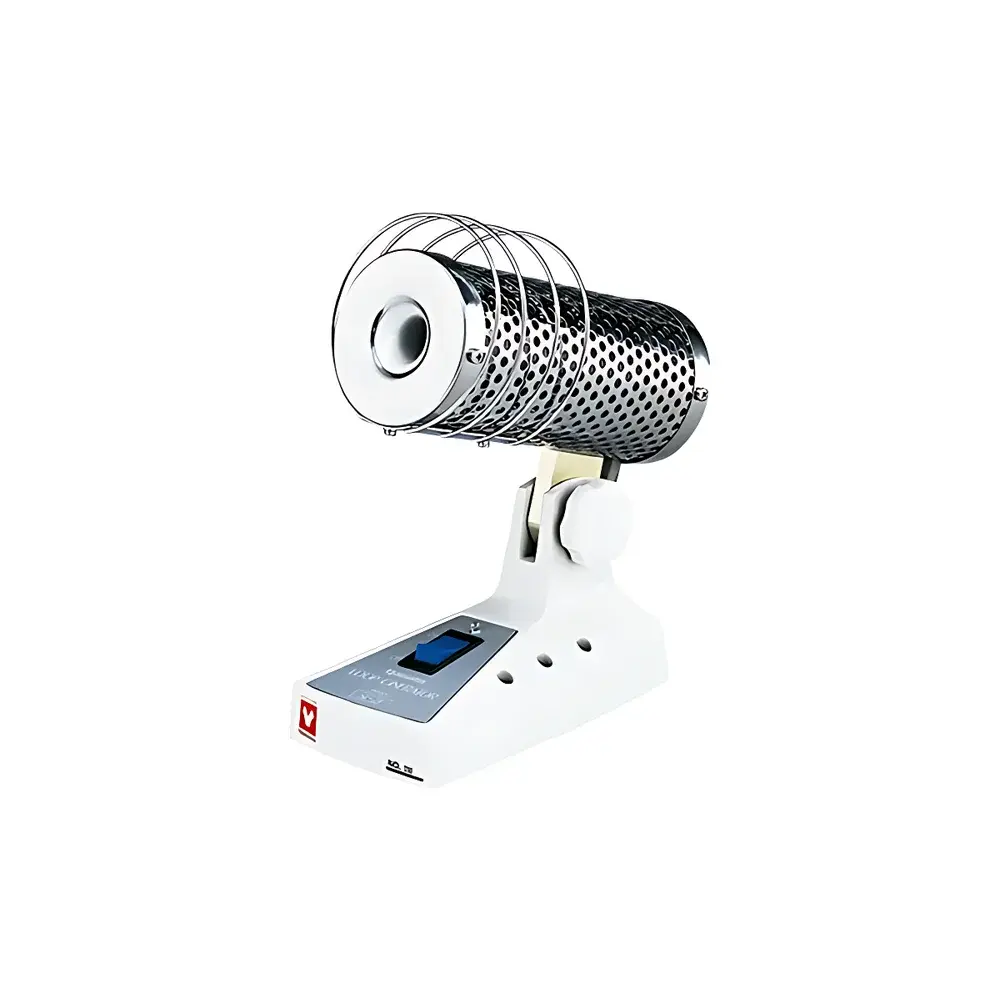
YAMATO SL-21 Platinum Loop and Needle Sterilizer
| Brand | YAMATO |
|---|---|
| Model | SL-21 |
| Type | Dry Heat Sterilizer for Microbiological Loops & Needles |
| Origin | Japan |
| Heating Element | Quartz Glass Tube Heater |
| Operating Temperature Range | 800–850 °C |
| Temperature Stability | ±5 °C (typical at setpoint) |
| Heating Power | 130 W |
| Internal Chamber Dimensions (W×D×H) | 95 × 170 × 200 mm |
| Weight | 1.8 kg |
| Safety Certification | CE-marked, compliant with IEC 61010-1 for laboratory electrical equipment |
Overview
The YAMATO SL-21 Platinum Loop and Needle Sterilizer is a compact, benchtop dry heat sterilization device engineered specifically for rapid, flame-free thermal decontamination of microbiological inoculation loops, needles, and other small platinum or stainless-steel instruments. Unlike open-flame or gas-based sterilizers, the SL-21 employs resistive heating within a high-purity quartz glass tube to achieve and maintain a stable operational temperature range of 800–850 °C—sufficient to incinerate all viable microorganisms, spores, and residual organic material in under 5 seconds. Its design adheres to fundamental principles of dry heat sterilization as defined in ISO 14937 and referenced in USP for non-steam sterilization methods. The unit operates without combustible gases, volatile solvents, or pressurized systems, making it inherently suitable for use inside laminar flow hoods, biosafety cabinets (Class II A2/B2), and confined laboratory workspaces where ignition hazards or exhaust ventilation are constrained.
Key Features
- Quartz glass heating chamber: Offers exceptional thermal stability, uniform radial heat distribution, and resistance to thermal shock—critical for consistent loop sterilization across repeated cycles.
- Adjustable sterilization port angle: The front-facing heating aperture rotates ±30° vertically, enabling ergonomic alignment for both seated and standing operators without repositioning the unit.
- Low-power, high-efficiency operation: Rated at only 130 W, the SL-21 consumes approximately one-sixth the energy of conventional Bunsen-burner-based sterilization—reducing ambient heat load and minimizing risk of cabinet airflow disruption.
- Cool-down support stand: Integrated aluminum alloy bracket provides a thermally isolated resting position for hot loops post-sterilization, preventing accidental contact and facilitating high-throughput workflows during serial plating or streaking procedures.
- Compact footprint and lightweight construction: With external dimensions of 130 × 190 × 280 mm and mass of 1.8 kg, the SL-21 integrates seamlessly into crowded biosafety cabinets or shared benchtop environments without compromising workspace efficiency.
Sample Compatibility & Compliance
The SL-21 is validated for use with standard 1–10 mm diameter platinum or nickel-chromium wire loops and straight/angled needles up to 150 mm in length. It is not intended for sterilizing glassware, plastic consumables, or liquid-filled items. The device conforms to IEC 61010-1:2010 (Safety Requirements for Electrical Equipment for Measurement, Control, and Laboratory Use) and carries CE marking for EMC and Low Voltage Directive compliance. While not a Class I medical device, its operational parameters align with GLP-relevant practices for aseptic technique validation—particularly when incorporated into SOPs for microbial culture handling per ISO 13485–aligned quality systems. No regulatory submission (e.g., FDA 510(k)) applies, as it functions solely as an auxiliary tool for manual instrument decontamination.
Software & Data Management
The YAMATO SL-21 is a standalone, analog-controlled instrument with no embedded firmware, digital interface, or data logging capability. Temperature regulation is achieved via a calibrated bimetallic thermostat; no software calibration, audit trail, or electronic recordkeeping is provided. As such, it does not comply with FDA 21 CFR Part 11 requirements for electronic records and signatures. Users requiring traceable sterilization events should implement manual logbook entries—including operator ID, time/date stamp, and cycle count—consistent with internal GLP documentation protocols.
Applications
- Routine sterilization of inoculation loops and needles in clinical microbiology, pharmaceutical QC labs, and academic research settings performing bacterial isolation, colony purification, or antibiotic susceptibility testing.
- Aseptic transfer operations in BSL-2 laboratories where open flames are prohibited due to volatile solvent use or oxygen-enriched environments.
- Teaching laboratories emphasizing reproducible, low-risk sterilization techniques for undergraduate microbiology instruction.
- Facility-constrained environments—including mobile labs, cleanrooms with strict HVAC protocols, and ISO Class 5 laminar flow hoods—where minimal heat dissipation and zero exhaust demand are mandatory.
FAQ
What types of loops and needles can be sterilized in the SL-21?
Platinum, nichrome, or stainless-steel loops and needles with maximum diameters of 1.2 mm and lengths up to 150 mm. Avoid titanium or coated wires unless verified for 850 °C thermal stability.
Is the SL-21 suitable for use inside a biosafety cabinet?
Yes—the unit generates negligible convective air disturbance and requires no external venting, making it compatible with Class II A2 and B2 cabinets per NSF/ANSI 49 guidelines.
How long does it take to reach operating temperature?
Approximately 15–20 minutes from ambient to 800 °C; stabilization at setpoint is confirmed visually by uniform orange-red glow of the quartz tube interior.
Does the SL-21 require periodic calibration?
No formal calibration is specified by YAMATO; however, users may verify temperature performance using a calibrated infrared pyrometer focused on the inner quartz surface—recommended annually or after physical impact.
Can the SL-21 be used for sterilizing glass spreaders or forceps?
No—its chamber geometry and thermal profile are optimized exclusively for thin-wire instruments. Bulkier tools exceed thermal mass limits and risk incomplete sterilization or quartz tube fracture.



