
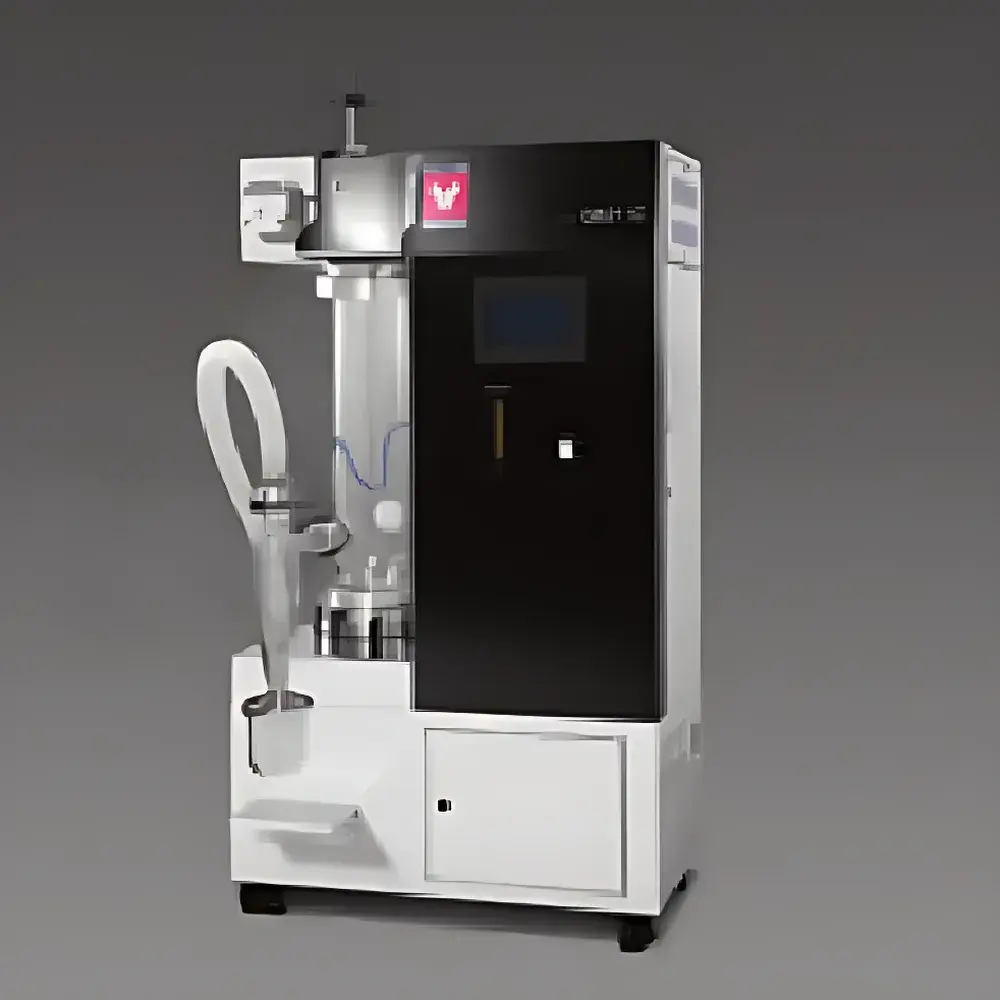
Yamato GB211C-A Benchtop Spray Dryer
| Brand | Yamato |
|---|---|
| Origin | Japan |
| Model | GB211C-A |
| Sample Types | Aqueous & Organic Solvent Solutions/Suspensions |
| Max. Feed Rate | 1500 mL/h |
| Inlet Temperature Range | 40–240 °C |
| Outlet Temperature Range | 0–100 °C |
| Air Flow Rate | 0–1.0 m³/min |
| Atomizing Air Flow | 0–30 L/min |
| Heating Power | 3.2 kW |
| Control Interface | 7-inch Touchscreen (English/Chinese/Japanese) |
| Data Logging | Optional |
| Remote Operation | Supported |
| Safety Features | Overheat Protection (Inlet/Outlet), Pump Reverse Detection, Leakage Current Protection, Nozzle Connection Monitoring |
| Dimensions (W×D×H) | 760 × 420 × 1350 mm |
| Weight | 110 kg |
| Power Supply | AC 200–230 V, 50 Hz, 16–18 A |
Overview
The Yamato GB211C-A is a high-precision benchtop spray dryer engineered for reproducible, contamination-free powder production from liquid feedstocks in research and development laboratories. It operates on the principle of rapid solvent evaporation via atomization—where feed solution or suspension is dispersed into fine droplets using either a two-fluid or three-fluid nozzle, then exposed to a controlled stream of heated drying air. This enables instantaneous drying with minimal thermal degradation, preserving thermolabile compounds such as proteins, enzymes, pharmaceutical actives, and functional food ingredients. Designed for flexibility across aqueous and organic solvent systems (when coupled with the optional GAS411C solvent recovery unit), the GB211C-A supports GMP-aligned process development, formulation screening, and pilot-scale feasibility studies without requiring downstream filtration, centrifugation, or milling steps.
Key Features
- Intelligent multi-zone temperature control with PID-regulated inlet and outlet temperature management (±1 °C accuracy at inlet), ensuring stable thermal profiles throughout drying cycles.
- Dual-atomization compatibility: interchangeable two-fluid and three-fluid nozzles support broad viscosity and surface tension ranges—ideal for emulsions, colloidal suspensions, and polymer solutions.
- Integrated peristaltic feed pump with adjustable flow rate (0–1500 mL/h), paired with nozzle cooling and pulse-jet cleaning mechanisms to prevent clogging during extended operation.
- Motorized height-adjustable platform facilitates seamless integration of auxiliary modules—including the GF200 fluidized-bed granulation kit (optional) and GAS411C solvent recovery system.
- 7-inch full-color touchscreen HMI with tri-language interface (English, Japanese, Chinese), real-time trend visualization, and configurable alarm thresholds for critical parameters (temperature, airflow, pump status).
- Dedicated 2 A AC outlet for inline magnetic stirrers ensures homogeneous suspension feeding; built-in electrostatic discharge grounding minimizes particle agglomeration.
- Robust stainless-steel construction with dual-stage filtration (intake and exhaust), HEPA-grade exhaust filter option available for particulate containment in biosafety-sensitive applications.
Sample Compatibility & Compliance
The GB211C-A accommodates a wide spectrum of feed materials: water-based solutions (e.g., whey protein, sodium alginate), ethanol- or acetone-soluble APIs, polymeric nanoparticles, ceramic precursors, and industrial surfactants. When configured with the GAS411C solvent recovery unit, it complies with OSHA and ATEX guidelines for handling flammable organics under inert conditions. All electrical components meet IEC 61010-1 safety standards; temperature sensors conform to PT100 Class B tolerance (IEC 60751). The system supports audit-ready operation when equipped with optional data logging—capturing timestamped inlet/outlet temperatures, airflow, feed rate, and alarm events in CSV format for GLP/GMP documentation. While not inherently 21 CFR Part 11 compliant, its digital output signals (4–20 mA) enable integration with validated SCADA or LIMS platforms meeting regulatory data integrity requirements.
Software & Data Management
Data acquisition is supported via analog outputs (inlet/outlet temperature, airflow) compatible with third-party DAQ systems. Optional firmware upgrade enables internal storage of up to 100 drying protocols and 30 days of continuous parameter logging (sampled at 1 Hz). Exported datasets include metadata (date/time, operator ID, batch tag) and are structured for direct import into statistical analysis tools (e.g., JMP, MATLAB) or electronic lab notebooks (ELNs). Remote monitoring and control are implemented over Ethernet using Modbus TCP protocol—allowing centralized supervision across multi-instrument lab environments. Audit trail functionality (user login, parameter changes, start/stop events) is available upon activation of the advanced software package.
Applications
This instrument serves critical roles in pharmaceutical R&D (e.g., amorphous solid dispersion preparation, microencapsulation of peptides), nutraceutical development (enzyme stabilization, probiotic powder formulation), advanced material synthesis (Li-ion cathode precursors, metal-organic frameworks), and food science (instant coffee, dairy powders, flavor microcapsules). Its ability to produce low-moisture (<3% w/w), non-oxidized, and sterile-filterable powders makes it suitable for preclinical inhalation studies, lyophilization feedstock conditioning, and quality-by-design (QbD) process mapping. Researchers routinely use it to investigate particle morphology–process parameter relationships via SEM/XRD correlation studies.
FAQ
Can the GB211C-A handle heat-sensitive biological samples?
Yes—the short residence time (<2 seconds) and precise inlet temperature control minimize thermal stress, enabling successful drying of monoclonal antibodies, vaccines, and live bacterial cultures when optimized with cryoprotectants.
Is organic solvent processing safe without additional equipment?
No—organic solvents require the GAS411C solvent recovery unit to ensure explosion-proof operation, vapor condensation, and atmospheric emission compliance.
What particle size distribution can be expected?
Typical median diameters range from 1–20 µm depending on feed concentration, nozzle type, and drying air velocity; narrow distributions are achievable via nozzle selection and feed rate optimization.
Does the system support IQ/OQ validation documentation?
Yamato provides factory calibration certificates and mechanical verification reports; full qualification support (including URS, DQ/IQ/OQ templates) is available through authorized service partners.
Can the GB211C-A be integrated into automated lab workflows?
Yes—it features digital I/O ports and Modbus TCP connectivity for synchronization with robotic liquid handlers, environmental chambers, or automated sampling stations.



