
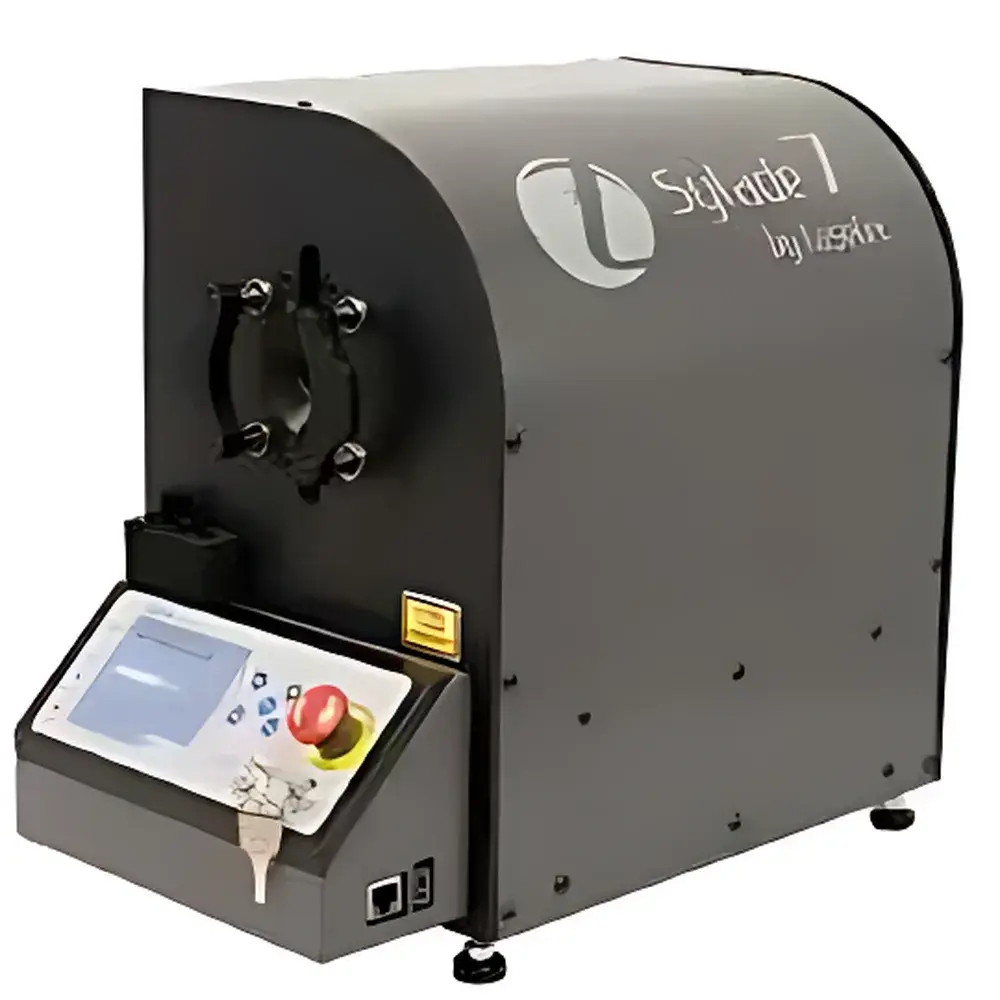
Laselec SYLADE 7 Ultra-Compact Laser Wire Stripping System
| Brand | Laselec |
|---|---|
| Origin | France |
| Model | SYLADE 7 |
| Laser Class | Class 1 (open-floor industrial environment) |
| Power Supply | 90–230 VAC, 50–60 Hz |
| Power Consumption | < 200 W |
| Noise Level | < 65 dB(A) |
| Dimensions (L×D×H) | 407 × 204 × 321 mm |
| Weight | 16 kg (35 lbs) |
| Wire Diameter Range | 0.5–7.0 mm (AWG 6–26) |
| Standard Annular Strip Length | 2–72 mm |
| Extended Strip Length (optional) | up to 200 mm |
| Compatible Insulation Materials | Polyimide (Kapton®), Polytetrafluoroethylene (PTFE/Teflon®), Perfluoroalkoxy (PFA), Nylon (Polyamide) |
| Control Interface | 3.5-inch embedded touchscreen |
| Integrated Fume Extraction | Front-mounted HEPA + activated carbon filter assembly |
| Compliance | CE, FDA 21 CFR Part 11 (audit trail enabled), FCC Part 15 |
Overview
The Laselec SYLADE 7 is an ultra-compact, Class 1 laser wire stripping system engineered for precision, repeatability, and operational safety in regulated electronics manufacturing, aerospace harness assembly, and medical device cable preparation environments. Unlike mechanical or thermal stripping methods, the SYLADE 7 employs a focused, pulsed near-infrared laser beam operating at a wavelength optimized for selective ablation of polymer insulation layers—without thermal conduction into underlying conductors or braided shields. This non-contact, photochemical removal mechanism ensures zero mechanical stress on copper, aluminum, or tinned conductors—even at sub-100 µm strand diameters—and preserves the structural integrity of delicate shielding architectures such as aluminum-polyester tapes or fine-wire braids. Designed for integration into cleanroom-adjacent workcells or QC laboratories, the SYLADE 7 delivers deterministic stripping outcomes across heterogeneous cable constructions—including single-core, multi-core, shielded twisted pairs, and coaxial assemblies—without tool changeover or manual repositioning.
Key Features
- Class 1 laser architecture: Fully enclosed beam path with interlocked access points; no external laser safety enclosures or operator training certifications required under IEC 60825-1:2014.
- Sub-millimeter positional accuracy: Motorized XYZ stage with optical encoder feedback enables ±0.05 mm repeatability in strip start/end point placement.
- Material-specific pulse parameter library: Pre-validated ablation profiles for PTFE, Kapton®, PFA, and nylon—each calibrated for minimal carbon residue and absence of micro-cracking at insulation–conductor interfaces.
- Integrated fume management: Dual-stage filtration (mechanical pre-filter + HEPA/activated carbon cartridge) meets ISO 14644-1 Class 8 cleanroom particulate limits during continuous operation.
- Footswitch-compatible operation: Optional hands-free triggering supports ergonomic workflow integration in high-volume production lines.
- Embedded control firmware: Real-time monitoring of laser diode temperature, pulse energy stability, and stage positioning error—logged with timestamp and user ID for GLP/GMP traceability.
Sample Compatibility & Compliance
The SYLADE 7 accommodates wire gauges from AWG 6 (7.0 mm OD) down to AWG 26 (0.5 mm OD), including stranded, solid-core, and foil-shielded configurations. Its annular cutting geometry maintains concentricity within ±0.1° across full 360° circumferential ablation—critical for maintaining EMI shielding continuity post-stripping. All process parameters are configurable per job lot and stored with digital signatures, satisfying FDA 21 CFR Part 11 requirements for electronic records and signatures. The system bears CE marking per Machinery Directive 2006/42/EC and Electromagnetic Compatibility Directive 2014/30/EU, and complies with RoHS 2011/65/EU material restrictions. Validation documentation includes IQ/OQ protocols aligned with ASTM F2657-22 (Standard Guide for Validation of Laser-Based Processes in Medical Device Manufacturing).
Software & Data Management
The SYLADE 7 runs Laselec’s proprietary STRIPWARE v4.2 firmware, accessible via its 3.5-inch resistive touchscreen interface. Each stripping program stores up to 128 parameter sets—including pulse width (5–20 ns), repetition rate (1–50 kHz), focal offset, and rotational dwell time—with version-controlled revision history. Audit trails capture all parameter modifications, user logins, and execution timestamps, exportable as CSV or PDF for internal quality audits. Optional Ethernet connectivity enables remote diagnostics, firmware updates, and integration with MES platforms via OPC UA (IEC 62541) protocol—supporting automated lot traceability and SPC charting of strip length variance over time.
Applications
- Aerospace wiring harnesses: Stripping fluoropolymer-insulated MIL-DTL-27500 cables without compromising braid geometry or inducing whisker formation.
- Implantable medical leads: Precision removal of polyimide insulation from platinum-iridium coil conductors prior to solder termination—validated per ISO 10993-1 biocompatibility testing protocols.
- Quantum computing cryogenic cabling: Non-thermal ablation of PFA jackets on superconducting NbTi wires to prevent cold weld contamination.
- Automotive ADAS sensor harnesses: High-throughput stripping of shielded LVDS cables with dual-layer insulation (nylon over PTFE) while preserving drain wire continuity.
- Research-grade micro-coax: Sub-0.8 mm diameter RF cables requiring <±0.1 mm length tolerance and zero conductor nicking.
FAQ
Does the SYLADE 7 require laser safety officer (LSO) oversight or facility certification?
No. As a fully interlocked Class 1 system per IEC 60825-1, it poses no accessible radiation hazard during normal operation and requires no LSO designation or controlled area designation.
Can the system handle wires with metallic braids or foil shields?
Yes. The laser’s pulse energy and dwell time are tuned to volatilize polymer layers while reflecting off conductive substrates—preventing localized heating, melting, or oxidation of braids or aluminum foils.
Is validation support provided for regulated industries?
Yes. Laselec supplies IQ/OQ documentation templates, calibration certificates traceable to NIST standards, and on-site installation qualification services compliant with ISO 13485 and AS9100D requirements.
What maintenance intervals are recommended?
Filter replacement every 250 operating hours; laser diode lifetime rated at ≥20,000 hours; annual optical alignment verification recommended using supplied collimation test kit.
How is process consistency verified between shifts or operators?
Each program execution generates a digital signature-secured log file containing raw sensor data, parameter settings, and environmental conditions—enabling cross-shift statistical analysis via built-in SPC tools or third-party Minitab integration.





