
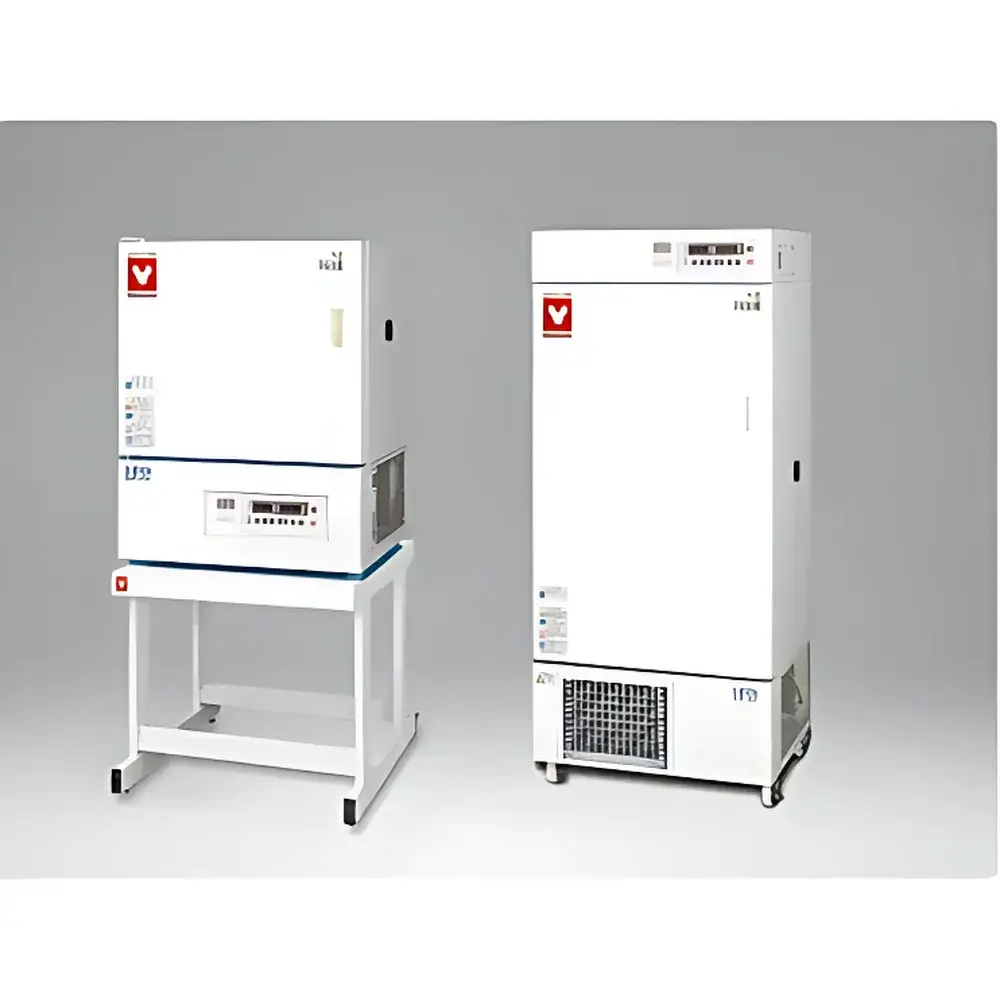
YAMATO IN612C Low-Temperature Incubator
| Brand | YAMATO |
|---|---|
| Origin | Japan |
| Model | IN612C |
| Temperature Range | –10 to 50 °C |
| Temperature Uniformity | ±1.0 °C |
| Humidity Control | Not Available |
| Chamber Capacity | 143 L |
| Power Supply | Standard Single-Phase AC (specification compliant with JIS C 61000-3-2/3) |
| Safety Compliance | JIS B 7958-1, PSE Mark Certified |
| Cooling System | Hermetic Compressor with R134a Refrigerant |
| Heating System | PID-Controlled Resistive Heaters |
| Air Circulation | Forced-Air Convection via Adjustable Axial Fan |
Overview
The YAMATO IN612C Low-Temperature Incubator is an engineered environmental control system designed for precise, stable thermal management across life science research, pharmaceutical stability testing, and industrial microbiology applications. Unlike standard ambient-temperature incubators, the IN612C integrates a dual-mode thermal architecture—combining high-efficiency refrigeration and proportional-integral-derivative (PID)-regulated resistive heating—to maintain setpoints from –10 °C to +50 °C with ≤±1.0 °C uniformity throughout its 143 L stainless-steel chamber. Its forced-air convection system employs an adjustable axial fan to ensure laminar airflow distribution, minimizing thermal gradients and eliminating cold/hot spots critical for cell culture viability, enzyme kinetics studies, and low-temperature fermentation protocols. The unit complies with JIS B 7958-1 (incubator performance standards) and carries Japan’s mandatory PSE safety certification, confirming electromagnetic compatibility (EMC) and electrical safety per JIS C 61000-3-2/3.
Key Features
- Wide operational temperature range (–10 to 50 °C) enabled by hermetically sealed R134a refrigeration circuit and redundant PID-controlled heating elements
- Forced-air convection with variable-speed axial fan ensures consistent thermal homogeneity (±1.0 °C) across full chamber volume
- Dual-glass external door with optional triple-glazed inner door (IN612CW variant) reduces heat transfer coefficient by >40% versus single-pane designs
- Manual and programmable defrost modes prevent ice accumulation on evaporator coils without interrupting temperature stability
- Power-fail recovery function automatically resumes pre-interruption setpoint operation upon grid restoration—no manual reconfiguration required
- Multi-layer safety architecture includes compressor overload relay, independent over-temperature cut-off (separate from main controller), earth-leakage circuit breaker, and real-time self-diagnostic monitoring of sensor integrity, heater continuity, SSR functionality, and thermal runaway conditions
Sample Compatibility & Compliance
The IN612C accommodates standard ISO/IEC 60068-2-1 (cold test) and ISO/IEC 60068-2-2 (dry heat test) sample configurations—including Petri dishes, multi-well plates, Erlenmeyer flasks (up to 2 L), and stacked culture racks. Its stainless-steel interior (SUS304), rounded corners, and seamless welds meet ISO 14644-1 Class 8 cleanroom-compatible surface requirements. While humidity control is not integrated (0% RH nominal), the chamber’s low-permeability gasketing and vacuum-formed insulation minimize ambient moisture ingress during sub-zero operation—critical for cryopreservation intermediate storage and lyophilization pre-chilling. Regulatory alignment includes JIS-compliant documentation packages suitable for GLP audit trails; optional calibration certificates traceable to JCSS (Japan Calibration Service System) are available upon request.
Software & Data Management
The IN612C operates via an embedded microcontroller with non-volatile memory storing up to 10 user-defined programs (each with ramp/soak segments). Real-time temperature logging occurs at 1-minute intervals, with data exportable via USB port in CSV format. Although no native Ethernet or cloud interface is included, the unit supports third-party SCADA integration through RS-485 Modbus RTU protocol (optional adapter kit). All operational events—including power failures, alarm triggers, defrost cycles, and parameter modifications—are timestamped and stored in a tamper-resistant event log compliant with ALCOA+ principles for data integrity. Audit trail functionality satisfies basic FDA 21 CFR Part 11 requirements when paired with validated electronic record systems.
Applications
- Low-temperature microbial growth studies (e.g., psychrophilic bacteria isolation at 4–10 °C)
- Pharmaceutical stability testing per ICH Q1A(R3) guidelines under refrigerated conditions
- Enzyme activity assays requiring precise sub-ambient thermal control
- Pre-chilling of reagents, media, and chromatographic columns prior to analytical workflows
- Intermediate storage of frozen cell stocks before liquid nitrogen transfer
- Environmental simulation for material stress testing (e.g., polymer crystallinity assessment)
FAQ
Does the IN612C support humidity control?
No—this model is configured exclusively for temperature-controlled environments. Humidity regulation is unavailable; relative humidity remains ambient-dependent.
Is remote monitoring possible without additional hardware?
Local display and USB data export are standard. Remote access requires optional RS-485-to-Ethernet gateway and compatible SCADA platform.
What is the typical recovery time after door opening at –10 °C?
Within 12 minutes for ≤30-second door exposure (tested per JIS B 7958-1 Annex B using 9-point chamber mapping).
Can the unit be validated for GMP environments?
Yes—IQ/OQ protocols are available from YAMATO-certified service partners; PQ execution requires site-specific load mapping and thermocouple validation per ISO 17025.
Is refrigerant servicing covered under warranty?
Refrigerant recharge is excluded from standard warranty; leak detection and compressor replacement are covered for 24 months from date of commissioning.
Related Products




