
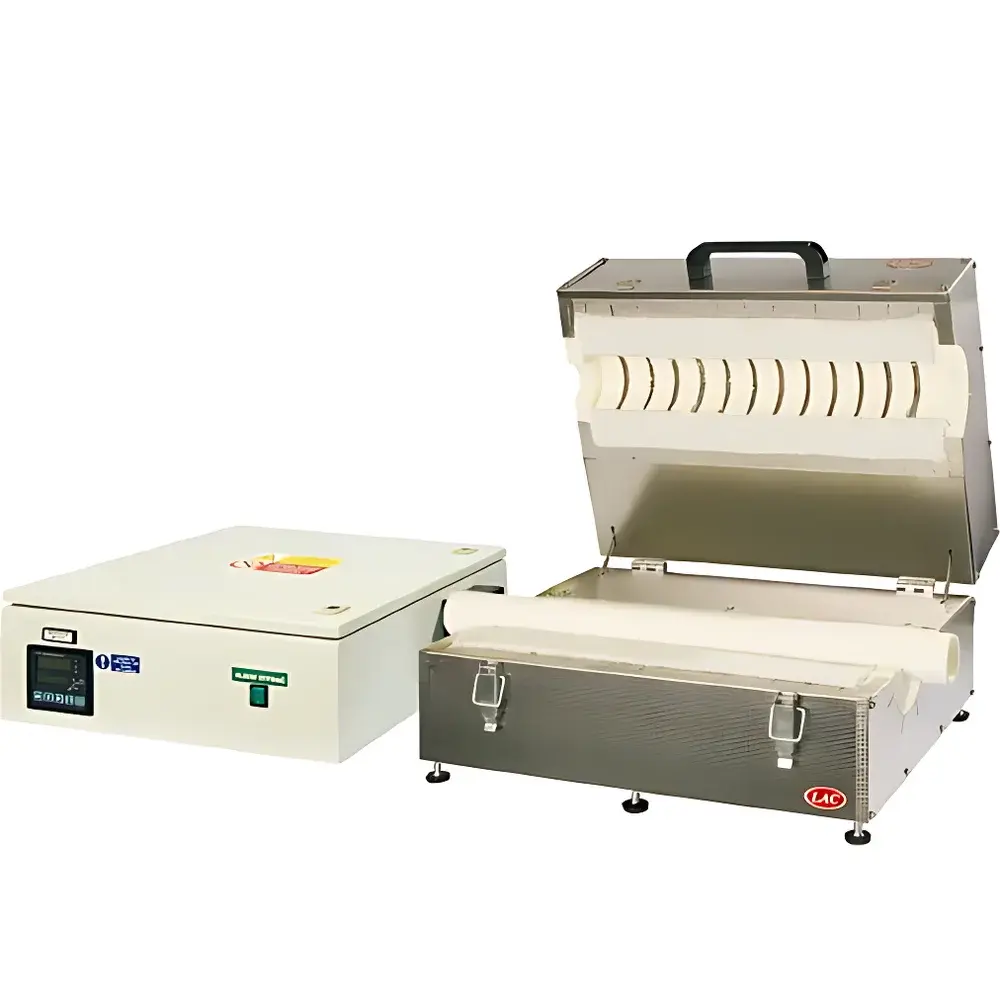
LAC LT Series Laboratory Tube Furnace
| Brand | LAC |
|---|---|
| Origin | Czech Republic |
| Model | LT |
| Instrument Type | Tube Furnace |
| Max Temperature | 1300 °C |
| Temperature Control Accuracy | ±1 °C |
| Power Range | 3.2–11.5 kW |
| Ramp Time to Max Temp | 80 min |
| Heating Method | Resistance Wire Heating |
| Tube Length (Heated Zone) | 300–750 mm |
| Tube ID | 50–100 mm |
| Voltage | 400 V (3-phase) or 230 V (single-phase, model-dependent) |
| Weight | 75–95 kg |
| Compliance | CE-marked, IEC 61000-6-3 (EMC), IEC 61000-6-2 (Immunity), EN 60519-1 (Safety of Industrial Electroheating Equipment) |
Overview
The LAC LT Series Laboratory Tube Furnace is a precision-engineered horizontal tube furnace designed for controlled high-temperature thermal processing in research laboratories and quality control environments. Based on resistive heating principles using high-stability Kanthal A1 or similar alloy resistance wires embedded in refractory grooves, the LT furnace delivers uniform axial temperature distribution across its defined heating zone—critical for reproducible annealing, sintering, calcination, and controlled-atmosphere reactions. Its maximum operating temperature of 1300 °C complies with ASTM E1142 (Standard Terminology Relating to Thermal Processing) and supports applications requiring Class III furnace classification per ISO 8573-1 (compressed air purity) when integrated with gas purging systems. The furnace’s modular architecture—separating the heating chamber from the dedicated control cabinet—ensures electromagnetic compatibility (EMC) and thermal isolation, minimizing interference with adjacent instrumentation.
Key Features
- Robust stainless-steel outer casing with frameless benchtop design—optimized for space-constrained lab environments and safe manual operation.
- High-efficiency insulation system using low-conductivity ceramic fiber modules, reducing standby heat loss and enabling rapid ramp rates (≤80 min to 1300 °C) while maintaining energy efficiency (typical specific energy consumption <1.8 kWh/kg at 1200 °C).
- Dedicated HT40AL digital temperature controller with PID algorithm, type S or K thermocouple input, and programmable multi-step ramp/soak profiles (up to 16 segments).
- Zero-crossing solid-state relay (SSR) power regulation—ensuring silent, jitter-free heating without voltage spikes or EMI emission that could disrupt nearby analytical instruments (e.g., mass spectrometers or microbalances).
- Modular tube configuration: standard alumina ceramic tubes (Al₂O₃, 99.7% purity); optional quartz (SiO₂) or recrystallized alumina tubes available for specific chemical inertness or UV-transmission requirements.
- Independent electrical cabinet housing all control electronics—including safety cutoffs, phase monitoring, and overtemperature protection per EN 60519-1 Annex B.
Sample Compatibility & Compliance
The LT furnace accommodates cylindrical samples and reactors up to 100 mm internal diameter and 1220 mm total length, supporting both static and dynamic configurations (e.g., with optional rotary tube drive, 1–20 rpm). Its sealed tube interface enables integration with inert gas (N₂, Ar) or reactive gas (H₂, CO/CO₂) delivery systems via standardized 6 mm Swagelok® ports. All LT models are CE-certified and conform to EU Machinery Directive 2006/42/EC and Low Voltage Directive 2014/35/EU. For GLP/GMP-regulated workflows, optional audit-trail-enabled controllers (HT40AL-GLP variant) support 21 CFR Part 11-compliant electronic records when paired with validated data acquisition software.
Software & Data Management
While the base HT40AL controller operates standalone, optional RS485 (Modbus RTU) or USB-C interfaces enable bidirectional communication with third-party SCADA or LIMS platforms. LAC provides open protocol documentation for seamless integration into automated test sequences. Graphical temperature recording (via optional chart recorder or PC-based software) logs time-stamped setpoint, actual temperature, and power output—exportable as CSV for traceability. Firmware updates are performed via secure USB key; version history and calibration logs are retained internally for audit readiness.
Applications
- Thermal treatment of catalysts, battery electrode materials, and metal-organic frameworks (MOFs) under controlled atmospheres.
- Pre-sintering and debinding of ceramic green bodies prior to final HIP or pressureless sintering.
- Calibration of thermocouples and reference materials per ISO/IEC 17025 accredited procedures.
- Controlled oxidation/reduction studies in metallurgy and corrosion science.
- Pyrolysis kinetics analysis using thermogravimetric coupling (TGA-furnace synchronization possible via analog trigger signals).
- Material phase transformation studies requiring precise dwell times at intermediate temperatures (e.g., martensitic transitions in shape-memory alloys).
FAQ
What tube materials are compatible with the LT furnace at 1300 °C?
Alumina (Al₂O₃) ceramic tubes rated for continuous use at 1300 °C are standard. Quartz tubes are limited to ≤1100 °C and not recommended for reducing atmospheres. Recrystallized alumina or molybdenum disilicide (MoSi₂)-sheathed tubes are available for specialized high-purity or high-temperature cyclic applications.
Can the LT furnace be operated under vacuum?
Yes—when equipped with vacuum-rated flanges and appropriate sealing (e.g., Viton O-rings for ≤200 °C or metal C-seals for full 1300 °C range), the LT series supports rough vacuum (10⁻² mbar) and can be interfaced with turbomolecular pumps for high-vacuum processes.
Is the HT40AL controller compliant with FDA 21 CFR Part 11?
The base HT40AL is not Part 11 compliant; however, the HT40AL-GLP firmware upgrade adds electronic signature capability, audit trail logging, and role-based access control—validated for use in pharmaceutical and medical device manufacturing environments.
What safety interlocks are built into the LT furnace?
Dual redundant overtemperature cutoffs (mechanical and digital), door-open power kill switch, phase-loss detection, and earth leakage monitoring per EN 61000-6-2 are standard. Optional gas leak detection integration is supported via dry contact inputs.
How is temperature uniformity verified across the heating zone?
LAC provides factory calibration certificates showing axial uniformity (±5 °C over 90% of heated length at 1300 °C), measured per ASTM E220. Users may perform periodic verification using a traversing thermocouple probe or fixed-point cell (e.g., Ag, Cu) per ISO/IEC 17025 guidelines.



