
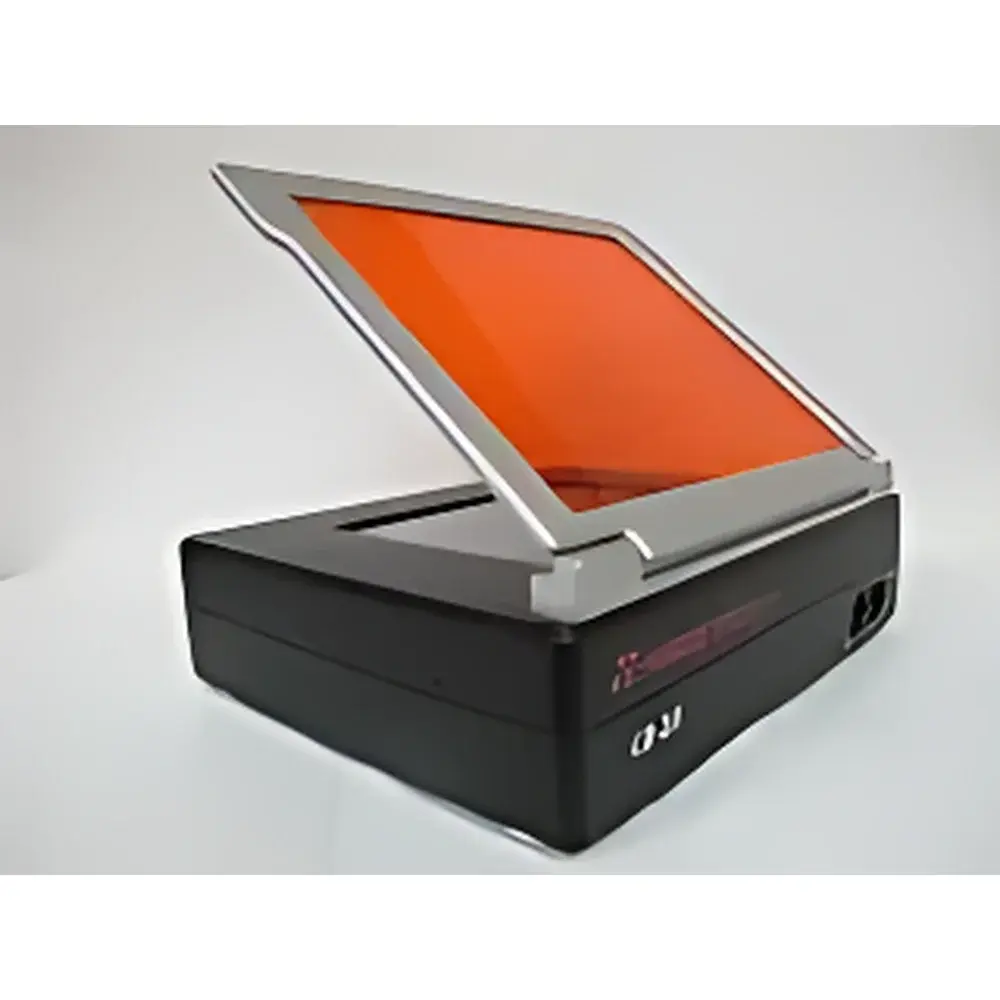
MaestroGen UltraBright LED Blue Light Transilluminator and Gel Cutter
| Brand | MaestroGen |
|---|---|
| Origin | USA |
| Manufacturer Type | Authorized Distributor |
| Origin Category | Imported |
| Model | UltraBright |
| Instrument Type | Portable (Handheld) |
| Wavelength | 470 nm (Single Peak) |
| Power | 30 W |
| Excitation Efficiency | 3× higher intensity vs. conventional blue transilluminators |
| Intensity Adjustment | 50–99.9% continuous dimming |
| Detection Sensitivity | 0.1 ng DNA/RNA/protein |
| CV (Coefficient of Variation) | <5% |
| Viewing Area | 16 × 20 cm |
| LED Lifetime | 50,000 hours |
| Dimensions (D×W×H) | 28 × 34 × 8 cm |
| Weight | 3 kg |
| Filter System | Flip-mounted yellow emission filter with adjustable locking position |
| Compatible Stains | SYBR Safe, SYBR Gold, SYBR Green I & II, SYPRO Ruby, SYPRO Orange, Coomassie Fluor Orange, GelGreen, GelRed, Lumitein Protein Gel Stain |
Overview
The MaestroGen UltraBright LED Blue Light Transilluminator and Gel Cutter is an engineered solution for safe, high-fidelity nucleic acid and protein gel visualization and excision—designed specifically to replace hazardous UV-based systems in routine molecular biology workflows. Operating at a narrow-band 470 nm blue LED excitation peak, the instrument leverages solid-state optoelectronics to efficiently activate commercially available UV-free fluorescent dyes without requiring external excitation filters. This eliminates both ozone generation and direct UV exposure risks while maintaining sub-nanogram detection sensitivity (0.1 ng) across ethidium bromide (EB)-alternative stains including SYBR Safe, GelGreen, GelRed, SYPRO Ruby, and Lumitein. Its compact, portable architecture—measuring only 28 × 34 × 8 cm and weighing 3 kg—supports benchtop, field, or shared-core lab deployment without compromising optical uniformity or signal reproducibility (CV <5%). The system adheres to ALARA (As Low As Reasonably Achievable) safety principles for light exposure and aligns with institutional biosafety policies mandating elimination of Class 1/2 UV-C sources.
Key Features
- High-intensity 470 nm monochromatic LED array delivering 3× greater irradiance than conventional blue transilluminators—enabling rapid, low-background visualization of stained gels
- Continuous dimming control (50–99.9%) for precise excitation optimization across stain types and gel thicknesses, minimizing photobleaching and sample degradation
- Flip-mounted yellow emission filter with mechanical detent locking—allows real-time switching between observation (filter engaged) and cutting (filter disengaged), eliminating manual filter handling during excision
- Uniform illumination over a 16 × 20 cm active viewing area, validated via ISO 15739-compliant flat-field photometry
- 50,000-hour LED lifetime ensures long-term radiometric stability without output drift or lamp replacement cycles
- Low-power 30 W operation reduces thermal load on temperature-sensitive gels and minimizes ambient heat accumulation in laminar flow hoods or cold rooms
Sample Compatibility & Compliance
The UltraBright supports all major non-UV fluorescent nucleic acid and protein stains approved for use in GLP- and GMP-aligned laboratories, including SYBR Green I/II (Life Technologies), SYBR Safe (Thermo Fisher), GelRed/GelGreen (Biotium), SYPRO Orange/Ruby (Invitrogen), Coomassie Fluor Orange (Thermo Fisher), and Lumitein Protein Gel Stain (Biotium). It meets ASTM D7213-18 requirements for optical safety in laboratory transillumination devices and conforms to IEC 62471:2006 (Photobiological Safety of Lamps and Lamp Systems) for Risk Group 1 (Exempt) classification. No UV radiation hazard (UVC/UVB) is emitted; therefore, no interlocked enclosures or personal protective equipment beyond standard lab gloves are required per OSHA 1910.133 guidelines.
Software & Data Management
As a standalone optical instrument, the UltraBright requires no proprietary software or driver installation. Its analog dimming interface enables seamless integration into existing imaging workflows—compatible with all commercial gel documentation systems (e.g., Bio-Rad ChemiDoc, Azure Sapphire, UVP VisionWorks) when used as an excitation source. For audit-trail compliance in regulated environments (FDA 21 CFR Part 11, ISO/IEC 17025), users may log operational parameters—including intensity setting, duration of use, and date/time stamps—via laboratory notebook entries or LIMS-integrated electronic records. Firmware updates are not applicable; hardware calibration is factory-performed and traceable to NIST-traceable spectroradiometric standards.
Applications
- Routine agarose and polyacrylamide gel inspection post-electrophoresis using EB-alternative dyes
- Target band excision under visible-light conditions for downstream cloning, sequencing, or mass spectrometry analysis
- Teaching laboratory implementation where UV safety training and infrastructure are cost-prohibitive
- Field-deployable diagnostics requiring rapid nucleic acid confirmation without electrical grid dependency (when paired with portable power banks)
- Quality control testing of dye-labeled oligonucleotides, PCR products, and recombinant proteins under controlled lighting conditions
FAQ
Does the UltraBright require UV-blocking goggles or shielding?
No. The 470 nm blue LED emits no ultraviolet radiation (200–400 nm); standard lab safety glasses are sufficient per ANSI Z87.1 requirements.
Can it be used with ethidium bromide (EB)?
No. EB has negligible excitation efficiency at 470 nm; the system is optimized exclusively for modern blue-light–excitable dyes listed in the compatibility section.
Is the yellow filter removable for maintenance?
Yes—the filter assembly is tool-free and designed for periodic cleaning with isopropanol and lint-free wipes; no recalibration is needed after reinstallation.
What is the recommended maximum exposure time per gel during excision?
For optimal stain integrity, limit cumulative exposure to ≤5 minutes at full intensity; dimming below 80% extends usable time without significant photodegradation.
How is intensity calibration verified?
Each unit ships with a factory-issued spectral irradiance report (measured at center and four corners of the viewing area), traceable to NIST SRM 2241 and calibrated using an Ocean Insight HDX spectroradiometer.



