
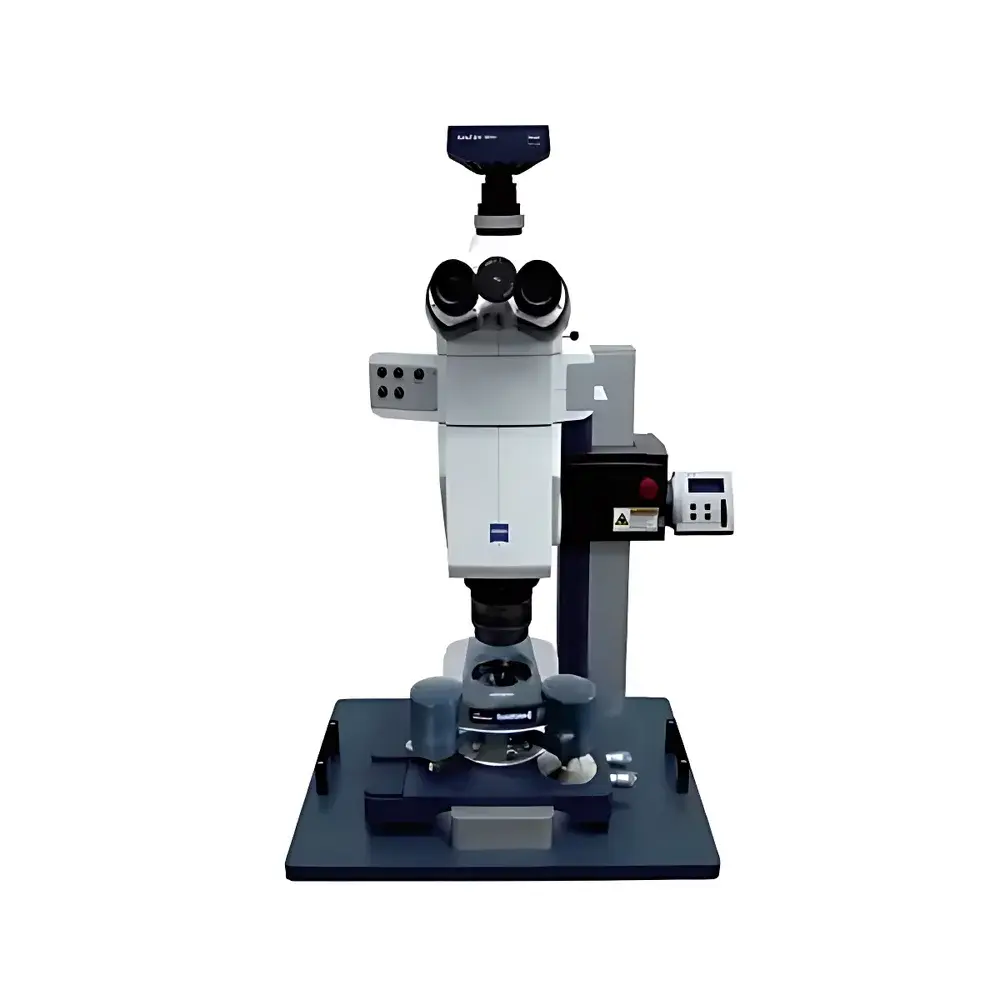
Bruker NanoWizard 4 XP Atomic Force Microscope
| Brand | Bruker |
|---|---|
| Origin | Germany |
| Manufacturer Type | Authorized Distributor |
| Origin Category | Imported |
| Model | NanoWizard 4 XP |
| Instrument Type | Biological AFM (Atomic Force Microscope) |
| Z-Direction Position Detection Noise | RMS < 0.030 nm |
| Sample Dimensions | Diameter < 15 mm, Thickness < 5 mm |
| XY Scanner Range | 20 mm × 20 mm |
| Maximum Z-Range | 16.5 µm |
| Line Scan Rate | Up to 150 Hz |
| Controller | Vortis™ 2 |
| Software Platform | Nanoscope V7 Workflow-Based Control Suite |
| Integration Capability | Fully compatible with super-resolution optical microscopy platforms (e.g., STED, SIM, TIRF) |
Overview
The Bruker NanoWizard 4 XP is a high-performance, biological atomic force microscope engineered for quantitative nanoscale imaging and real-time mechanobiological characterization in physiological environments. Based on the fundamental principles of dynamic and static force sensing via piezoresistive or optical beam deflection detection, the system operates across multiple operational modes—including contact, tapping, PeakForce QNM®, and QI™ (Quantitative Imaging)—to deliver sub-nanometer spatial resolution and piconewton force sensitivity. Its integrated Vortis™ 2 controller enables closed-loop feedback bandwidth exceeding 10 kHz, ensuring stable force regulation even during high-speed scanning (up to 150 Hz line rate) over large-area 100 µm scanners—without compromising positional fidelity or thermal drift stability. Designed specifically for life science applications, the NanoWizard 4 XP maintains compatibility with inverted optical microscopes, enabling true correlative AFM-optical workflows under liquid, ambient, or controlled environmental conditions.
Key Features
- Sub-0.03 nm RMS Z-noise performance for ultra-stable topographic quantification in physiological buffers.
- 150 Hz line-scan capability enables time-resolved imaging of dynamic cellular processes—including membrane remodeling, cytoskeletal reorganization, and ligand-receptor binding events.
- Vortis™ 2 controller architecture supports simultaneous multi-channel data acquisition, real-time force spectroscopy, and synchronized optical trigger integration (e.g., with TIRF or confocal systems).
- Modular design accommodates interchangeable scanner modules (including 100 µm large-range and high-speed 16.5 µm Z-scanners), fluid cells, temperature-controlled stages, and electrochemical accessories.
- Nanoscope V7 software provides workflow-driven experiment setup, automated calibration guidance, and context-aware parameter suggestions—reducing operator dependency while maintaining GLP-compliant audit trails.
- QI™ mode acquires full force-distance curves at every pixel, enabling simultaneous mapping of adhesion, elasticity (Young’s modulus), deformation, and energy dissipation—validated against ISO 11339 and ASTM E2546 standards for nanomechanical testing.
Sample Compatibility & Compliance
The NanoWizard 4 XP accepts standard 15 mm diameter coverslips and custom substrates up to 5 mm thick, supporting live-cell cultures, tissue sections, hydrogels, biomolecular monolayers, and soft polymer films. Its open-access fluid cell design permits long-term (>24 h) imaging in buffered saline, CO₂-equilibrated media, or serum-containing solutions. All hardware and firmware comply with IEC 61000-6-3 (EMC), IEC 61010-1 (safety), and EU RoHS directives. Data integrity features—including electronic signatures, version-controlled method files, and 21 CFR Part 11–compliant audit logging—are embedded in Nanoscope V7 for regulated environments (e.g., preclinical biopharmaceutical characterization per USP ).
Software & Data Management
Nanoscope V7 introduces a task-oriented interface that structures experiments into discrete, validated workflows: “Cell Adhesion Mapping,” “Single-Molecule Unfolding,” “Elasticity Profiling,” and “Correlative AFM-Optical Alignment.” Each workflow enforces parameter constraints based on probe type, sample mechanics, and environmental conditions. Raw force-volume datasets (typically >1 GB/hour at 150 Hz) are processed using Bruker’s proprietary Gwyddion-compatible libraries, supporting batch fitting with Hertz, Sneddon, and DMT models. Export formats include HDF5 (for MATLAB/Python analysis), TIFF (8/16-bit), and CSV (force-curve metadata). All processing steps retain traceable provenance, satisfying ALCOA+ (Attributable, Legible, Contemporaneous, Original, Accurate, Complete, Consistent, Enduring, Available) data governance requirements.
Applications
- Real-time nanomechanics of living cells: stiffness gradients across lamellipodia, nuclear envelope deformation, and drug-induced cytoskeletal stiffening.
- Single-molecule force spectroscopy: unfolding kinetics of titin, fibronectin, or IgG domains under physiological loading rates (100 pN/s to 10 nN/s).
- Surface property mapping of biomaterials: protein adsorption density, hydrogel crosslink heterogeneity, and nanoparticle-cell membrane interaction forces.
- Correlative structural biology: registration of AFM-derived height maps with STORM/TIRF fluorescence localization to resolve nanoscale receptor clustering relative to membrane topography.
- Quality control of therapeutic nanoparticles: batch-to-batch consistency assessment of surface roughness, aggregation state, and mechanical resilience in suspension.
FAQ
Is the NanoWizard 4 XP compliant with FDA 21 CFR Part 11 for use in regulated biomanufacturing environments?
Yes—Nanoscope V7 includes role-based access control, electronic signatures, immutable audit logs, and method validation templates aligned with Part 11 Annex 11 requirements.
Can the system perform force spectroscopy on suspended cells without substrate interference?
Yes—the optional CellHesion module enables cantilever-based cell detachment assays in suspension, with calibrated spring constants traceable to NIST standards.
What is the maximum scan area achievable without stitching in air or liquid?
With the 100 µm scanner, single-frame imaging up to 100 × 100 µm² is supported; larger areas require automated tile-based stitching with sub-pixel registration accuracy.
Does Bruker provide application support for custom probe functionalization protocols?
Yes—Bruker’s Application Scientists offer documented SOPs for NHS-ester, maleimide, and click-chemistry conjugation of antibodies, peptides, and PEG linkers to commercial AFM probes.
How is thermal drift compensated during extended time-lapse experiments?
The system employs active drift compensation via real-time stage position feedback from integrated capacitive sensors, achieving <0.1 nm/min drift over 60-minute acquisitions in temperature-stabilized enclosures.





