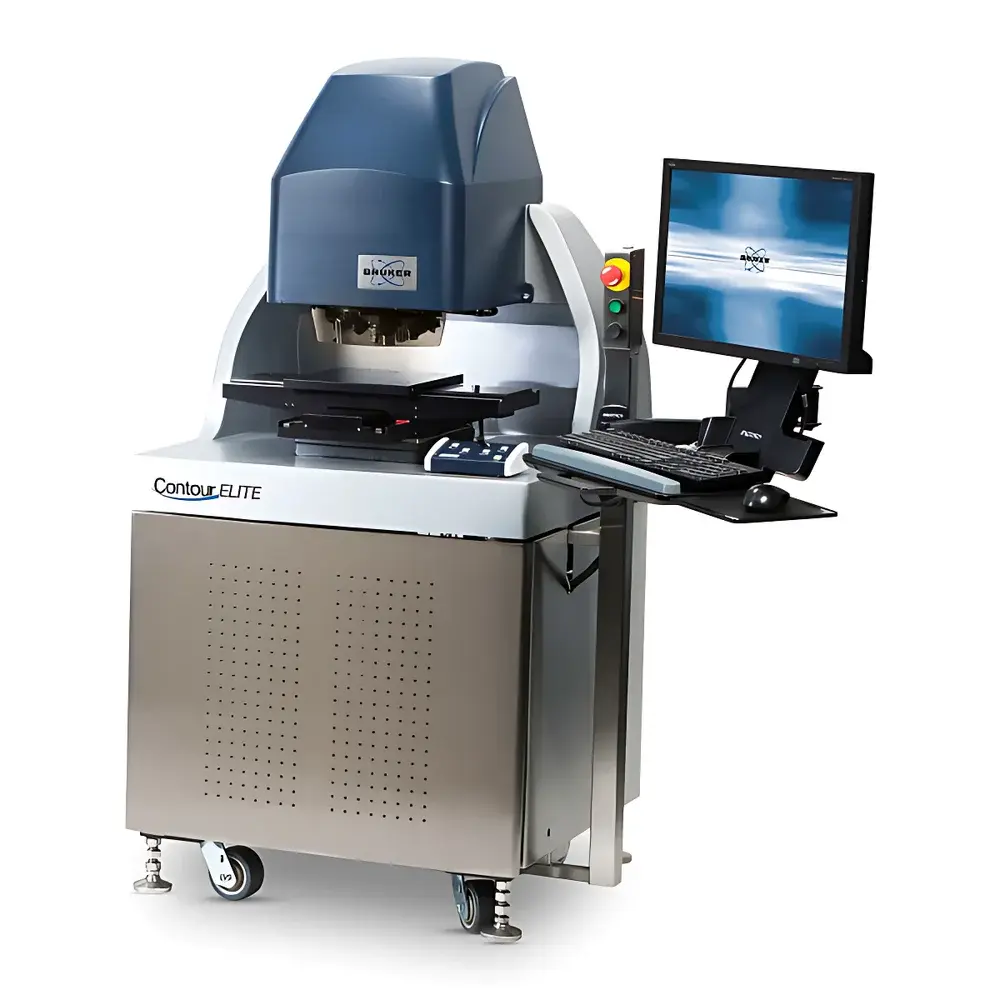
Bruker GT-X 3D Optical Surface Metrology System
| Brand | Bruker |
|---|---|
| Origin | Germany |
| Model | GT-X |
| Product Type | Non-contact Profilometer / Surface Roughness Analyzer |
| Operating Principle | White-light Interferometry |
| Mounting Configuration | Floor-standing, Integrated Granite Vibration-Isolation Base |
| Measurement Mode | Fully Automated, Motorized Scanning Head with Auto-tilt Optimization |
| Illumination Source | Dual High-brightness Long-life LED |
| Calibration Method | Metrology-grade Laser Self-calibration |
| Vertical Resolution | Sub-nanometer (RMS repeatability ≤ 0.004 nm) |
| Software Interface | Modular, Role-based GUI (Engineering Lab Mode / Production Floor Mode) |
| Compliance Framework | Designed for GLP/GMP environments |
Overview
The Bruker GT-X 3D Optical Surface Metrology System is the flagship instrument within Bruker’s Contour series of optical profilometers. Engineered for precision surface topography characterization in R&D, quality assurance, and process control laboratories, the GT-X implements white-light interferometry (WLI) as its core measurement principle. This non-contact technique relies on the interference pattern generated when broadband light reflects from both a reference mirror and the sample surface—enabling high-resolution height mapping without mechanical contact or surface deformation. The system is purpose-built for large-field-of-view metrology with traceable vertical accuracy, delivering calibrated, NIST-traceable surface data across mm- to cm-scale areas. Its floor-standing architecture integrates a monolithic granite base and active vibration isolation, ensuring mechanical stability essential for sub-nanometer repeatability in industrial and metrology-critical applications.
Key Features
- Metrology-grade laser self-calibration system: Performs in-situ vertical scale validation before and during each measurement sequence—eliminating drift-related uncertainty and removing dependency on external calibration standards.
- Dual high-brightness, long-lifetime LED illumination: Optimized spectral output ensures consistent fringe contrast across surfaces with widely varying reflectivity (from 95%), enabling robust data acquisition on metals, ceramics, polymers, and thin-film stacks.
- Fully automated scanning head with motorized tilt optimization: Dynamically compensates for sample tilt and curvature in real time, preserving measurement fidelity on highly sloped or warped specimens without manual intervention.
- Integrated granite vibration-isolation platform: Provides passive damping and thermal mass stability, minimizing environmental perturbations that compromise nanoscale height resolution.
- Sub-nanometer vertical repeatability: Achieves RMS height repeatability of ≤ 0.004 nm under controlled laboratory conditions—validated per ISO 25178-601 and ASTM E2923 protocols.
- Intelligent autofocus and exposure control: Combines high-speed z-scanning with real-time intensity feedback to maintain optimal signal-to-noise ratio across multi-scale topographies.
Sample Compatibility & Compliance
The GT-X accommodates samples up to 300 mm × 300 mm (customizable), with height ranges spanning ±10 mm and lateral fields of view from 0.1 mm² to 100 mm² per scan. It measures surfaces ranging from polished silicon wafers and optical coatings to machined engine components and additive-manufactured metal parts. All hardware and software modules are designed to support compliance with international metrology standards including ISO 25178 (surface texture), ISO 1101 (geometrical product specifications), and ASTM E2923 (non-contact surface profiler performance verification). The system’s firmware and software architecture comply with FDA 21 CFR Part 11 requirements for electronic records and signatures—featuring role-based user permissions, full audit trail logging, and secure data integrity controls suitable for regulated manufacturing environments.
Software & Data Management
Bruker’s proprietary Vision64 software provides a modular, role-adaptive interface: engineers access advanced scripting (via Python API), filter design, and custom parameter mapping, while production operators utilize simplified workflow-driven templates with embedded pass/fail logic. Real-time measurement optimization adjusts acquisition parameters—including integration time, scan speed, and coherence envelope positioning—based on live surface feedback. Data analysis includes ISO-compliant roughness (Sa, Sq, Sz), waviness, form error separation, step height, volume, and bearing ratio calculations. Measurement programs can be saved, version-controlled, and deployed across multiple GT-X systems. Raw interferograms and processed topography maps are stored in vendor-neutral formats (e.g., .tif, .xyz, .opd), with optional integration into LIMS or MES platforms via OPC UA or RESTful APIs.
Applications
- Microelectronics: Quantifying CMP uniformity, trench depth, and lithographic feature height on wafers and reticles.
- Optics & Photonics: Validating surface flatness, scratch/defect detection, and coating thickness uniformity on lenses and mirrors.
- Medical Devices: Measuring surface finish of orthopedic implants, stent strut geometry, and microfluidic channel profiles.
- Automotive & Aerospace: Assessing wear scars, tribological surfaces, turbine blade leading-edge geometry, and additive manufacturing build layer fidelity.
- Academic Research: Supporting nanotribology, biomaterial interface studies, and thin-film growth kinetics through time-series 3D topography tracking.
FAQ
Does the GT-X require periodic recalibration using physical reference standards?
No—the integrated metrology-grade laser self-calibration system validates vertical scale traceability in real time, eliminating routine reliance on certified step-height artifacts.
Can the GT-X measure transparent or semi-transparent films?
Yes, through optimized coherence gating and multi-wavelength analysis modes, it resolves air-film-substrate interfaces with sub-5 nm vertical sensitivity.
Is the system compatible with cleanroom environments?
The GT-X is available with ISO Class 5-compatible enclosures, low-outgassing materials, and ESD-safe construction options upon request.
How does the software handle measurement uncertainty reporting?
Vision64 generates comprehensive uncertainty budgets per ISO/IEC 17025 guidelines, incorporating contributions from environmental stability, calibration traceability, and algorithmic noise models.
What training and documentation support is provided?
Bruker delivers on-site installation qualification (IQ), operational qualification (OQ), and comprehensive metrology training—including traceable SOP development and GxP documentation templates.