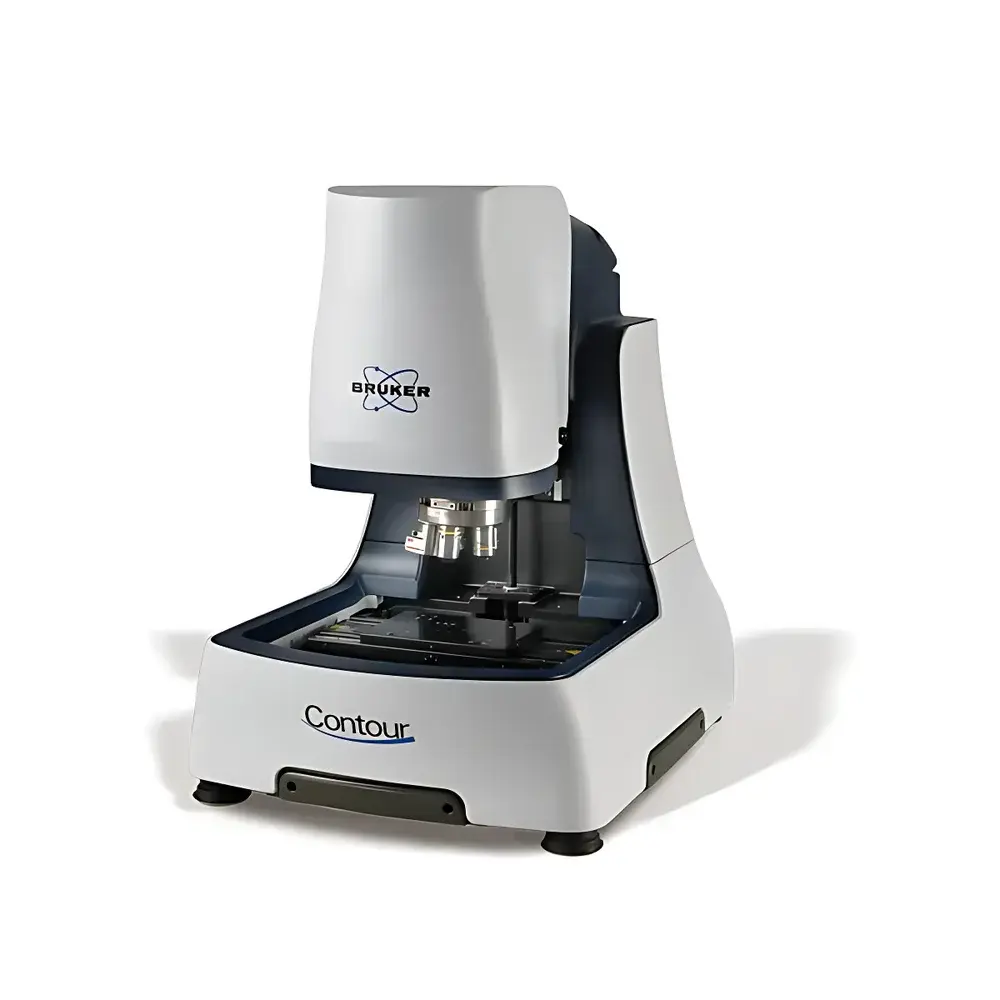
Bruker ContourX-500 3D Optical Profilometer
| Brand | Bruker |
|---|---|
| Origin | Germany |
| Model | ContourX-500 |
| Product Type | Non-contact Profilometer / Surface Roughness Analyzer |
| Operating Principle | White-Light Interferometry |
| Category | Precision Geometric Measurement Instrument |
Overview
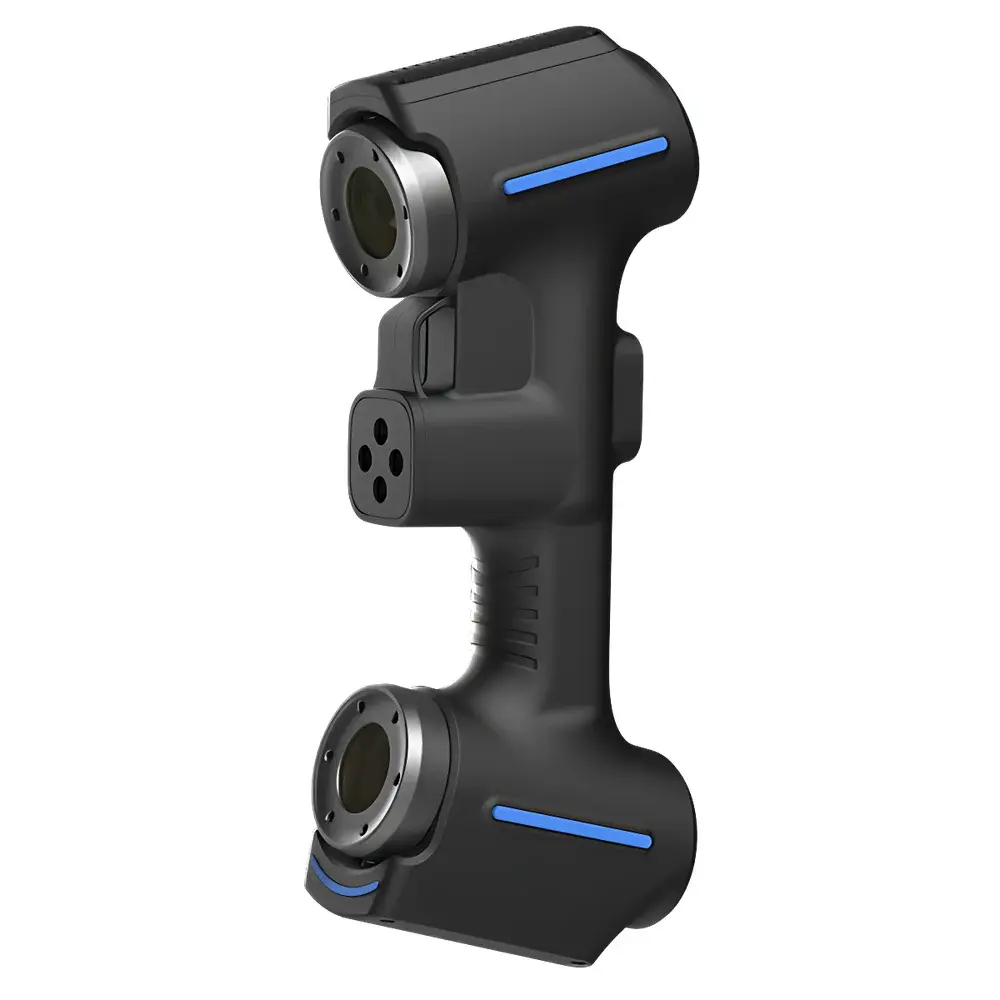
The Bruker ContourX-500 is a high-precision, benchtop 3D optical profilometer engineered for non-contact surface topography and roughness metrology. It employs white-light interferometry (WLI) — a coherence-based optical technique that exploits the interference fringes generated when broadband light reflects from both the sample surface and a reference mirror. By scanning the objective vertically and analyzing the envelope of interference intensity versus position, the system reconstructs nanometer-scale surface height variations with exceptional vertical (Z-axis) resolution and repeatability. Designed for laboratories and production environments requiring traceable, ISO-compliant surface characterization, the ContourX-500 delivers metrological performance comparable to Bruker’s floor-standing WLI platforms — but within a compact, vibration-isolated air-damped base. Its fully programmable, motorized tilt sensor head enables automated angular alignment across user-defined ranges, eliminating manual repositioning and minimizing stylus-like tracking errors common in tilted or structured surfaces.
Key Features
- Proprietary motorized auto-tilt optical sensor head with full programmability and closed-loop angular positioning — enabling accurate measurement of inclined, curved, or micro-structured surfaces without operator intervention.
- Universal Scanning Interferometry (USI) mode: dynamically adapts scan parameters (e.g., step size, integration time, focus search range) to optimize signal-to-noise ratio and lateral resolution across diverse surface types — from polished silicon wafers to textured medical implants.
- Encoder-equipped high-precision XY stage with 100 mm × 100 mm travel range and sub-micron positional repeatability; integrated with a multi-position objective turret supporting magnifications from 2.5× to 100×.
- Real-time auto-brightness adjustment and intelligent focus search algorithms ensure robust acquisition across surfaces with varying reflectivity, step heights, or transparency — including thin-film stacks and coated optics.
- Compact, air-damped mechanical design minimizes environmental vibration coupling, delivering stable Z-resolution down to <0.1 nm RMS (typical) under standard lab conditions.
- Comprehensive hardware synchronization: seamless coordination between tilt head, Z-scanner, stage motion, and illumination ensures phase-consistent data capture for high-fidelity 3D reconstruction.
Sample Compatibility & Compliance
The ContourX-500 accommodates a broad spectrum of sample geometries and materials — including semiconductor wafers (Si, GaN, SiC), MEMS devices, ophthalmic lenses, precision-machined metal components, ceramic substrates, and polymer-based microfluidic chips. Its non-contact nature eliminates risk of surface damage or probe wear, making it suitable for soft, fragile, or coated samples. The system supports compliance with international surface metrology standards including ISO 25178 (areal surface texture), ISO 4287 (profile-based roughness), ASME B46.1, and ISO 1101 (geometrical product specifications). Data audit trails, user access controls, and electronic signature support align with GLP and GMP documentation requirements. Optional 21 CFR Part 11–compliant software modules are available for regulated pharmaceutical and medical device QA/QC environments.
Software & Data Management
Bruker’s Vision64™ software provides an intuitive, workflow-driven interface for method development, measurement automation, and standardized reporting. It includes over 200 built-in analysis filters (Gaussian, Spline, Robust Gaussian), segmentation tools, and geometric feature extraction (e.g., peak counting, valley depth, curvature mapping). Users can define custom analysis sequences using drag-and-drop scripting or Python API integration for advanced statistical process control (SPC) and inline feedback loops. All raw interferograms, reconstructed height maps, and metadata are stored in vendor-neutral HDF5 format. Version-controlled method templates, report generation in PDF/Excel formats, and configurable pass/fail thresholds facilitate integration into enterprise LIMS or MES systems.
Applications
- Semiconductor manufacturing: critical dimension verification, CMP uniformity assessment, trench depth profiling, and lithography mask inspection.
- MEMS and micro-optics R&D: characterization of actuator displacement, mirror flatness, grating pitch, and packaging-induced warpage.
- Ophthalmic device validation: surface finish evaluation of intraocular lenses (IOLs), corneal topography correlation, and hydrophobic/hydrophilic coating uniformity.
- Precision machining and tribology: wear scar quantification, surface defect detection (scratches, pits), and functional parameter derivation (Sk, Spk, Smr).
- Advanced materials research: thin-film thickness mapping via interference fringe analysis, grain boundary topography in polycrystalline ceramics, and additive manufacturing surface fidelity assessment.
FAQ
What is the typical Z-axis resolution of the ContourX-500 under standard laboratory conditions?
The system achieves sub-angstrom vertical resolution (≤ 0.1 nm RMS) in optimized configurations, depending on optical setup, surface reflectivity, and environmental stability.
Does the ContourX-500 support automated batch measurement of multiple samples?
Yes — with optional robotic sample handling integration and Vision64’s sequence-based automation engine, users can define unattended multi-site, multi-sample workflows.
Can the system measure transparent or semi-transparent thin films?
Yes — through multi-spectral analysis and phase-unwrapping algorithms, the ContourX-500 resolves film thickness and interfacial topography by modeling interference from multiple reflective interfaces.
Is calibration traceable to national metrology institutes?
All Z-axis calibration artifacts are NIST-traceable; Bruker provides documented calibration certificates compliant with ISO/IEC 17025 requirements upon request.
How does the auto-tilt sensor head improve measurement accuracy on angled surfaces?
By dynamically aligning the optical axis normal to the local surface vector, the tilt head maintains optimal interference contrast and eliminates cosine error — ensuring true-height fidelity independent of macroscopic part orientation.