
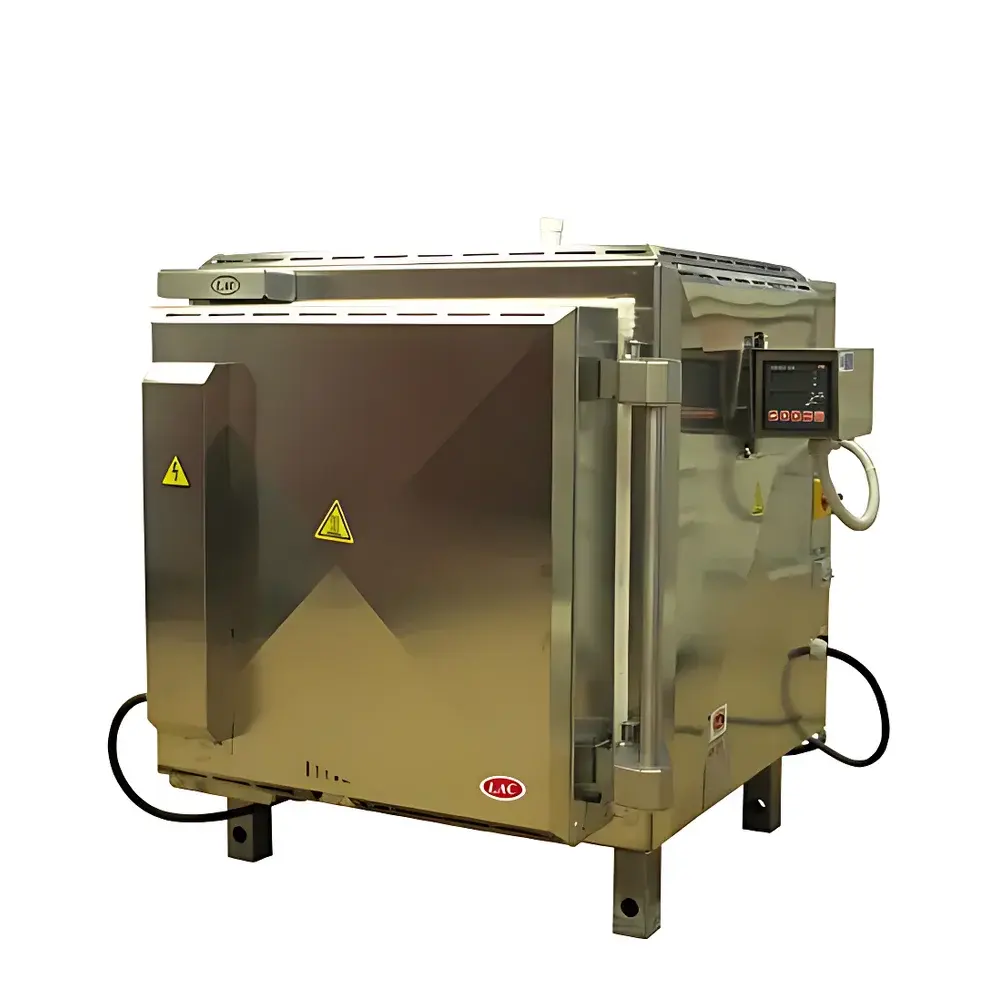
LAC KE125/12 Box-Type Muffle Furnace
| Brand | LAC |
|---|---|
| Origin | Czech Republic |
| Model | KE125/12 |
| Maximum Temperature | 1280 °C |
| Temperature Control Accuracy | ±1 °C |
| Rated Power | 9 kW |
| Heating Time to Max Temp | 80 min |
| Internal Chamber Dimensions | 500 × 500 × 500 mm |
| Heating Configuration | Five-Sided Resistive Heating (Bottom + Four Walls) |
| Controller | HT40AL Programmable Temperature Controller |
| Thermocouple Type | Type S (Platinum/Rhodium) |
| Safety Features | Dual Independent Over-Temperature Limit Switches, Door-Interlocked Safety Cut-Off |
Overview
The LAC KE125/12 Box-Type Muffle Furnace is a high-precision, laboratory-grade thermal processing instrument engineered for reproducible heat treatment across materials science, ceramics, glass technology, and quality assurance laboratories. Designed and manufactured in the Czech Republic by LAC, a long-established European furnace specialist, this unit operates on resistive heating principles using high-stability nickel-chromium or Kanthal A1 alloy heating elements embedded within refractory brick linings. The furnace chamber is fully isolated from external thermal influence via multi-layer insulation—including mineral wool backing, firebrick lining, and thermally decoupled structural steel framing—ensuring minimal heat loss and stable thermal equilibrium. Its maximum operating temperature of 1280 °C conforms to ASTM E1142 (Standard Specification for Laboratory Muffle Furnaces) and supports applications requiring precise pyrolysis, sintering, ashing, annealing, and calcination under controlled atmospheric conditions.
Key Features
- Five-sided heating configuration (bottom + four vertical walls) ensures exceptional temperature uniformity (±3 °C at 1200 °C across the working volume), critical for ISO 5667-17-compliant sample conditioning and ASTM C20-compliant ceramic testing.
- HT40AL programmable controller with semiconductor-integrated protection circuitry enables up to 16-segment ramp-soak profiles, real-time deviation monitoring, and automatic safety shutdown upon thermal excursion.
- Type S platinum/rhodium thermocouple (IEC 60584-2 compliant) provides traceable measurement stability up to 1400 °C, with cold-junction compensation integrated into the controller electronics.
- Dual independent over-temperature limit switches—mechanical (bimetallic) and electronic (SSR-triggered)—actuate separate cut-off circuits, satisfying EN 61000-6-2 EMC immunity requirements and GLP audit criteria for fail-safe operation.
- Robust welded steel frame with reinforced door hinge assembly and counterbalanced manual left-hinged door minimizes mechanical drift during repeated thermal cycling.
- Energy-efficient insulation architecture reduces standby power consumption by >35% versus conventional single-wall muffle designs, supporting sustainability targets without compromising thermal response time.
Sample Compatibility & Compliance
The KE125/12 accommodates standard crucibles (alumina, silicon carbide, platinum), ceramic setters, glass frit molds, and metal alloy test bars within its 500 × 500 × 500 mm isothermal zone. It complies with CE marking directives (2014/35/EU Low Voltage Directive, 2014/30/EU EMC Directive), meets IEC 61000-4-30 Class A power quality specifications, and is suitable for use in environments governed by ISO/IEC 17025:2017 (clause 6.4.3 on equipment validation). Optional factory-installed overpressure venting and industrial-grade data logging modules enable integration into GMP-regulated processes per FDA 21 CFR Part 11 when paired with validated software protocols.
Software & Data Management
While the standard HT40AL controller operates as a standalone hardware interface, optional firmware upgrades support RS485 Modbus RTU communication for integration with LabVIEW™, MATLAB®, or custom SCADA systems. An optional industrial controller package includes certified temperature recording software compliant with EN 14683 Annex B (for thermal validation logs) and provides encrypted audit trails, user-access levels, and electronic signature capability—fully aligned with ALCOA+ data integrity principles. All recorded datasets are timestamped, checksum-verified, and exportable in CSV or PDF formats for regulatory submission.
Applications
- Ceramic and glaze development: fast-firing trials, bisque firing, and vitrification studies under repeatable thermal profiles.
- Metallurgical analysis: ash content determination (ASTM D3174), loss-on-ignition (LOI) testing (ISO 1171), and flux fusion preparation for XRF sample pellets.
- Glass manufacturing R&D: annealing lehr simulation, devitrification onset assessment, and thermal expansion coefficient calibration.
- Environmental testing labs: TGA pre-conditioning, filter media ignition, and sludge residue quantification per EPA Method 2540E.
- Academic research: solid-state reaction kinetics, phase transformation mapping, and catalyst thermal stability evaluation.
FAQ
What is the recommended maintenance interval for the KE125/12’s heating elements and insulation?
LAC recommends visual inspection of brick integrity and element continuity every 200 operational hours; full refractory replacement is advised after 5,000 hours at ≥1100 °C or upon observed thermal gradient deviation exceeding ±5 °C.
Can the furnace be operated under inert or reducing atmospheres?
The standard KE125/12 is rated for air atmosphere only; optional quartz tube inserts with flanged gas ports (N₂, Ar, H₂/N₂ mixtures) are available under model suffix “-ATM” and require separate pressure-rated sealing certification.
Is third-party calibration documentation provided with shipment?
Yes—each unit ships with a factory-issued calibration certificate traceable to Czech Metrology Institute (ČMI) standards, covering thermocouple linearity, controller setpoint accuracy, and uniformity mapping at 600 °C, 900 °C, and 1200 °C.
Does the HT40AL controller support remote monitoring via Ethernet or Wi-Fi?
No—the base controller uses analog I/O and RS485; Ethernet/Wi-Fi connectivity requires the optional Industrial Communication Module (ICM-KE), which includes TLS 1.2 encryption and OPC UA server functionality.
What is the expected service life under continuous 24/7 operation at 1000 °C?
With scheduled preventive maintenance and adherence to LAC’s cooling-rate guidelines (≤10 °C/min below 800 °C), the furnace structure maintains dimensional stability for ≥12 years; heating elements typically last 18–24 months under these conditions.



