
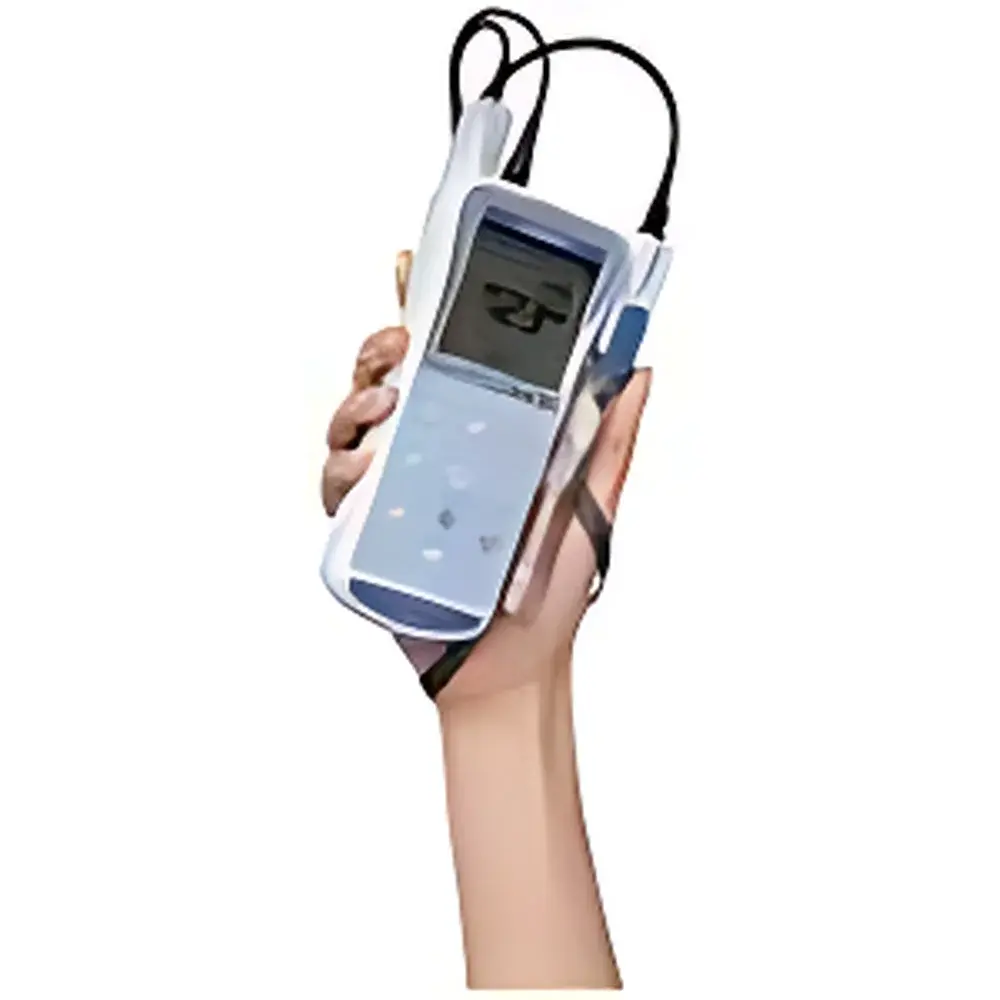
HORIBA D-52 Portable Multi-Parameter Water Quality Analyzer
| Brand | HORIBA |
|---|---|
| Origin | Japan |
| Model | D-52 |
| Measurement Principles | Glass Electrode (pH, ORP), Thermistor (Temperature) |
| pH Range | 0.000–14.000 (Resolution: 0.01 / 0.001 pH) |
| ORP Range | −1999 to +1999 mV (Resolution: 1 mV) |
| Temperature Range | 0.0–100.0 °C (Resolution: 0.1 °C) |
| Repeatability | pH ±0.01 pH ±1 digit |
| Power Supply | DC 3 V (AA × 2, LR6) |
| Weight | Approx. 300 g |
| Interface | RS-232C serial port |
| Optional Accessories | AC adapter, RS-232C printer interface |
Overview
The HORIBA D-52 Portable Multi-Parameter Water Quality Analyzer is an engineered field-deployable instrument designed for reliable, real-time measurement of critical water quality parameters in environmental monitoring, wastewater treatment, aquaculture, and educational field studies. Built upon proven electrochemical sensing principles—including glass electrode-based potentiometric detection for pH and oxidation-reduction potential (ORP), and precision thermistor-based temperature compensation—the D-52 delivers laboratory-grade accuracy in a rugged, handheld form factor. Its dual-channel architecture enables simultaneous, independent measurement of two parameters (e.g., pH and temperature, or pH and ORP), supporting immediate calculation of temperature-compensated values without external correction. The device operates on standard AA batteries, offering extended field runtime and eliminating dependency on mains power—making it suitable for remote sampling locations where infrastructure is limited or unavailable.
Key Features
- IP67-rated waterproof housing with reinforced electrode connectors for consistent performance in rain, splashing, or submerged short-term exposure (up to 1 m for 30 min).
- Dual-channel analog input architecture enabling concurrent measurement and display of two parameters with automatic cross-compensation (e.g., pH corrected to measured temperature in real time).
- High-resolution backlit LCD (128 × 64 pixels) with intuitive icon-driven menu navigation—no training required for routine calibration or data acquisition.
- Onboard data logging with automatic timestamped storage of up to 1,000 measurement records (user-configurable interval or manual trigger).
- Integrated self-diagnostic system that continuously monitors electrode impedance, battery voltage, sensor response slope, and reference junction integrity—flagging anomalies prior to data corruption.
- RS-232C serial interface compliant with EIA/TIA-232-F standards, enabling direct connection to PCs, data loggers, or thermal printers for traceable reporting.
Sample Compatibility & Compliance
The D-52 is validated for use with natural waters (freshwater, estuarine, and low-salinity brackish systems), treated effluents, drinking water distribution points, and process streams in municipal and industrial settings. It is not intended for high-conductivity seawater (>45 mS/cm) or highly viscous or suspended-laden slurries without pre-filtration. Electrode compatibility follows ISO 7888 (pH determination), ASTM D1293 (pH of water), and ASTM D3222 (ORP of water). While the D-52 itself does not carry CE marking for medical or pharmaceutical applications, its measurement traceability aligns with ISO/IEC 17025 requirements when used with NIST-traceable calibration buffers (pH 4.01, 7.00, 10.01 at 25 °C) and certified ORP standards (e.g., Zobell’s solution, quinhydrone). Routine calibration verification and electrode maintenance logs support GLP-compliant documentation workflows.
Software & Data Management
Data export from the D-52 is performed via ASCII-formatted serial transmission using standard terminal emulation software (e.g., Tera Term, PuTTY) or custom scripts (Python, LabVIEW). Each record includes UTC timestamp (derived from host PC clock during transfer), parameter values, unit identifiers, and diagnostic flags (e.g., “ELEC_OK”, “LOW_BAT”, “SLOPE_WARN”). No proprietary software is required; raw .CSV or .TXT files are directly importable into LIMS platforms, Excel, or statistical analysis tools. Audit trails—including calibration date, buffer lot numbers, operator ID (manually entered), and instrument firmware version—are retained in user-maintained lab notebooks or electronic records per FDA 21 CFR Part 11 guidelines when paired with validated data capture systems.
Applications
- Regulatory field screening for EPA Method 150.1 (pH) and Method 150.2 (ORP) compliance in surface water and groundwater monitoring networks.
- Real-time verification of disinfection efficacy in chlorine-treated distribution systems via ORP trend analysis.
- Process control in aquaculture facilities—tracking diurnal pH shifts correlated with photosynthetic activity and dissolved CO₂ dynamics.
- Education and student fieldwork: robust design withstands classroom-to-streamside transitions; ideal for teaching fundamental electrochemistry and environmental sampling protocols.
- Troubleshooting membrane fouling in reverse osmosis pretreatment by correlating pH drift and ORP hysteresis across filtration stages.
FAQ
What calibration standards are required for daily operation?
Standard two-point pH calibration using NIST-traceable buffers at pH 7.00 and either pH 4.01 or 10.01 is recommended before each field session. ORP calibration is optional but advised using a fresh Zobell’s solution (≈220 mV at 25 °C) or quinhydrone standard.
Can the D-52 measure conductivity or dissolved oxygen?
No. The D-52 is a dedicated pH/ORP/temperature platform. HORIBA offers complementary portable instruments—such as the LAQUA twin series—for conductivity, DO, and ion-selective measurements.
Is firmware upgrade supported in the field?
Firmware updates require connection to a Windows PC running HORIBA’s legacy D-Tools configuration utility (v2.1.x); no over-the-air or SD-card update capability is provided.
How often should the pH electrode be cleaned and stored?
Rinse with deionized water after each use; store immersed in 3 M KCl solution. Clean with mild detergent or 0.1 M HCl if fouled with organic film; avoid abrasive pads or ethanol on the glass membrane.
Does the D-52 meet ATEX or IECEx certification for hazardous areas?
No. The D-52 is not intrinsically safe and is not rated for use in explosive atmospheres (Zone 0/1/2 or Class I/II/III divisions).
Related Products







