
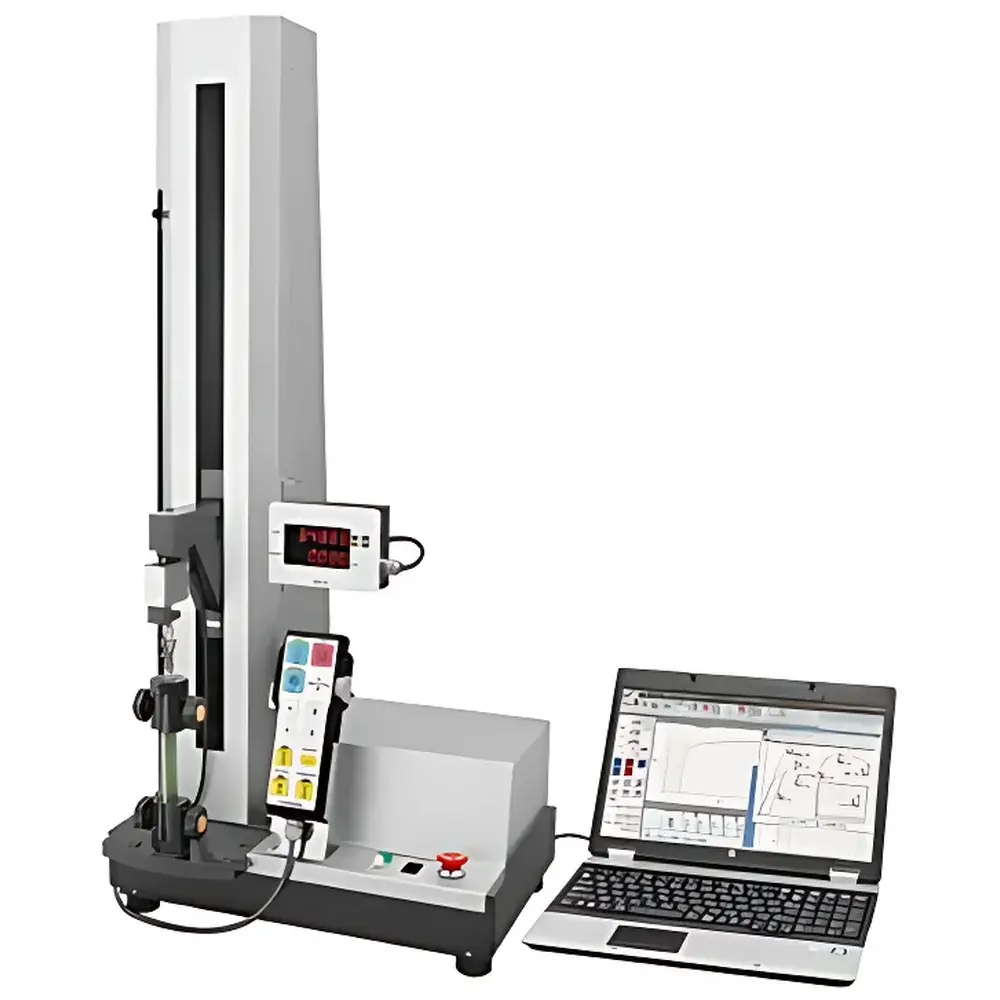
A&D STB Series Electronic Tensile Testing Machine
| Brand | A&D |
|---|---|
| Origin | Japan |
| Model | STB Series |
| Type | Electronic Tensile Testing Machine |
| Max Load Capacity | 2.5 kN |
| Effective Travel | 850 mm (STB-1225L) / 550 mm (STB-1225S) |
| Crosshead Speed Range | 0.05–1000 mm/min |
| Speed Resolution | 0.01 mm/min |
| Speed Accuracy | ±0.5% |
| Load Measurement Accuracy | ±1% of reading (within 1/1 to 1/500 of sensor rated capacity) |
| Automatic Load Range Switching | Up to 128× |
| Load Calibration | One-touch, integrated sensor-based calibration with built-in load cell identification |
| Overload Protection | Dual-mode — electronic cut-off detection + mechanical travel limiters (upper/lower) |
| Position Resolution | 0.001 mm (≤10 mm), 0.01 mm (>10 mm) |
| Display | 6-digit digital crosshead position readout |
| Power Supply | AC 100 V, 1φ, 50/60 Hz, 350 VA |
| Operating Environment | 5–40 °C, 20–80 % RH |
| Dimensions (L×H×W) | 470 × 1450 × 335 mm (L-type), 470 × 1050 × 335 mm (S-type) |
| Weight | 56 kg (L), 43 kg (S) |
| Energy Saving | 30% reduced standby power consumption |
| Data Acquisition Rate | 0.2 ms (with TACT interface) |
Overview
The A&D STB Series Electronic Tensile Testing Machine is a compact, high-precision universal testing system engineered for static mechanical characterization of metals, polymers, elastomers, composites, thin films, adhesives, and biomedical materials. Based on servo-controlled electromechanical actuation and compliant with ISO 6892-1, ASTM E4, and JIS Z2241 standards, the STB platform delivers repeatable force-displacement data under uniaxial tension, compression, peel, shear, and bend configurations. Its rigid C-frame architecture, low-inertia crosshead assembly, and real-time closed-loop control ensure minimal compliance error and high fidelity in modulus, yield strength, elongation at break, and fracture energy measurements. Designed for integration into QC labs, R&D facilities, and academic teaching environments, the STB series balances laboratory-grade metrology with operational simplicity and space-efficient footprint.
Key Features
- Servo-driven crosshead with programmable speed range from 0.05 to 1000 mm/min, adjustable in 0.01 mm/min increments for precise strain-rate control
- High-speed data acquisition at 0.2 ms sampling interval when paired with the optional TACT high-resolution analog-to-digital interface
- Auto-ranging load measurement system supporting up to 128× dynamic range switching—enabling accurate quantification across micro-newton to kilonewton scales without manual sensor swaps
- Integrated load cell self-calibration routine: one-touch execution with embedded sensor identification logic to prevent mismatched transducer configuration
- Dual-layer overload protection: hardware-level travel limit switches (upper/lower mechanical stops) combined with real-time electronic cut-off detection
- Energy-optimized design reducing standby power draw by 30% compared to legacy models—aligned with ISO 50001 energy management principles
- Optional multifunctional color touchscreen HMI or ergonomic handheld controller for offline test setup and real-time monitoring
Sample Compatibility & Compliance
The STB series accommodates specimens ranging from fine wires (Ø < 0.1 mm) to structural coupons (up to 25 mm width × 5 mm thickness), using standardized grips including wedge-action, pneumatic, and custom fixture interfaces. All models comply with ISO/IEC 17025 requirements for testing laboratory competence and support traceable calibration per ISO/IEC 17025:2017 Annex A.2. Force transducers are certified to OIML R60 Class C3 accuracy, and displacement measurement meets ISO 9513 Class 1. The system supports audit-ready documentation for GLP and GMP-regulated environments, including timestamped raw data logs, operator ID tagging, and electronic signature capability when configured with compliant software modules.
Software & Data Management
Control and analysis are performed via A&D’s proprietary TENSILON PC software (Windows OS compatible), which provides full parameter scripting, real-time curve overlay, automatic peak detection, and multi-curve statistical comparison. Raw data exports in CSV, TXT, and XML formats ensure compatibility with third-party analysis tools (e.g., MATLAB, Python Pandas, JMP). Software features include FDA 21 CFR Part 11-compliant user access levels, electronic audit trails, and version-controlled method templates. Optional cloud synchronization enables centralized instrument fleet monitoring and remote diagnostics through secure TLS 1.2–encrypted channels.
Applications
- Tensile property evaluation of thermoplastic sheets and injection-molded parts per ASTM D638 and ISO 527
- Peel strength assessment of pressure-sensitive adhesives (PSAs) and laminated packaging per ASTM D903 and FINAT FTM 1
- Compression testing of foams, gels, and hydrogels in biomedical device development
- Loop tensile and knot strength validation for surgical sutures and monofilament fibers
- Quality conformance testing for wire harnesses, battery tab welds, and flexible printed circuits (FPCs)
- Educational use in materials science curricula for stress-strain curve derivation and Young’s modulus calculation
FAQ
What standards does the STB series comply with for force and displacement measurement?
The system conforms to ISO 9513 (displacement) Class 1 and ISO 376 (force) Class 1. Load cells are OIML R60 Class C3 certified, and all calibrations follow ISO/IEC 17025 procedures.
Can the STB operate without a PC connection?
Yes—optional standalone operation is supported via the color touchscreen HMI or handheld controller, enabling basic test execution and result viewing without external computing hardware.
Is the STB suitable for high-cycle fatigue testing?
No—the STB series is optimized for quasi-static mechanical testing only. For dynamic or cyclic loading, A&D recommends its dedicated fatigue testing platforms compliant with ASTM E466.
How is traceability maintained during calibration?
Each load cell includes embedded EEPROM storing serial number, calibration coefficients, and date-stamped certificate metadata. The software automatically loads these parameters upon sensor recognition, ensuring metrological continuity across instrument reconfigurations.
What environmental conditions are required for valid test results?
Testing must be conducted within 5–40 °C ambient temperature and 20–80 % RH, as specified in ISO 291. Deviations require environmental correction factors applied per ISO 6892-1 Annex B.



