
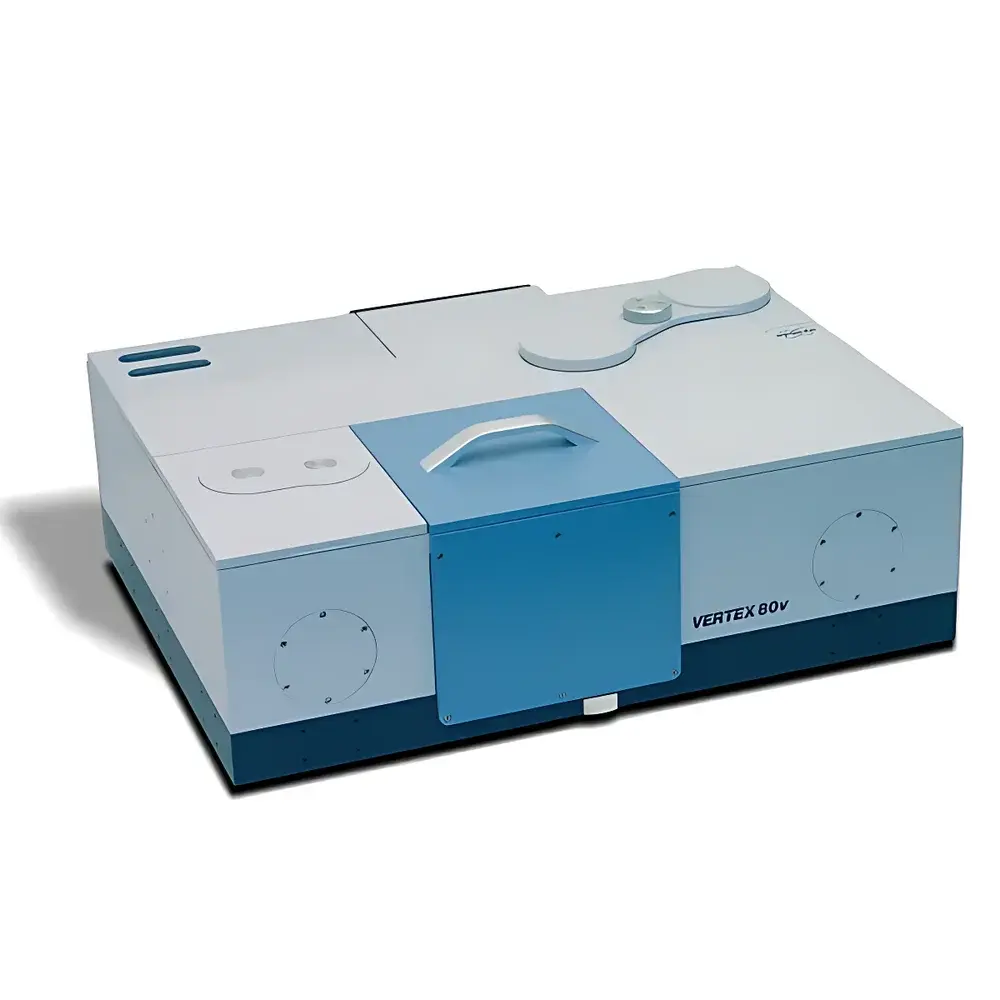
Bruker VERTEX 80/80v Fourier Transform Infrared (FTIR) Spectrometer
| Brand | Bruker |
|---|---|
| Origin | USA |
| Model | VERTEX 80 |
| Optical Resolution (Standard) | < 0.2 cm⁻¹ |
| Vacuum-Optimized Resolution (Peak) | < 0.06 cm⁻¹ |
| Spectral Range (Configurable) | 5 cm⁻¹ to 50,000 cm⁻¹ (Far-IR/THz to UV) |
| Interferometer | UltraScan™ actively aligned |
| Detector Ports | 2 external cryogenic ports |
| Beam Ports | 5 output + 2 input |
| Automation | BMS-c 4-position vacuum-compatible beamsplitter changer |
| Compliance | Fully compatible with ASTM E1421, ISO 17025 workflows, and GLP/GMP data integrity requirements (21 CFR Part 11-ready via OPUS software) |
Overview
The Bruker VERTEX 80 and VERTEX 80v are research-grade Fourier Transform Infrared (FTIR) spectrometers engineered for maximum spectral fidelity, long-term stability, and experimental versatility across the full electromagnetic spectrum—from far-infrared (5 cm⁻¹) and terahertz regimes through mid- and near-infrared, visible, and into the ultraviolet (up to 50,000 cm⁻¹). At the core of both systems lies the UltraScan™ interferometer, featuring active alignment and linear pneumatic bearing scanning—ensuring sub-micron optical path difference (OPD) control and eliminating mechanical hysteresis. The VERTEX 80v extends this architecture with a fully evacuated optical bench, removing atmospheric water vapor absorption and enabling detection of ultra-weak spectral features down to monolayer-level sensitivity (≤10⁻³ ML), critical for surface science, low-temperature semiconductor characterization, and vacuum-based reaction monitoring.
Key Features
- UltraScan™ interferometer with real-time active alignment and <0.06 cm⁻¹ peak resolution under vacuum—among the highest achievable in commercial benchtop FTIR instrumentation.
- Vacuum optical platform (VERTEX 80v) eliminates H₂O and CO₂ interference, delivering baseline stability <1×10⁻⁵ absorbance over multi-hour acquisitions.
- DigiTect™ detector interface technology ensures galvanically isolated signal transmission, minimizing electromagnetic interference and enabling tool-free, repeatable detector swaps without recalibration.
- Modular beam architecture: 5 optical output ports and 2 input ports support simultaneous integration of synchrotron sources, polarization modulation accessories (PMA 50), FTIR microscopes (HYPERION series), cryogenic bolometers, and fiber-coupled probes.
- BMS-c automated beamsplitter changer enables remote, vacuum-compatible switching among up to four beamsplitters—including new broadband solid-state far-IR/THz optics—eliminating vacuum break cycles during spectral range transitions.
- Expandable source/detector ecosystem: Supports liquid-helium-cooled bolometers, Hg-arc lamps for THz generation, high-power visible/UV sources, and vacuum-mounted 4-position detector turrets.
Sample Compatibility & Compliance
The VERTEX 80/80v accommodates diverse sample environments—including ultra-high vacuum (UHV) chambers, electrochemical cells, cryostats (4 K–300 K), TGA-FTIR interfaces, and gas-phase reaction cells with pressure control down to 10⁻⁶ mbar. Its optical design supports reflection-absorption (PM-IRRAS), photoacoustic (PAS), emission, and transmission geometries across solids, thin films, monolayers, gases, and liquids. The system complies with analytical standards including ASTM E1421 (FTIR terminology), ISO 17025 (testing laboratory competence), and supports audit-trail-enabled data acquisition per FDA 21 CFR Part 11 when operated with OPUS software in validated mode. All hardware components meet IEC 61010-1 safety requirements for laboratory instrumentation.
Software & Data Management
Controlled exclusively via Bruker’s OPUS software suite, the VERTEX platform provides integrated acquisition, processing, and reporting tools optimized for advanced spectroscopic techniques. OPUS supports time-resolved methods (step-scan, rapid-scan, cross-correlation), phase-sensitive measurements (VCD, PM-IRRAS), and multidimensional data handling (e.g., hyperspectral imaging with HYPERION 3000). Raw interferograms are stored in Bruker’s proprietary .0 format with embedded metadata (instrument configuration, environmental logs, user annotations). Export options include ASCII, JCAMP-DX, and HDF5 for third-party analysis. Data integrity is enforced via electronic signatures, role-based access control, and configurable audit trails meeting GLP and GMP documentation requirements.
Applications
- Materials Science: Oxygen/carbon quantification in silicon wafers; phonon dispersion mapping in 2D materials; THz conductivity of topological insulators; far-IR identification of inorganic fillers in polymer composites.
- Pharmaceutical R&D: Polymorph discrimination in API crystallinity (far-IR fingerprinting); VCD-based absolute configuration determination; TGA-FTIR coupling for volatile impurity profiling and thermal degradation pathway analysis.
- Surface & Interface Chemistry: In situ FTIR electrochemistry of electrode/electrolyte interfaces; PM-IRRAS of Langmuir-Blodgett monolayers; catalytic reaction monitoring under UHV or controlled atmospheres.
- Gas-Phase Dynamics: High-resolution ro-vibrational spectroscopy of transient species at low pressure; step-scan studies of photoinduced conformational changes in biomolecules.
- Advanced Photonics: Characterization of high-reflectivity coatings, metamaterial resonances, and plasmonic nanostructures via variable-angle reflection and ellipsometric FTIR modes.
FAQ
What is the primary advantage of the vacuum optical bench in the VERTEX 80v?
It eliminates rotational-vibrational absorption bands from ambient H₂O and CO₂, enabling unobstructed access to the far-IR/THz region (<100 cm⁻¹) and improving signal-to-noise ratio by up to two orders of magnitude for weak absorptions.
Can the VERTEX 80/80v perform step-scan time-resolved measurements?
Yes—its UltraScan™ interferometer supports true step-scan operation with sub-nanosecond timing synchronization, making it suitable for pump-probe IR experiments, photochemical kinetics, and lock-in detection of periodic phenomena.
Is the BMS-c beamsplitter changer compatible with all spectral ranges?
BMS-c supports pre-aligned beamsplitters for UV/Vis, NIR, MIR, FIR, and THz—each optimized for its respective range—and enables fully automated, vacuum-intact transitions between them.
How does DigiTect™ improve measurement reproducibility?
By electrically isolating the detector signal path from ground loops and RF noise, DigiTect™ ensures consistent detector response across repeated installations and eliminates drift associated with analog cabling artifacts.
What level of spectral calibration traceability does the VERTEX platform provide?
All instruments ship with NIST-traceable HeNe laser wavelength calibration and optional certified reference standards (e.g., polystyrene film, water vapor cells) for routine verification of resolution, wavenumber accuracy, and photometric linearity.






