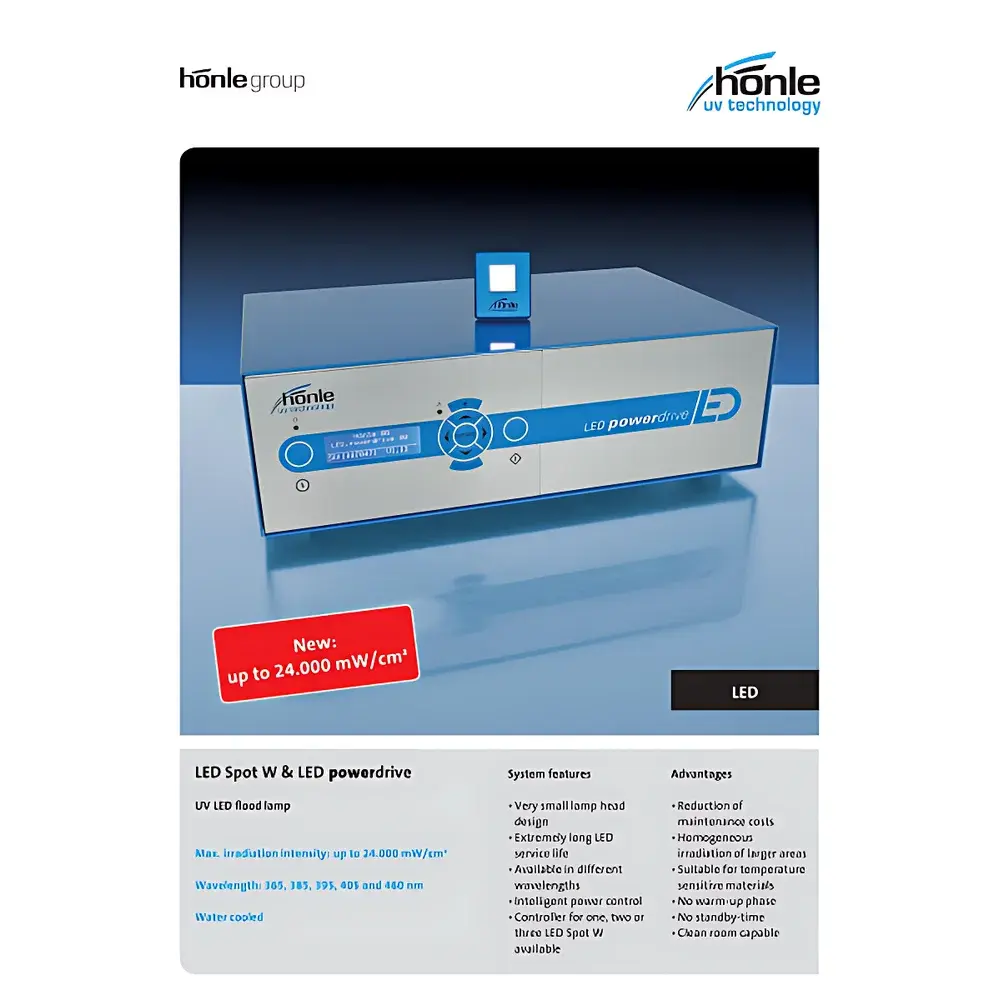
Honle LED Spot W & LED PowerDrive High-Intensity UV Irradiation System
| Brand | Honle |
|---|---|
| Origin | Germany |
| Model | LED Spot W + LED PowerDrive Controller |
| Wavelength Options | 365, 385, 395, 405, 460 nm |
| Max. Irradiance | 24,000 mW/cm² |
| Cooling | External Water-Cooling System |
| Warm-up Time | None |
| Compliance | CE, RoHS, ISO 14644-1 (Cleanroom-Compatible Design) |
Overview
The Honle LED Spot W UV irradiation system—paired with the programmable LED PowerDrive controller—is an engineered solution for precision, high-fluence ultraviolet exposure in controlled industrial and laboratory environments. Unlike conventional mercury-vapor or broad-spectrum UV sources, this system employs high-power, narrow-band LED emitters operating at discrete wavelengths (365, 385, 395, 405, and 460 nm), enabling wavelength-selective photochemical activation with exceptional spectral purity and stability. Its core design leverages external water cooling to sustain continuous operation at maximum irradiance levels up to 24,000 mW/cm² without thermal drift or emitter degradation. The absence of warm-up time ensures immediate, repeatable dosing—critical for process validation and high-throughput manufacturing. Engineered in Germany to meet stringent optical and thermal performance benchmarks, the LED Spot W integrates seamlessly into cleanrooms (ISO Class 5–8), semiconductor fabrication lines, and regulated pharmaceutical labs where spatial uniformity, irradiance stability, and traceable dose delivery are mandatory.
Key Features
- Modular architecture: LED Spot W emitter head couples directly with the LED PowerDrive controller via digital interface (RS-485/Ethernet), supporting remote parameter setting and real-time monitoring.
- Five selectable emission wavelengths (365/385/395/405/460 nm), each delivered through individually calibrated, collimated optics ensuring ±2% spatial irradiance uniformity across the defined spot area (standard 10 mm Ø; optional 5–30 mm apertures available).
- External water-cooling integration eliminates internal heat buildup, permitting indefinite duty-cycle operation while maintaining emitter junction temperature below 55 °C—essential for long-term radiometric stability and LED lifetime (>15,000 h at rated output).
- Programmable irradiation protocols: Dose (J/cm²), irradiance (mW/cm²), exposure duration (ms–hours), and ramp profiles are fully configurable via the LED PowerDrive touchscreen interface or external SCADA systems.
- Integrated safety interlocks compliant with IEC 60825-1 (Class 3B/4 UV laser safety standards), including shutter control, key-switch enable, and emergency stop linkage.
Sample Compatibility & Compliance
The LED Spot W accommodates substrates ranging from silicon wafers and optical lenses to polymer-based medical devices and microfluidic chips—provided surface geometry permits optical access within the defined working distance (10–50 mm). Its compact footprint (emitter head: 68 × 68 × 75 mm) and low electromagnetic emissions allow installation adjacent to sensitive instrumentation (e.g., SEMs, interferometers) without interference. All configurations comply with EU Machinery Directive 2006/42/EC, Electromagnetic Compatibility Directive 2014/30/EU, and RoHS 2011/65/EU. For GMP-regulated applications—including photopolymerization of dental composites or UV-curing of sterile packaging—the system supports IQ/OQ documentation packages and can be configured with audit-trail-enabled firmware (21 CFR Part 11-ready when paired with validated LIMS integration).
Software & Data Management
The LED PowerDrive controller runs embedded Linux-based firmware with a web-accessible configuration portal (HTTPS/TLS 1.2) and local HMI. All irradiation parameters—including timestamped dose logs, thermal sensor readings, and error codes—are stored internally (8 GB flash memory) and exportable via USB or network transfer in CSV/JSON format. Optional API support enables bidirectional communication with MES platforms (e.g., Siemens Opcenter, Rockwell FactoryTalk) for automated batch record generation. Calibration certificates (NIST-traceable spectroradiometric verification) are provided per unit and remain valid for 12 months under documented usage conditions.
Applications
- Industrial bonding & encapsulation: Curing acrylate, epoxy, and silicone adhesives on optoelectronic assemblies, MEMS sensors, and fiber-optic connectors with minimal thermal stress.
- Fluorescence microscopy & assay development: Controlled excitation of DAPI, FITC, Cy3, and Hoechst dyes in automated slide scanners and high-content screening systems.
- Photostability testing: Accelerated UV degradation studies per ICH Q1B guidelines for pharmaceutical actives and packaging materials.
- Cleanroom surface decontamination: Non-thermal, residue-free inactivation of spores and biofilms on stainless-steel surfaces using 254 nm-compatible LED arrays (optional upgrade).
- Microfabrication: Maskless photopatterning of SU-8, AZ resists, and photoresist-coated glass substrates in R&D prototyping environments.
FAQ
What is the recommended calibration interval for radiometric accuracy?
Annual recalibration is advised; however, daily verification using Honle’s traceable reference sensor (model UV-SR-100) is recommended for GLP/GMP workflows.
Can the LED Spot W be integrated into a robotic handling cell?
Yes—digital I/O ports (8 inputs / 8 outputs) and EtherNet/IP support enable synchronization with PLCs and robotic arms for inline curing stations.
Is ozone generation a concern during operation?
No. Emission wavelengths ≥365 nm produce negligible ozone; the system requires no ventilation beyond standard lab airflow.
Does the system support multi-wavelength sequential exposure?
Yes—LED PowerDrive firmware v3.2+ allows user-defined wavelength sequencing with sub-second switching and independent dose control per channel.
What documentation is supplied for regulatory submissions?
Standard delivery includes Declaration of Conformity, EC Type Examination Certificate, Factory Calibration Report, and optional 21 CFR Part 11 compliance package (electronic signature, audit trail, role-based access control).