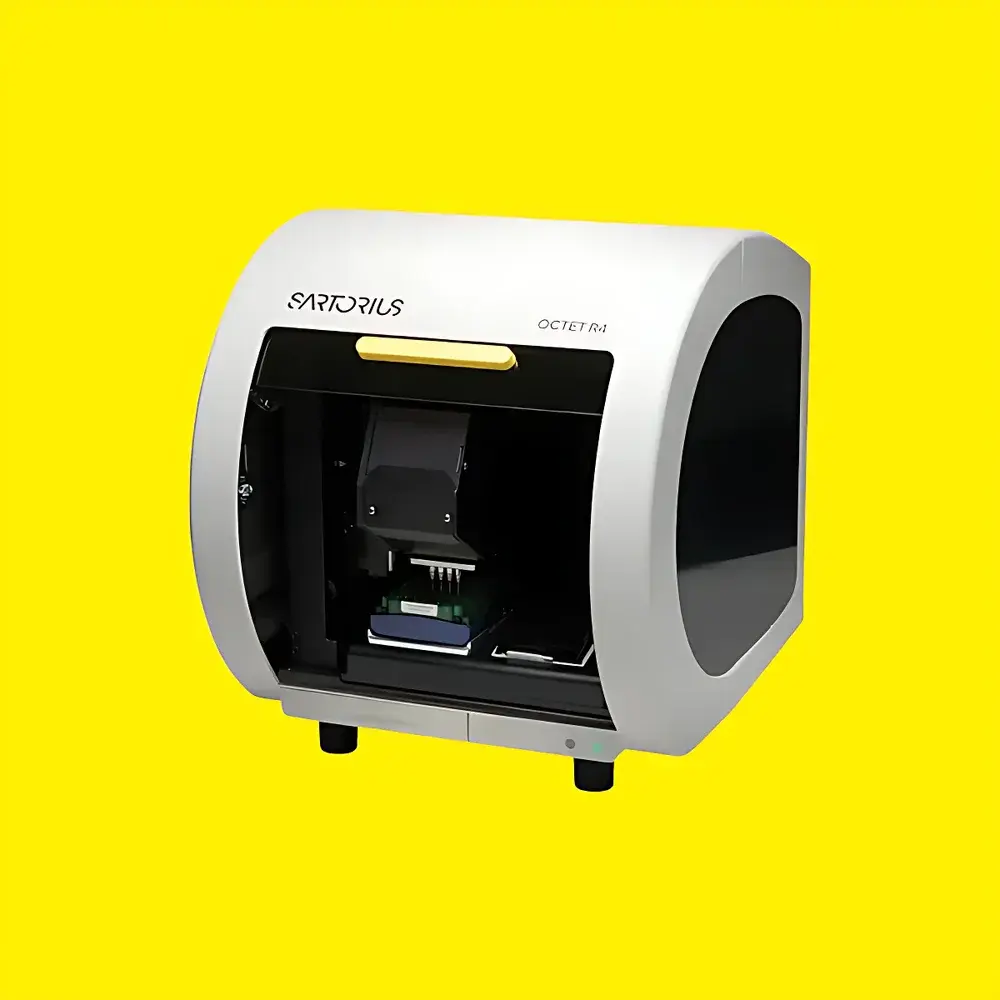
Sartorius Octet® R4 Biomolecular Interaction Analysis System
| Brand | Sartorius |
|---|---|
| Origin | Beijing, China |
| Manufacturer Type | Authorized Distributor |
| Country of Origin | China |
| Model | Octet® R4 |
| Detection Method | Label-Free Biosensor-Based Interferometry (BLI) |
| Sample Format | 96-Well Microplate |
| Sample Volume per Well | 200 µL |
| Assay Duration | 2–60 min |
| Temperature Control Range | 15–40 °C |
Overview
The Sartorius Octet® R4 Biomolecular Interaction Analysis System is a benchtop, label-free platform engineered for real-time, quantitative analysis of biomolecular interactions using BioLayer Interferometry (BLI) technology. BLI measures changes in the interference pattern of white light reflected from the surface of disposable biosensors immersed in sample solutions—enabling direct detection of binding events without fluorescent, enzymatic, or radioactive labeling. Unlike microfluidic SPR or ITC systems, the Octet® R4 employs a flow-free, dip-and-read architecture: biosensors are mechanically lowered into wells of standard 96-well plates, eliminating tubing, pumps, and associated carryover or clogging risks. This design delivers high reproducibility, minimal sample consumption, and robust performance across heterogeneous matrices—including unpurified cell culture supernatants, lysates, serum, and crude bacterial extracts. The system’s four independent optical channels operate in parallel, supporting simultaneous kinetic characterization of up to four analyte–ligand pairs per plate—making it particularly suited for early-stage screening, epitope binning, affinity ranking, and concentration determination in academic, biopharma R&D, and QC environments.
Key Features
- Four fully independent optical channels with synchronized data acquisition and real-time sensor referencing
- Label-free, non-destructive measurement preserving sample integrity for downstream assays
- Integrated Peltier-controlled plate temperature regulation (15–40 °C ±0.5 °C), critical for thermolabile proteins and kinetic stability studies
- Disposable fiber-optic biosensors available in multiple chemistries (e.g., Anti-Human IgG Fc, Streptavidin, Ni-NTA, Aminosilane) enabling broad target versatility—from small molecules (<200 Da) to full-length antibodies, membrane proteins, viruses, and extracellular vesicles
- No fluidics infrastructure: eliminates maintenance of valves, pumps, or capillaries; reduces downtime and consumable costs
- Minimal sample requirement: 200 µL per well supports low-volume sample conservation without dilution or concentration steps
- Scalable architecture: hardware and software support seamless upgrade path to Octet® R8 configuration for GMP-aligned high-throughput workflows
Sample Compatibility & Compliance
The Octet® R4 demonstrates exceptional tolerance for complex biological matrices. It routinely quantifies binding kinetics in clarified CHO or HEK293 supernatants, insect cell lysates, and even filtered tissue homogenates—without prior purification or buffer exchange. This capability aligns with ICH Q5E guidelines on comparability assessment and supports USP recommendations for orthogonal methods in biologics characterization. While not validated as a standalone GMP instrument, its audit-trail-enabled software (Octet Data Acquisition v12.x+) complies with FDA 21 CFR Part 11 requirements when deployed within validated laboratory IT infrastructures. Instrument qualification documentation (IQ/OQ/PQ templates) and electronic lab notebook (ELN) integration via CSV/Excel export facilitate GLP/GMP alignment during method transfer and regulatory submissions.
Software & Data Management
The system ships with Octet Data Acquisition Software—a native Windows application providing end-to-end workflow control: assay setup, real-time sensor monitoring, automated baseline subtraction, global fitting of association/dissociation phases, and equilibrium binding analysis. Kinetic parameters (ka, kd, KD) are calculated using proprietary algorithms based on 1:1 Langmuir binding models or user-defined multi-state fits. Raw data (.octet files) and processed results (.xlsx, .pdf) are stored with embedded metadata (operator ID, timestamp, sensor lot, plate map). Role-based access control, electronic signatures, and configurable audit trails meet ALCOA+ principles. Export formats support LIMS integration and third-party analysis platforms including GraphPad Prism and MATLAB.
Applications
- Antibody–antigen affinity maturation and lead selection
- Epitope binning and mapping using competition assays
- Concentration determination of mAbs, Fc-fusion proteins, and bispecifics in fermentation broths
- Binding stoichiometry and avidity assessment for multivalent interactions
- Stability profiling under variable pH or temperature conditions
- Quality control release testing for biosimilars and novel modalities (e.g., ADCs, VLPs)
FAQ
Does the Octet® R4 require calibration before each run?
No—biosensors are factory-calibrated and do not require user calibration. System performance verification is performed using reference standards (e.g., BSA anti-BSA) during routine qualification.
Can the same biosensor be reused?
No—biosensors are single-use, disposable components designed to ensure assay consistency and prevent cross-contamination.
Is regeneration of ligand-bound sensors supported?
Yes—regeneration protocols (e.g., low-pH glycine, high-salt washes) are programmable and sensor-specific; success depends on ligand stability and binding reversibility.
What level of technical support does Sartorius provide outside China?
Global field application scientists and certified service engineers support installation, training, troubleshooting, and method development across EMEA, North America, and APAC regions.
How is data integrity ensured during long-duration kinetic experiments?
The system logs all environmental parameters (temperature, humidity, sensor position), timestamps every data point at 1 Hz resolution, and implements automatic error recovery for transient communication loss.