
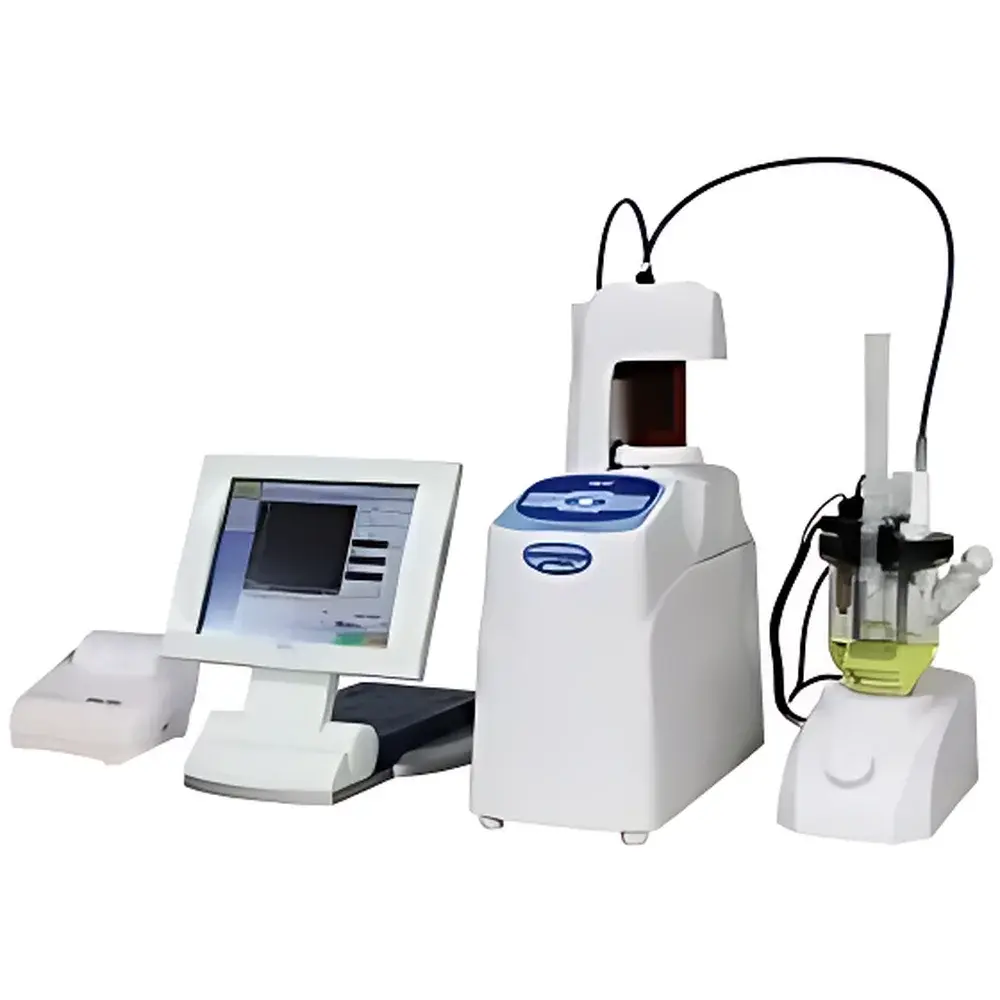
KEM Kyoto Electronics MKH-700 Hybrid Coulometric/Volumetric Karl Fischer Moisture Titrator
| Brand | KEM Kyoto Electronics |
|---|---|
| Origin | Japan |
| Model | MKH-700 |
| Instrument Type | Hybrid Coulometric/Volumetric Karl Fischer Titrator |
| Water Content Range | 0 μg – 500 mg H₂O |
| Measurement Accuracy | ±0.3% RSD |
| Minimum Dispensing Volume | 0.1 μg |
| Coulometric Range | 10 μg – 300 mg H₂O |
Overview
The KEM Kyoto Electronics MKH-700 Hybrid Coulometric/Volumetric Karl Fischer Moisture Titrator represents a paradigm shift in trace moisture quantification for laboratories requiring both broad dynamic range and high metrological rigor. Engineered on the principle of dual-mode electrochemical titration, the MKH-700 uniquely integrates volumetric Karl Fischer (KF) titration—ideal for samples with moderate-to-high water content—and coulometric KF determination—optimized for ultra-trace analysis—within a single, unified cell architecture. Unlike conventional instruments constrained to one method, the MKH-700 dynamically selects and concurrently executes volumetric reagent delivery and coulometric iodine generation based on real-time water concentration feedback from the titration cell. This hybrid algorithm eliminates manual method switching, reduces operator-dependent variability, and ensures seamless transition across measurement regimes—from sub-microgram to milligram-level H₂O—without recalibration or cell replacement.
Key Features
- Intelligent Hybrid Titration Algorithm: Automatically switches between volumetric and coulometric modes—or operates them in parallel—based on detected water load, enabling uninterrupted analysis across 0–500 mg H₂O with consistent accuracy.
- Electrolytic Titer Calibration System: Performs fully automated, reagent-independent titer verification using integrated electrolysis; eliminates reliance on certified water standards or manual calibration procedures, reducing uncertainty and supporting ISO/IEC 17025-compliant workflows.
- Unified Dual-Mode Electrode Cell: Single sealed titration vessel accommodates both volumetric reagent addition and coulometric iodine generation, minimizing dead volume, enhancing reproducibility, and simplifying maintenance.
- Modular Anode Diaphragm Design: Removable and replaceable diaphragm assembly for the generator electrode enables routine cleaning, extends electrode service life, and maintains stable current efficiency over extended operation.
- Triple-Mode Operational Flexibility: Supports standalone volumetric, standalone coulometric, or adaptive hybrid mode—all programmable and executable within identical cell configuration and software environment.
- Regulatory-Ready Data Handling: Built-in USB port supports encrypted export of methods, raw titration curves, audit trails, and final reports to removable media; compatible with electronic record retention per FDA 21 CFR Part 11 requirements when deployed with validated LIMS integration.
Sample Compatibility & Compliance
The MKH-700 is validated for direct analysis of diverse sample matrices including pharmaceutical excipients (e.g., lactose, microcrystalline cellulose), polymer granules, lithium battery electrolytes, petrochemical solvents, and hygroscopic APIs. Its sealed cell design prevents ambient moisture ingress during analysis, critical for low-water-content materials (<100 μg). The instrument conforms to ASTM D6304, ISO 760, and USP for Karl Fischer titration methodology. All calibration, validation, and operational logs—including electrode status, reagent consumption, and drift compensation—are timestamped and user-attributed, fulfilling GLP and GMP documentation prerequisites for QC laboratories subject to regulatory audits.
Software & Data Management
The MKH-700 runs KEM’s proprietary KF-Manager v3.x firmware, offering intuitive touchscreen navigation, customizable method templates, and real-time visualization of titration curves, current response, and endpoint detection algorithms (dynamic potential thresholding). Data integrity is enforced via password-protected user roles (Operator, Supervisor, Administrator), automatic electronic signatures, and immutable audit trails that log every parameter change, result modification, or system event. Raw data files (.kfd) retain full metadata—including cell temperature, stirring speed, reagent batch ID, and environmental humidity—and are exportable in CSV or PDF format for traceability and external statistical review.
Applications
- Pharmaceutical quality control: Residual moisture in lyophilized products, active pharmaceutical ingredients (APIs), and packaging headspace validation.
- Materials science: Water content in silicones, epoxy resins, and catalyst precursors where hydrolysis sensitivity demands sub-10 μg precision.
- Battery R&D: Quantification of trace H₂O in non-aqueous Li-ion electrolytes (e.g., LiPF₆ in EC/DMC), directly impacting SEI formation and cell cycle life.
- Fine chemical synthesis: Monitoring reaction water evolution during esterification or amidation processes to determine endpoint completion.
- Food & feed analysis: Determination of bound vs. free moisture in starches, gums, and powdered dairy products per AOAC Official Method 952.07.
FAQ
How does the hybrid titration method improve measurement reliability compared to single-mode instruments?
The MKH-700 eliminates method-selection bias by continuously monitoring residual water in the cell and adjusting titration strategy in real time—preventing over-titration in high-moisture samples and ensuring sufficient iodine generation in trace analyses.
Is the electrolytic titer calibration traceable to national standards?
While the calibration itself is internal and reagent-free, its performance is verified against NIST-traceable water standards during factory validation; users may perform periodic verification using certified reference materials per ISO/IEC 17025 Clause 7.7.
Can the MKH-700 be integrated into a networked laboratory information management system (LIMS)?
Yes—via optional RS-232 or Ethernet interface (not USB), the instrument supports ASTM E1384-compliant data streaming and bidirectional command protocols for automated method push and result ingestion.
What maintenance intervals are recommended for the generator electrode diaphragm?
KEM recommends visual inspection after every 500 analyses or weekly in high-throughput environments; cleaning frequency depends on sample matrix—non-polar solvents typically extend diaphragm service life beyond 1,000 runs.
Does the instrument support multi-point linearity verification per pharmacopeial guidelines?
Yes—the built-in validation module allows execution of ≥5-point water standard series (e.g., 10–1000 μg) with automatic calculation of correlation coefficient (r²), slope, intercept, and % recovery per USP Annex I.
Related Products






