
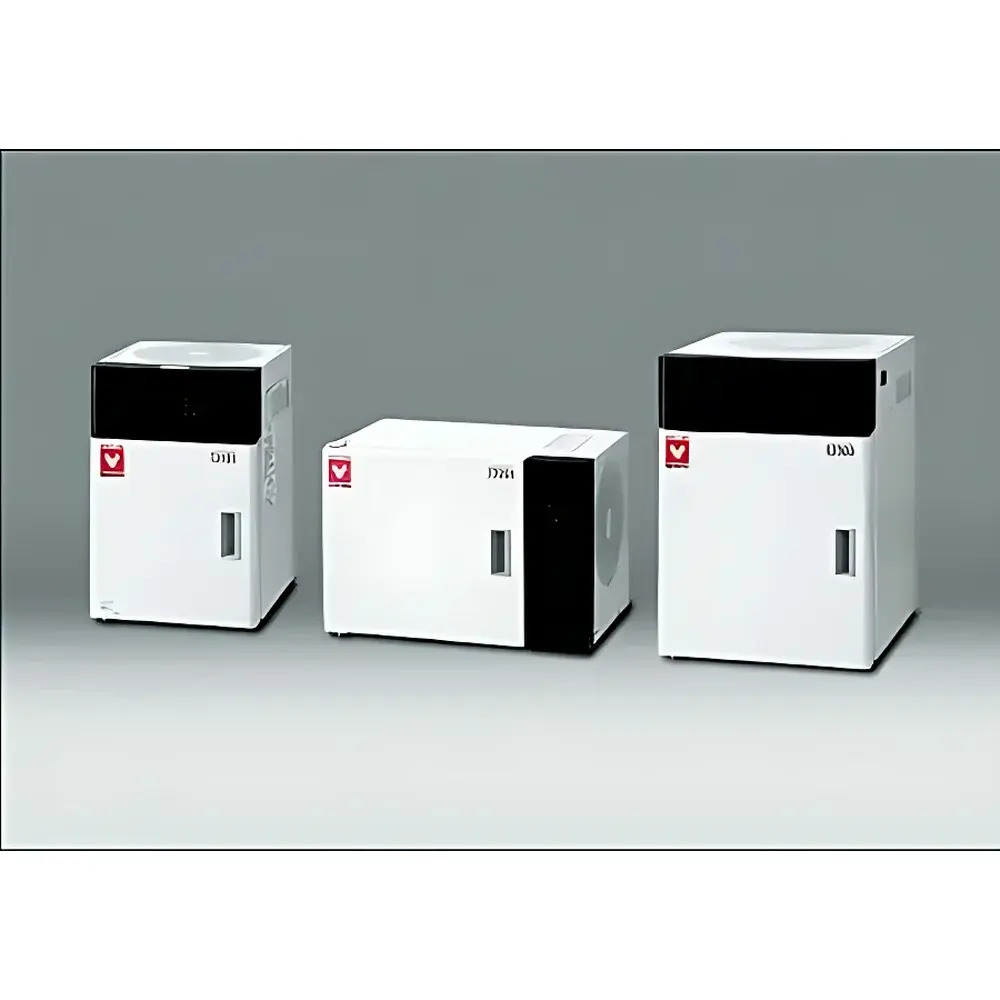
YAMATO IJ201 Low-Vibration, Thermoelectric Cooled Low-Temperature Incubator
| Brand | YAMATO |
|---|---|
| Origin | Japan |
| Model | IJ201 |
| Temperature Range | 5–60 °C |
| Temperature Uniformity | ±1.0 °C |
| Humidity Control | Not Available |
| Chamber Capacity | 27 L |
| Cooling Method | Solid-State Thermoelectric (Peltier) |
| Vibration Level | Low |
| Refrigerant | CFC-Free / HFC-Free |
| Safety Features | Self-Diagnostic System, Dual Over-Temperature Protection (Electronic + Mechanical), Leakage Current & Overcurrent Circuit Breaker |
Overview
The YAMATO IJ201 is a compact, low-vibration, thermoelectric-cooled low-temperature incubator engineered for precise temperature maintenance in life science laboratories where mechanical stability and environmental safety are critical. Unlike conventional compressor-based units, the IJ201 employs solid-state Peltier elements for both heating and cooling—eliminating chlorofluorocarbons (CFCs), hydrofluorocarbons (HFCs), and associated refrigerant-related regulatory compliance burdens. Its passive thermal architecture minimizes mechanical vibration transmission (<0.5 µm peak-to-peak at 10–100 Hz), making it suitable for sensitive applications including cell culture maintenance, enzyme activity assays, microbial storage, and reagent stabilization where micro-vibrational interference must be avoided. With a chamber volume of 27 L and a stable operating range from 5 °C to 60 °C, the IJ201 delivers consistent thermal performance across its full span, validated per ISO 13485-aligned internal calibration protocols.
Key Features
- Thermoelectric (Peltier) temperature control system enabling CFC-free, HFC-free operation with no moving refrigerant compressors or oil-lubricated components.
- Low-vibration design optimized for vibration-sensitive biological samples—ideal for long-term cell monolayer maintenance and microplate-based kinetic assays.
- Programmable digital temperature controller with ramp-soak functionality, adjustable setpoint resolution of 0.1 °C, and real-time deviation monitoring.
- Dual-stage over-temperature protection: independent electronic limiter + fail-safe mechanical thermostat, compliant with IEC 61010-1 safety requirements.
- Integrated self-diagnostic routine verifying sensor integrity, heater/cooler status, and fan operation at power-on and periodic intervals.
- Energy-efficient double-layer semi-tempered glass observation window with low-emissivity surface treatment to reduce radiant heat transfer and improve thermal insulation.
- Modular configuration support: units may be stacked vertically (dual-layer installation) using optional alignment brackets; compatible with YAMATO’s dedicated gas jacket accessory (sold separately) for CO2-inerted environments.
Sample Compatibility & Compliance
The IJ201 accommodates standard laboratory vessels including Petri dishes (up to 150 mm), multi-well plates (6–96-well), Erlenmeyer flasks (≤500 mL), and cryovials stored in upright racks. Its uniform temperature distribution (±1.0 °C at 37 °C, measured per ASTM E2735-21 methodology at 9 spatial points) ensures reproducibility across all load configurations. The unit complies with JIS B 7952:2020 (incubators for laboratory use), meets EMC requirements per CISPR 11 Group 1 Class B, and carries PSE certification for the Japanese market. While humidity control is not integrated, the sealed chamber design maintains ambient RH conditions—suitable for non-hygroscopic sample types or applications requiring dry storage. For GLP/GMP-regulated workflows, optional data logging modules support audit-trail generation aligned with FDA 21 CFR Part 11 principles when paired with validated software.
Software & Data Management
The built-in controller supports local parameter logging (setpoint, actual temperature, alarm events) with timestamping and non-volatile memory retention (≥30 days). Optional RS-485 interface enables integration into centralized lab monitoring systems via Modbus RTU protocol. Third-party SCADA platforms—including LabVIEW, Ignition, and Siemens Desigo CC—can poll real-time values and trigger alerts on deviation thresholds. Firmware updates are performed via USB port using YAMATO’s certified update utility, with version rollback capability and cryptographic signature verification to ensure firmware integrity.
Applications
- Long-term storage of temperature-sensitive reagents (e.g., restriction enzymes, polymerases, antibodies) at 4–8 °C without condensation risk.
- Pre-incubation of bacterial cultures prior to antibiotic susceptibility testing (CLSI M07-A10).
- Controlled-temperature equilibration of chromatography columns and HPLC mobile phases.
- Stabilization of calibration standards for pH meters, conductivity probes, and dissolved oxygen sensors.
- Support environment for electrophoresis apparatuses requiring ambient temperature consistency during extended runs.
- Backup incubation zone in core facilities where redundancy and vibration isolation are prioritized over humidification.
FAQ
Does the IJ201 support humidity control?
No—this model is designed as a dry incubator. Humidity regulation is not implemented; relative humidity remains ambient. For humidified applications, consider YAMATO’s MJ series or external humidification accessories.
Can the IJ201 be used for CO₂ incubation?
Not natively. However, the optional gas jacket kit (Model GJ-IJ) allows inert gas purging (N₂ or CO₂) when installed—enabling anaerobic or low-O₂ environments under user-controlled gas flow rates.
Is the unit suitable for GMP-regulated environments?
Yes—when equipped with the optional data logger and operated under documented SOPs, the IJ201 supports 21 CFR Part 11-compliant electronic records when validated per IQ/OQ protocols.
What is the maximum allowable load weight per shelf?
Each stainless-steel shelf supports up to 15 kg uniformly distributed. Total chamber load must not exceed 40 kg to maintain airflow integrity and thermal uniformity.
How often does the self-diagnostic system run?
A full diagnostic cycle executes automatically at power-up; abbreviated checks occur every 24 hours during continuous operation, reporting status via LED indicators and event log entries.





