
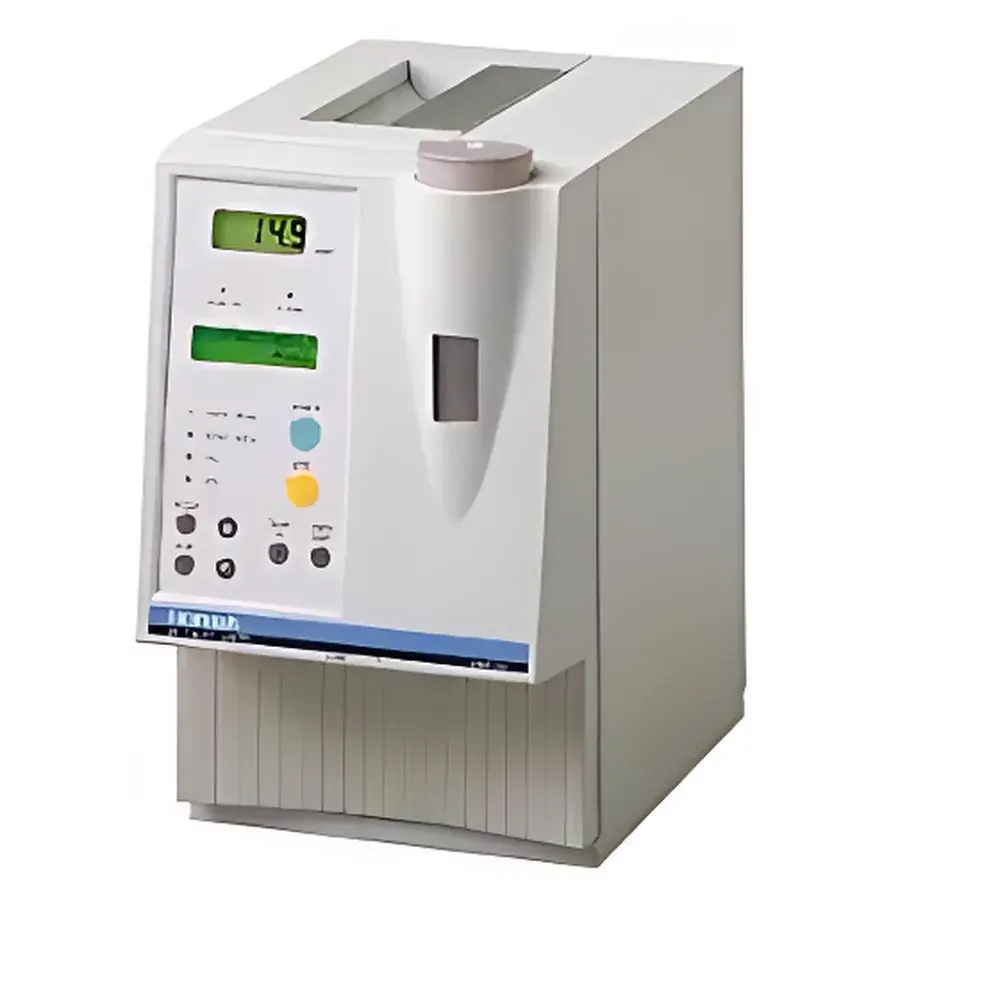
HORIBA OCMA-300/305 Oil Content Analyzer
| Brand | HORIBA |
|---|---|
| Origin | Japan |
| Model | OCMA-300/305 |
| Instrument Type | Laboratory Oil Content Analyzer |
| Measurement Principle | Non-Dispersive Infrared (NDIR) Spectrophotometry |
| Measurement Range | 0–200 mg/L (water), 0–1000 mg/kg (soil/solid), 0–1 Abs (absorbance) |
| Detection Limit | <0.2 mg/L |
| Accuracy | 0–9.9 mg/L: ±0.4 mg/L ±1 digit |
| 10.0–99.9 mg/L | ±2.0 mg/L ±1 digit |
| 100–200 mg/L | ±4.0 mg/L ±1 digit |
| 0–1 Abs | ±1% F.S. |
| Resolution | 0–99.9 mg/L: 0.1 mg/L |
| 100–200 mg/L | 1 mg/L |
| 0–9.99 mg/kg | 0.01 mg/kg |
| 9.9–99.9 mg/kg | 0.1 mg/kg |
| 100–1000 mg/kg | 1 mg/kg |
| 0–1 Abs | 0.001 Abs |
Overview
The HORIBA OCMA-300/305 Oil Content Analyzer is a laboratory-grade, non-dispersive infrared (NDIR) spectrophotometric instrument engineered for precise quantification of hydrocarbon-based oil contaminants in aqueous, solid, and surface matrices. Designed to meet the rigorous demands of environmental compliance laboratories, industrial wastewater treatment facilities, and regulatory testing centers, the OCMA-300/305 operates on the fundamental principle that aliphatic and aromatic C–H bonds exhibit strong, characteristic absorption bands near 2940 cm⁻¹ (3.4 µm) — a spectral region selectively isolated by NDIR optical filtering. Unlike fluorescence-based or gravimetric methods, NDIR delivers inherent specificity to petroleum-derived hydrocarbons while minimizing interferences from humic substances, detergents, or chlorophyll. The analyzer supports three primary measurement modes: liquid-phase analysis (0–200 mg/L in water or seawater), solid-phase extraction (0–1000 mg/kg in soil, sludge, or wiped surfaces), and direct absorbance monitoring (0–1 Abs), enabling trace-level detection with a documented limit of quantitation below 0.2 mg/L.
Key Features
- Integrated solvent extraction module compatible with standardized extraction solvents (e.g., S-316 or H-997), ensuring reproducible phase separation and analyte recovery per EPA Method 1664B and ISO 9377-2 protocols.
- Single-range dynamic detection (0–200 mg/L) eliminates manual range switching, reducing operator error and improving throughput across heterogeneous sample batches.
- Backlit monochrome LCD display with high-contrast alphanumeric rendering — optimized for readability under ambient lighting, direct sunlight, and low-illumination laboratory conditions.
- Onboard data evaluation algorithm applies statistical stabilization logic to raw absorbance signals, reporting only converged, noise-filtered concentration values after signal settling criteria are met.
- Real-time self-diagnostic system continuously monitors detector bias voltage, lamp intensity, optical path integrity, and thermal stability; alerts appear as unambiguous text messages on-screen (e.g., “LAMP ERROR”, “DETECTOR SATURATION”, “CALIBRATION EXPIRED”).
- RS-232C serial interface compliant with EIA/TIA-232-F standards enables bidirectional communication with LIMS, SCADA systems, or dedicated acquisition software; optional thermal printer support facilitates GLP-compliant hardcopy generation.
Sample Compatibility & Compliance
The OCMA-300/305 accommodates diverse sample types without hardware modification: clarified aqueous effluents (including saline and brackish waters), homogenized soil/sludge suspensions following Soxhlet or ultrasonic extraction, and solvent-rinsed metallic or polymer surfaces (e.g., machined parts, engine components). Its measurement methodology aligns with internationally recognized standards including ASTM D7066-22 (Standard Test Method for Determination of Oil and Grease and Selected Petroleum Hydrocarbons in Water by Extraction and Infrared Spectrophotometry), ISO 9377-2:2000 (Water quality — Determination of hydrocarbon oil index — Part 2: Infrared spectrometric method), and JIS K 0102 (Japanese Industrial Standard for water quality testing). All stored results retain embedded timestamps (YYYY-MM-DD HH:MM:SS), supporting audit-ready documentation required under ISO/IEC 17025:2017 clause 7.8 and EPA Contract Lab Program (CLP) data integrity guidelines.
Software & Data Management
Data handling adheres to principles of traceability and integrity. Each measurement record stores not only the final reported concentration but also the raw absorbance value, integration time, solvent blank correction offset, and internal calibration reference status. Internal memory retains up to 500 test records with full metadata. When interfaced via RS-232C, the instrument transmits ASCII-formatted packets containing CRC-16 checksums for error detection. No proprietary drivers are required; standard terminal emulation (e.g., Tera Term, PuTTY) suffices for manual data capture. For automated integration, HORIBA provides a documented command protocol (OCMA-ASCII v2.1) supporting remote zeroing, calibration invocation, and batch export — fully compatible with Python-based automation frameworks and LabVIEW VIs. Audit trails are immutable: once recorded, no timestamp or result may be edited or deleted via front-panel or serial interface.
Applications
- Environmental Monitoring: Quantification of total petroleum hydrocarbons (TPH) in groundwater, leachate, and sediment pore water at Superfund sites and landfill monitoring wells.
- Industrial Wastewater Compliance: Routine verification of oil/water separator performance in petrochemical refineries, metalworking facilities, and food processing plants.
- Marine Operations: Verification of oily bilge water discharge compliance with MARPOL Annex I limits (15 ppm) prior to overboard release.
- Soil Remediation: Pre- and post-treatment TPH assessment in excavated soils using standardized solvent extraction protocols.
- Manufacturing QA/QC: Residual oil verification on precision-machined components, hydraulic system parts, and textile substrates prior to coating or assembly.
FAQ
Does the OCMA-300/305 require daily calibration verification?
Yes — a solvent blank must be measured before each analytical session, and a mid-range calibration standard (e.g., 50 mg/L) is recommended every 10 samples or at shift change to confirm instrument linearity and drift compensation.
Can the OCMA-300/305 analyze diesel, lubricating oil, and crude oil equivalently?
It reports total extractable hydrocarbons relative to the calibration standard used (typically n-hexadecane or mineral oil); cross-sensitivity varies slightly by carbon chain distribution, but all petroleum fractions contribute measurably within the 2940 cm⁻¹ band.
Is the instrument suitable for field deployment?
No — it is designed exclusively for controlled laboratory environments (15–30°C, ≤80% RH, non-condensing); no battery operation or ruggedized housing is provided.
What solvent disposal protocols apply when using S-316 or H-997?
Both solvents are halogenated organics requiring hazardous waste classification per RCRA 40 CFR Part 261; users must comply with local institutional EH&S policies for collection, labeling, and third-party incineration.
How does the OCMA-300/305 handle turbid or emulsified samples?
Pre-filtration through 0.45 µm PTFE membrane filters is mandatory for aqueous samples; centrifugation (3000 × g, 10 min) is recommended for stable oil-in-water emulsions prior to extraction.







