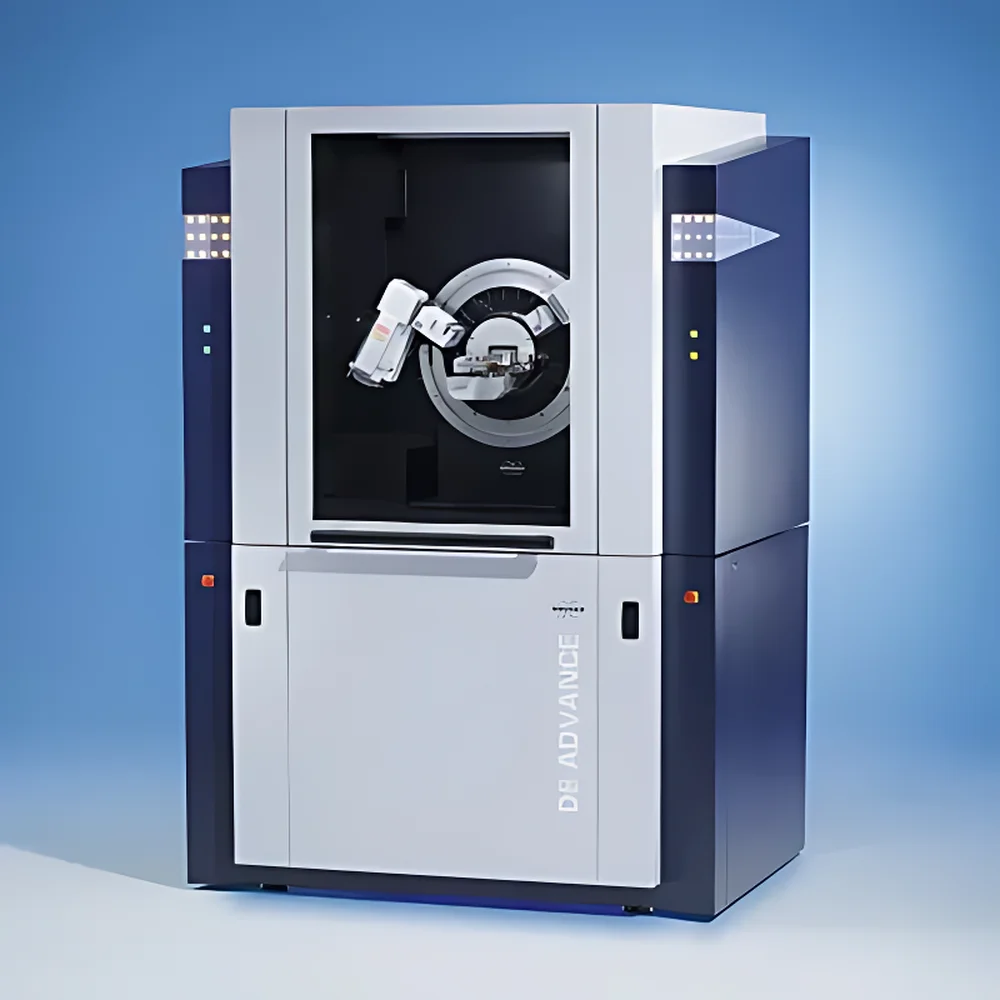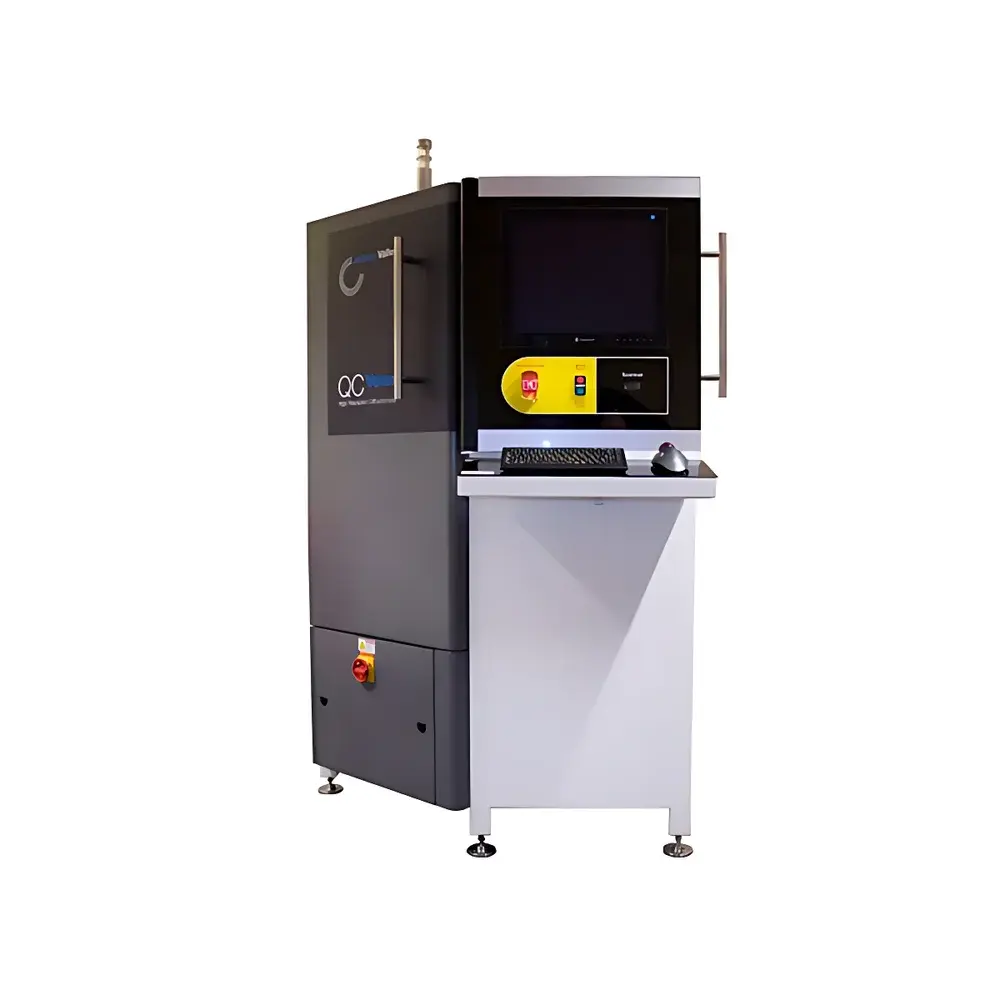
Bruker JV-QCVelox High-Resolution X-ray Diffractometer for Compound Semiconductor QC

| Brand | Bruker |
|---|---|
| Origin | USA |
| Model | JV-QCVelox |
| Instrument Type | High-Resolution X-ray Diffractometer (HRXRD) |
| Power | 0.0001 kW |
| Compliance | ASTM F394, ISO 15382, SEMI S2/S8, FDA 21 CFR Part 11 (software audit trail enabled) |
| Detector Dynamic Range | >3×10⁸ (with EDRc + auto-attenuator) |
| Sample Handling | Automated wafer loader (2″–200 mm), kinematic sample plates, barcode integration |
| Optical Configuration | VeloMAX™ high-flux optics with adjustable divergence crystals (25″ standard, <10″ optional for III-V), multilayer mirrors, motorized detector slits, triaxial crystal stage for GaN-grade resolution |
Ask about pricing, availability and specifications.
Overview
The Bruker JV-QCVelox is a production-grade, high-resolution X-ray diffractometer (HRXRD) engineered specifically for rapid, non-destructive structural characterization of compound semiconductor wafers and epitaxial layers in manufacturing environments. Based on Bragg’s law and utilizing Cu Kα or Mo Kα radiation (configurable), the system performs reciprocal space mapping (RSM), rocking curve analysis, θ–2θ scans, and asymmetric/symmetric/tilted-symmetric diffraction to quantify lattice parameters, strain states, composition gradients, relaxation degree, layer thickness, interfacial roughness, and mosaic spread. Its core architecture follows the proven JV-QC platform—refined over two decades—and integrates VeloMAX™ optics to deliver >10× beam intensity without compromising angular resolution (<10 arcsec FWHM typical). Designed for 24/7 operation in cleanroom settings (Class 100–1000), the JV-QCVelox meets stringent requirements for LED, laser diode, RF power device, and power electronics fabrication lines where reproducibility, throughput, and metrology traceability are critical.
Key Features
- VeloMAX™ high-intensity optics with optimized multilayer mirrors and selectable divergence crystals (25″ standard; <10″ optional for ultra-high-resolution III-V analysis)
- Triaxial crystal stage enabling sub-arcsecond angular control—essential for precise GaN and AlGaN layer analysis
- EDRc (Enhanced Dynamic Range) detector with intrinsic dynamic range >2×10⁷, extended to >3×10⁸ via software-controlled automatic attenuator
- Fully motorized detector slit assembly for real-time resolution tuning—no manual hardware swaps required
- Kinematic 31-position × 2″ sample plate system supporting rapid, alignment-free wafer exchange and batch processing
- Integrated robotic wafer handler compatible with standard FOUPs, SMIF pods, and tape carriers (2″–200 mm); auto-detects cassette size and slot configuration
- Zero-beam-access calibration routine—no open-beam cabinet entry required for routine maintenance or alignment
- Comprehensive motion control with encoder feedback on all goniometer axes ensuring long-term angular stability and repeatability (±0.0005° over 1000 h)
Sample Compatibility & Compliance
The JV-QCVelox supports structural analysis of single-crystal substrates—including Si, GaAs, InP, SiC, sapphire, and GaN—as well as complex heteroepitaxial stacks such as AlGaN/GaN HEMTs, InGaN/GaN MQWs, and AlInP/InGaAs DHBTs. It accommodates both bare and patterned wafers, with optional vacuum or He-purged sample chambers available for air-sensitive materials. All measurement protocols comply with industry standards including ASTM F394 (XRD for semiconductor epitaxy), ISO 15382 (crystallographic analysis of thin films), and SEMI S2/S8 (safety and ergonomics for semiconductor equipment). Software features full 21 CFR Part 11 compliance: electronic signatures, audit trails, role-based access control, and immutable data archiving—validated for GLP and GMP environments.
Software & Data Management
Control and analysis are unified under Bruker’s JV-RADS (Rapid Analysis and Data System) software suite. JV-RADS provides scriptable automation for routine QC workflows—from auto-alignment and multi-point mapping to report generation in PDF, CSV, or XML formats. It includes embedded libraries for common material systems (e.g., ternary and quaternary nitrides, phosphides, arsenides) and supports custom fitting models for strain/composition deconvolution in strained-layer superlattices. Raw data is stored in Bruker’s proprietary .raw/.uxd format with metadata tagging (operator ID, timestamp, instrument configuration, calibration log). Export modules integrate with LIMS and MES platforms via OPC UA and RESTful APIs. All software updates, calibration patches, and method templates are distributed through Bruker’s secure Customer Portal with version-controlled release notes.
Applications
- Real-time monitoring of MOCVD/MBE growth uniformity across 200 mm wafers via automated RSM grids
- Quantitative determination of In content and strain relaxation in InGaN quantum wells for blue/green LED yield control
- Layer-by-layer compositional profiling in AlGaN electron blocking layers for high-efficiency UV LEDs
- Assessment of threading dislocation density (TDD) via ω-scan full-width-at-half-maximum (FWHM) correlation
- Verification of wafer off-cut angle and surface miscut via asymmetric reflection analysis
- Process qualification of SiC-on-Si and GaN-on-Si templates for power device fabrication
- Root-cause analysis of wafer bow, curvature, and thermal stress-induced lattice distortion
FAQ
What X-ray sources are supported on the JV-QCVelox?
The system is configured with a sealed-tube Cu Kα source (standard); Mo Kα and Ag Kα anodes are available as factory-installed options for higher-energy applications.
Can the JV-QCVelox perform grazing-incidence XRD (GIXRD)?
Yes—optional motorized incidence angle stage enables GIXRD mode for ultra-thin film and interface analysis down to ~1 nm penetration depth.
Is remote diagnostics and service support available?
All instruments include Bruker RemoteConnect™ with TLS-encrypted telemetry, enabling proactive health monitoring, firmware updates, and secure remote assistance by certified field application engineers.
How is calibration traceability maintained?
Each system ships with NIST-traceable Si (111) and Si (220) reference crystals. Annual recalibration services include certificate of conformance per ISO/IEC 17025.
Does the software support custom scripting for proprietary analysis algorithms?
Yes—JV-RADS exposes a Python API (via Bruker PyXRD SDK) allowing integration of user-defined fitting routines, statistical process control (SPC) logic, and machine learning inference pipelines.