
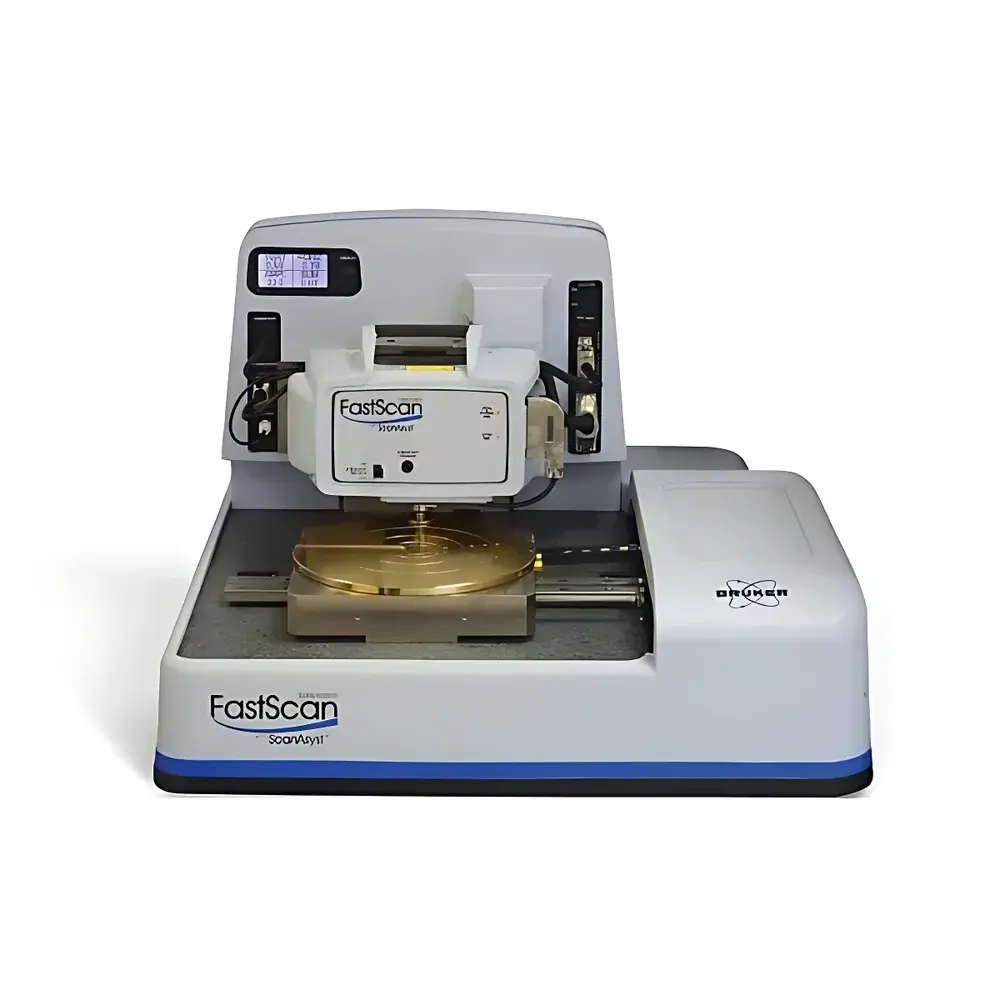
Bruker Dimension FastScan Atomic Force Microscope
| Brand | Bruker |
|---|---|
| Origin | USA |
| Model | Dimension FastScan |
| AFM Type | Industrial-grade |
| Instrument Category | Atomic Force Microscope |
| XY Positioning Noise | <1% |
| Sample Size Capacity | 200 mm diameter |
| XY Stage Travel Range | 210 × 210 mm |
| Z-Noise (Closed-loop) | <40 pm |
| Thermal Drift Rate | <200 pm/min |
| Max. Z-Approach Speed (Contact Mode) | 12 mm/s |
| Max. XY Tracking Speed (Closed-loop) | 2.5 mm/s |
| TappingMode Imaging Speed | ≥20 Hz (full-resolution) |
| ScanAsyst Imaging Speed | ≥6 Hz (full-resolution), up to 32 Hz (standard-res) |
| Resonance Frequency (Cantilever, air) | 1.3 MHz |
| Resonance Frequency (Cantilever, liquid) | 250–500 kHz |
| Controller | NanoScope V with enhanced bandwidth architecture |
| Optical Navigation System | MIRO integrated optical microscope |
Overview
The Bruker Dimension FastScan Atomic Force Microscope represents a paradigm shift in high-speed, high-fidelity nanoscale imaging. Engineered on Bruker’s proven Dimension platform, the FastScan system integrates a proprietary tip-scanning architecture with a low-thermal-drift, closed-loop XYZ piezoelectric scanner and an advanced NanoScope V controller. Unlike conventional tube-scanner AFMs limited by mechanical resonance and thermal hysteresis, the FastScan employs a rigid, kinematically optimized design that decouples tip motion from sample stage movement—enabling true sub-angstrom Z-noise performance (<40 pm RMS) while sustaining scanning speeds exceeding 125 Hz in ambient or liquid environments. This architecture preserves atomic-scale resolution without compromising speed: full-resolution TappingMode™ images are routinely acquired at 20 Hz; ScanAsyst® mode delivers quantitative topography and nanomechanical data at 6 Hz, with usable contrast maintained even at 32 Hz. The system’s fundamental innovation lies not in trade-offs—but in synchronized advances across transducer design, control electronics, probe physics, and software intelligence.
Key Features
- Tip-scanning configuration with 210 × 210 mm motorized XY stage—enabling large-area navigation without sacrificing Z-noise floor or thermal stability
- Closed-loop XYZ scanner with integrated temperature-compensated position sensors: Z-noise <40 pm, XY noise <1% tracking error, thermal drift <200 pm/min
- High-bandwidth NanoScope V controller supporting real-time force feedback at >2 MHz loop rates for precise PeakForce QNM™ and ScanAsyst® operation
- Automated laser alignment and photodetector optimization—reducing setup time from minutes to seconds
- MIRO optical navigation system with integrated 10×–50× zoom optics and sub-micron feature recognition for rapid region-of-interest targeting
- Compatibility with all Bruker AFM modes—including Contact, Tapping, PeakForce QNM, ScanAsyst, Force Volume, Electrostatic Force Microscopy (EFM), Kelvin Probe Force Microscopy (KPFM), and Conductive AFM (CAFM)
- Modular environmental control options: temperature stage (-35 °C to +250 °C), liquid cell, and localized thermal probing (up to 500 °C with heated tips)
Sample Compatibility & Compliance
The Dimension FastScan accommodates samples up to 200 mm in diameter and 50 mm in height, supporting standard semiconductor wafers, biological substrates (e.g., mica, silicon nitride membranes), polymer films, battery electrodes, and catalytic nanoparticles. Its open-access design permits integration of in situ electrochemical cells, gas flow modules, and custom sample holders. From a regulatory standpoint, the system supports audit-ready workflows compliant with GLP and GMP requirements: NanoScope software logs all parameter changes, user actions, and instrument calibrations with timestamped, non-editable records. Data export adheres to ASTM E2927-21 (Standard Guide for AFM Data Reporting) and ISO/IEC 17025 traceability frameworks. For pharmaceutical applications, the platform meets USP guidelines for nanomaterial characterization and supports FDA 21 CFR Part 11–compliant electronic signatures when deployed with validated software configurations.
Software & Data Management
NanoScope Analysis v2.0 provides a unified, scriptable environment for acquisition, processing, and reporting. Preconfigured experiment templates—covering TappingMode, ScanAsyst, PeakForce QNM, and electrical modes—ensure method reproducibility across operators and laboratories. Real-time multi-channel data capture (topography, adhesion, deformation, modulus, current, potential) enables correlative nanomechanical-electrical mapping without post-acquisition registration artifacts. All datasets are stored in Bruker’s proprietary .spm format (HDF5-based), fully compatible with third-party analysis tools including Gwyddion, MATLAB, and Python-based libraries (e.g., PySPM). Batch processing pipelines support automated roughness calculation (Sa, Sq, Sz per ISO 25178), grain analysis, particle counting, and statistical process control (SPC) chart generation—critical for QC/QA in semiconductor manufacturing and advanced materials R&D.
Applications
- Nanomaterials & Thin Films: Quantitative thickness, roughness, and phase separation analysis of 2D materials (graphene, TMDCs), ALD/CVD coatings, and organic photovoltaic layers
- Life Sciences: High-speed imaging of membrane proteins, DNA origami, and live-cell dynamics in physiological buffer—without radiation damage or vacuum constraints
- Electronics & Semiconductors: Defect inspection, trench depth metrology, and dopant profiling via SSRM/KPFM on FinFETs and advanced packaging substrates
- Battery Research: In situ/operando observation of SEI growth, cathode cracking, and lithium dendrite nucleation under electrochemical bias
- Pharmaceutical Development: Polymorph screening, amorphous content quantification, and nanoparticle dispersion uniformity assessment in drug formulations
- Nanoscale Manipulation: Precise nanolithography, molecular pushing, and single-molecule force spectroscopy with sub-nanometer positional fidelity
FAQ
What distinguishes FastScan from conventional high-speed AFMs?
FastScan achieves speed without resolution loss by combining a rigid tip-scanner architecture, ultra-low-noise closed-loop positioning, and a high-bandwidth controller—eliminating the thermal drift and hysteresis inherent in open-loop tube scanners.
Can FastScan operate in liquid environments at high speed?
Yes: it acquires full-resolution images at ≥1 Hz in aqueous media using optimized cantilevers (250–500 kHz resonance), with real-time feedback enabling stable PeakForce QNM in electrolytes.
Is the system compatible with existing Bruker probes and accessories?
All standard Bruker AFM probes—including conductive, magnetic, and high-aspect-ratio tips—are mechanically and electronically compatible; no adapter or recalibration is required.
How does FastScan ensure measurement repeatability across users?
Through automated alignment routines, pre-validated acquisition protocols, and comprehensive metadata logging—including environmental conditions, calibration history, and operator identity—supporting ISO/IEC 17025-compliant reporting.
What level of technical support and service coverage is available?
Bruker offers global field service engineering, application scientist support, annual preventive maintenance contracts, and remote diagnostics—aligned with ISO 9001-certified service delivery standards.



