
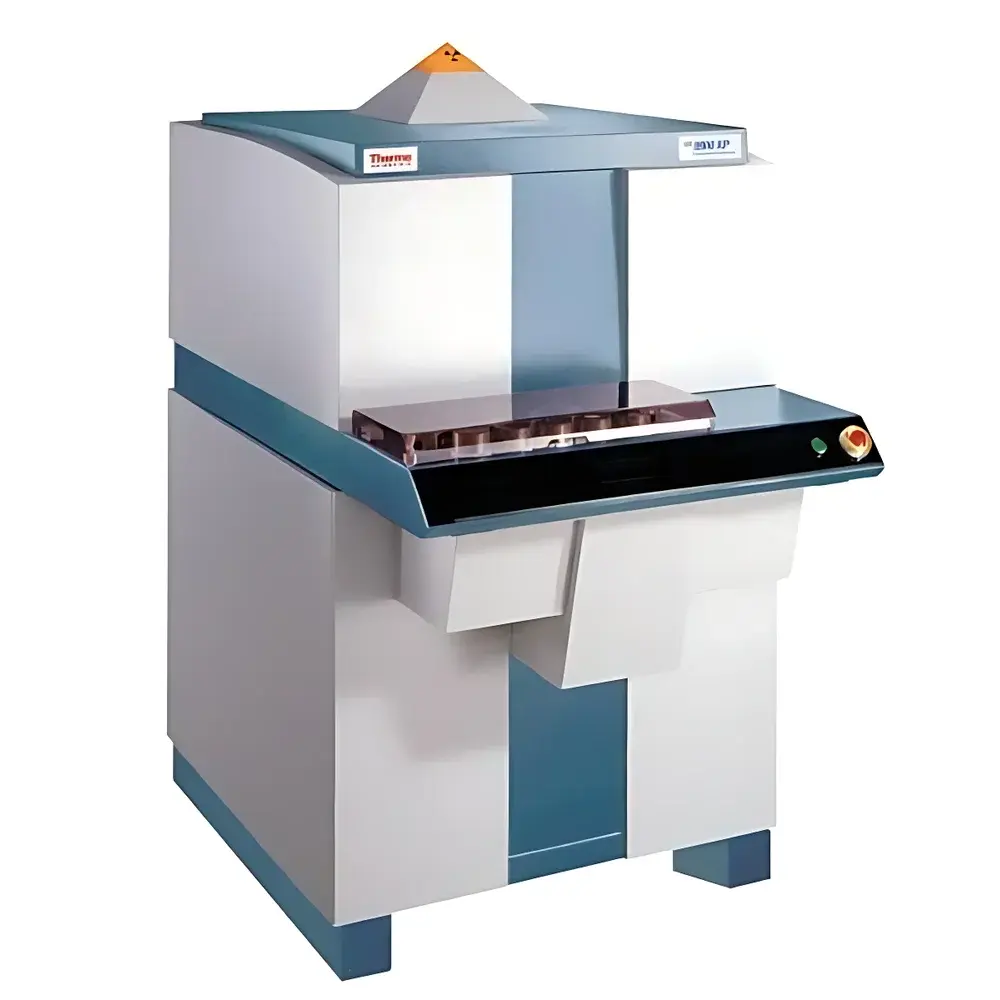
Thermo Scientific ARL 9900 XRF Energy Dispersive X-Ray Fluorescence Spectrometer with Integrated XRD Capability
| Brand | Thermo Fisher |
|---|---|
| Origin | Switzerland |
| Model | ARL 9900 XRF |
| Elemental Range | B (Z=5) to U (Z=92) |
| Detection Range | ppm to 100% |
| Available Generator Power Options | 1200 W (OASIS), 3600 W (XP), 4200 W (XP&plus |
| Sample Form | Solid (pressed pellets, fused beads, alloys, ores, cements) |
| Compliance | ASTM E1621, ISO 21043, ISO 8258, USP <233>, GLP/GMP-ready software architecture |
Overview
The Thermo Scientific ARL 9900 XRF is a high-performance, benchtop energy dispersive X-ray fluorescence (ED-XRF) spectrometer engineered for industrial process control and quality assurance laboratories requiring simultaneous elemental composition and crystalline phase analysis. Unlike conventional standalone ED-XRF systems, the ARL 9900 integrates a fully functional Bragg-Brentano θ–2θ X-ray diffractometer (XRD) within a single, co-aligned optical platform—enabling concurrent or sequential XRF quantification and XRD phase identification without sample repositioning. This hybrid architecture leverages dual-source excitation (twin X-ray tubes or selectable anode configurations) and a shared goniometer, ensuring spatial coherence between fluorescence emission and diffraction geometry. Designed for continuous operation in demanding production environments—including primary metal smelters, cement kiln lines, mineral concentrators, and foundries—the system delivers trace-level detection (sub-ppm for high-Z elements under optimized conditions), matrix-corrected quantification across heterogeneous solids, and robust repeatability (<0.5% RSD for major elements in certified reference materials). Its foundation builds upon the field-proven mechanical stability and vacuum-tight optics of the ARL 9800 platform, while introducing enhanced thermal management, real-time spectral deconvolution algorithms, and modular detector options (Si-PIN or SDD) calibrated per IEC 61000-4-30.
Key Features
- Integrated ED-XRF + XRD functionality in one instrument platform, eliminating inter-system calibration drift and enabling correlative analysis of chemistry and crystallography
- Modular high-power X-ray generator options: 1200 W (OASIS configuration for light-element sensitivity), 3600 W (XP for mid-Z throughput), and 4200 W (XP+ for heavy-element trace detection in refractory matrices)
- Automated sample handling with programmable XYZ stage, integrated press for pellet preparation, and optional fused-bead fusion station (ASTM E2489-compliant)
- Multi-detector support: Selectable silicon drift detector (SDD) with <125 eV Mn Kα resolution or high-count-rate Si-PIN for cost-sensitive routine QA
- Patented collimator and filter wheel system for dynamic background suppression and line separation optimization across B–U elemental range
- Hermetically sealed optical path with helium purge option for enhanced light-element (B, C, N, O, F) detection in air-sensitive samples
Sample Compatibility & Compliance
The ARL 9900 accepts standard 32 mm or 40 mm diameter solid samples—including as-cast alloys, sintered ceramics, crushed ores, clinker nodules, refractory bricks, and pressed powder pellets. Optional accessories include automated cup loaders for high-throughput screening (up to 120 samples/shift), fused bead molds compatible with lithium tetraborate/lithium metaborate fluxes, and custom holders for irregular geometries. All analytical methods are developed and validated in accordance with ASTM E1621 (standard test method for elemental analysis by ED-XRF), ISO 21043 (XRF performance verification), and ISO 8258 (Shewhart control charts for statistical process monitoring). Software audit trails, electronic signatures, and data integrity controls meet FDA 21 CFR Part 11 requirements, supporting GLP and GMP-regulated environments in metallurgical QC labs and cement plant quality departments.
Software & Data Management
The Thermo Scientific ARL QUANT’X software suite provides unified workflow control for both XRF quantification and XRD Rietveld refinement. It includes pre-loaded method libraries for ASTM E2796 (cement raw meal), ISO 12677 (cement analysis), and ASTM E2203 (alloy grade verification), with customizable calibration curves using fundamental parameters (FP) or empirical standards. Spectral deconvolution employs iterative least-squares fitting with interference correction matrices derived from pure element spectra and synthetic mixtures. XRD data processing supports phase identification via ICDD PDF-4+ database integration, quantitative phase analysis (QPA) using internal standard or reference intensity ratio (RIR) methods, and lattice parameter refinement. All raw spectra, processed reports, and audit logs are stored in a secure SQL-based repository with role-based access control and automated daily backup protocols.
Applications
- Metal Production: Real-time grade verification of Fe, Al, Cu, Zn, and Ni alloys; slag composition monitoring for furnace efficiency optimization; inclusion analysis in steel billets
- Mining & Mineral Processing: On-site ore grade estimation (Cu, Pb, Zn, Au, REEs); gangue mineral quantification (quartz, calcite, hematite); tailings characterization for environmental compliance
- Cement & Construction Materials: Raw mix homogeneity assessment; clinker free-lime determination; sulfate and alkali content tracking per EN 196-2; supplementary cementitious material (SCM) blending verification
- Environmental & Waste Management: Leachability screening of heavy metals (Pb, Cr, As, Cd) in fly ash and slag per TCLP protocols; identification of crystalline silica polymorphs (quartz, cristobalite, tridymite) in occupational health testing
FAQ
Does the ARL 9900 require liquid nitrogen cooling for detector operation?
No. The SDD and Si-PIN detectors are Peltier-cooled to –20 °C, eliminating cryogenic dependencies and enabling unattended 24/7 operation.
Can existing ARL 9800 methods be migrated to the ARL 9900 platform?
Yes. Method import utilities preserve calibration coefficients, spectral regions, and quantification models, with automatic adaptation to updated detector response functions and generator power profiles.
Is XRD phase analysis performed simultaneously with XRF measurement?
XRF and XRD operate sequentially on the same sample position using time-multiplexed beam routing; true simultaneity is not physically feasible due to divergent optical paths, but total cycle time remains under 180 seconds for full B–U + phase scan.
What maintenance intervals are recommended for high-duty-cycle industrial use?
X-ray tube replacement every 12,000 hours (typical); detector window inspection every 6 months; vacuum pump oil change every 3,000 operating hours; full optical alignment verification annually per ISO 17025 metrological guidelines.
Related Products





