
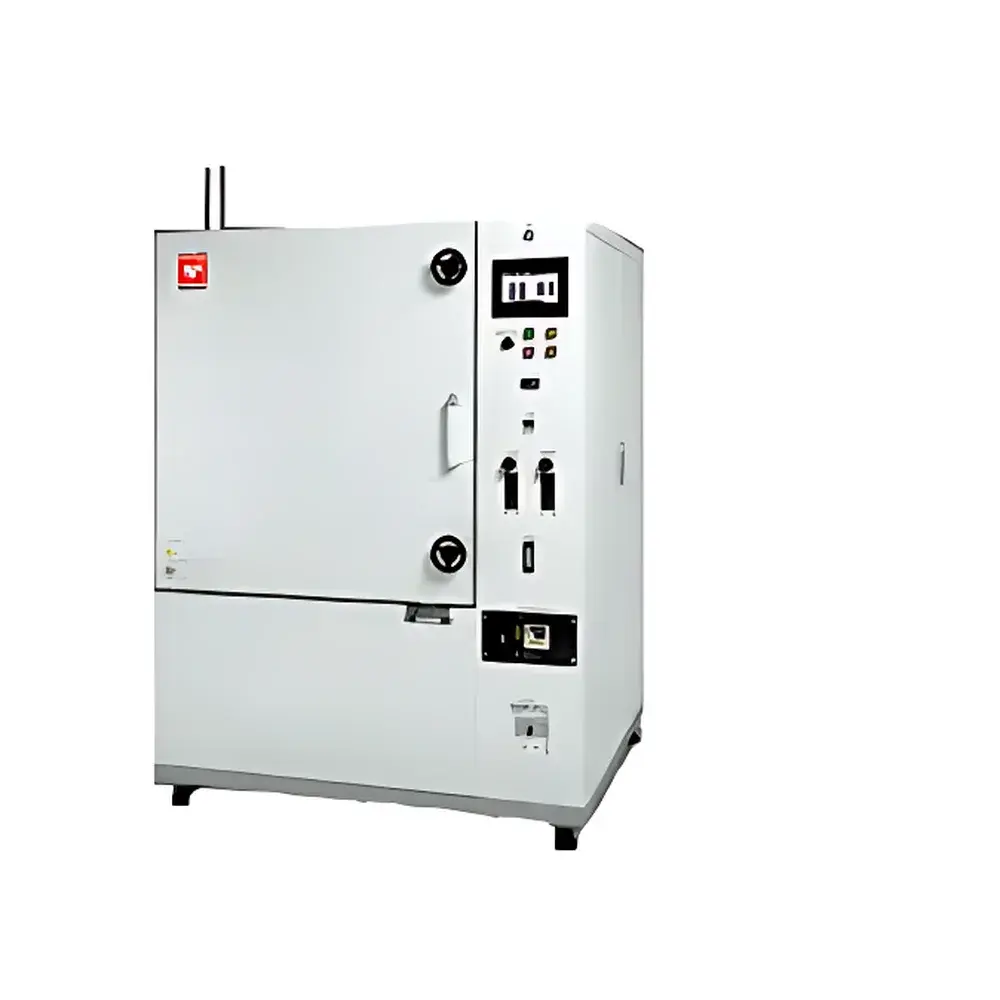
YAMATO DTN430C Cleanroom-Grade Anaerobic High-Temperature Atmosphere Furnace
| Brand | YAMATO |
|---|---|
| Origin | Japan |
| Model | DTN430C |
| Instrument Type | High-Temperature Atmosphere Oven |
| Temperature Range | Ambient + 50°C to 360°C |
| Temperature Uniformity | ±0.5°C |
| External Dimensions | 1090 × 950 × 1540 mm |
| Internal Chamber Dimensions | 450 × 450 × 450 mm |
| Chamber Material | Stainless Steel (SUS304) |
| Heating Method | Forced-Convection Thermal Circulation |
| Cleanliness Class | ISO Class 5 (100-level cleanroom) |
| Oxygen Concentration | <20 ppm |
| Gas Environment | Nitrogen-purged, hermetically sealed |
| Cooling System | Integrated Water-Cooled Magnetic Seals & Exhaust Condensation Trap |
| Safety Systems | Dual-door interlock switch, overtemperature cut-off, O₂ sensor alarm, N₂ pressure/flow monitoring, coolant flow sensor, leak detection, earth-leakage circuit breaker |
Overview
The YAMATO DTN430C is a precision-engineered, cleanroom-grade anaerobic high-temperature atmosphere furnace designed for semiconductor fabrication, advanced display manufacturing, and microelectronics R&D. It operates on the principle of inert gas displacement and dynamic thermal stabilization—using high-purity nitrogen to displace ambient air and maintain an oxygen concentration below 20 ppm within a thermally uniform, ISO Class 5 (100-level) environment. Unlike conventional drying ovens, the DTN430C integrates hermetic chamber architecture, water-cooled magnetic door sealing, and forced-convection heating to ensure both atmospheric integrity and thermal reproducibility across its full operating range (ambient + 50°C to 360°C). Its structural design eliminates particulate generation and minimizes nitrogen consumption through rapid purge kinetics and low-leakage volumetric containment—critical for photolithographic processes such as polyimide (PI) and photosensitive benzocyclobutene (PBO) curing, glass substrate baking, and precision annealing of thin-film devices.
Key Features
- ISO Class 5 (100-level) cleanroom-compatible chamber with HEPA-filtered recirculating nitrogen atmosphere
- Hermetically sealed pressure vessel construction with water-cooled magnetic gasket system—prevents thermal degradation of sealing surfaces and extends service life
- Forced-convection heating with optimized airflow distribution ensures ±0.5°C temperature uniformity across the 450 × 450 × 450 mm stainless steel (SUS304) chamber
- Real-time oxygen monitoring via electrochemical sensor with configurable alarm thresholds and automatic N₂ flow compensation
- Programmable ramp-soak profiles with independent control of heating rate (0.1–20°C/min) and cooling rate (via regulated N₂ purge + water-cooled jacket)
- Integrated condensate recovery unit for solvent-laden exhaust gases—enables safe handling of volatile organic residues from photoresist curing
- Comprehensive safety architecture compliant with IEC 61000-6-2 (EMC), IEC 61010-1 (lab equipment safety), and JIS B 8401 (Japanese industrial furnace standards)
Sample Compatibility & Compliance
The DTN430C accommodates wafers up to 300 mm, flat panel display (FPD) substrates, MEMS packages, and ceramic LTCC carriers. Its chamber geometry and low-particulate airflow profile prevent contamination during high-temperature processing steps requiring strict oxygen exclusion—such as post-apply bake (PAB), post-exposure bake (PEB), and hard bake of chemically amplified resists. The system meets critical requirements for ISO 14644-1 cleanroom integration and supports audit-ready documentation per GLP and GMP frameworks. While not FDA 21 CFR Part 11–certified out-of-box, its digital I/O interface and optional Ethernet module enable integration into validated process control systems with electronic signature and audit trail capabilities.
Software & Data Management
Equipped with YAMATO’s proprietary THERMO-LOGIC™ controller (7-inch color touchscreen HMI), the DTN430C provides real-time logging of temperature, O₂ concentration, N₂ pressure/flow, coolant flow rate, and door status. All parameters are timestamped and stored internally (≥10,000 data points) with USB export capability in CSV format. Optional RS-485 or Ethernet communication enables SCADA-level integration and remote supervision via Modbus TCP or OPC UA protocols. Data integrity safeguards include cyclic redundancy check (CRC) validation, write-protection modes, and automatic backup upon power interruption.
Applications
- Photolithography process support: PI and PBO resist curing at 300–360°C under sub-20 ppm O₂
- Thin-film transistor (TFT) array annealing on glass substrates (e.g., LCD/OLED backplanes)
- Low-dielectric constant (low-k) material densification without oxidation-induced property drift
- High-reliability packaging bake-out for aerospace and automotive ICs
- Research-scale thermal aging studies of polymer composites and nanomaterials under controlled inert atmospheres
FAQ
What is the typical nitrogen consumption rate during steady-state operation?
At 350°C and continuous purge mode, average N₂ flow is 15–25 L/min—optimized via pressure-feedback regulation to maintain <20 ppm O₂ while minimizing gas usage.
Can the DTN430C be configured for argon or forming gas (N₂/H₂) atmospheres?
Yes—gas inlet manifold supports interchangeable fittings and optional mass flow controllers for multi-gas operation; consult YAMATO engineering for compatibility validation and safety interlock reconfiguration.
Is the chamber interior electropolished for ultra-low particle retention?
Standard configuration uses mirror-finished SUS304; electropolished finish (Ra ≤ 0.4 µm) is available as a factory option for applications demanding ultra-high purity.
Does the system support automated recipe loading via external PLC?
Yes—digital I/O terminals and Modbus TCP enable seamless synchronization with wafer handling robots and MES-level process orchestration.
What maintenance intervals are recommended for the HEPA filter and O₂ sensor?
HEPA filter replacement every 12 months under continuous use; O₂ sensor calibration every 6 months or after 500 operational hours—both tracked via built-in maintenance scheduler.
Related Products



