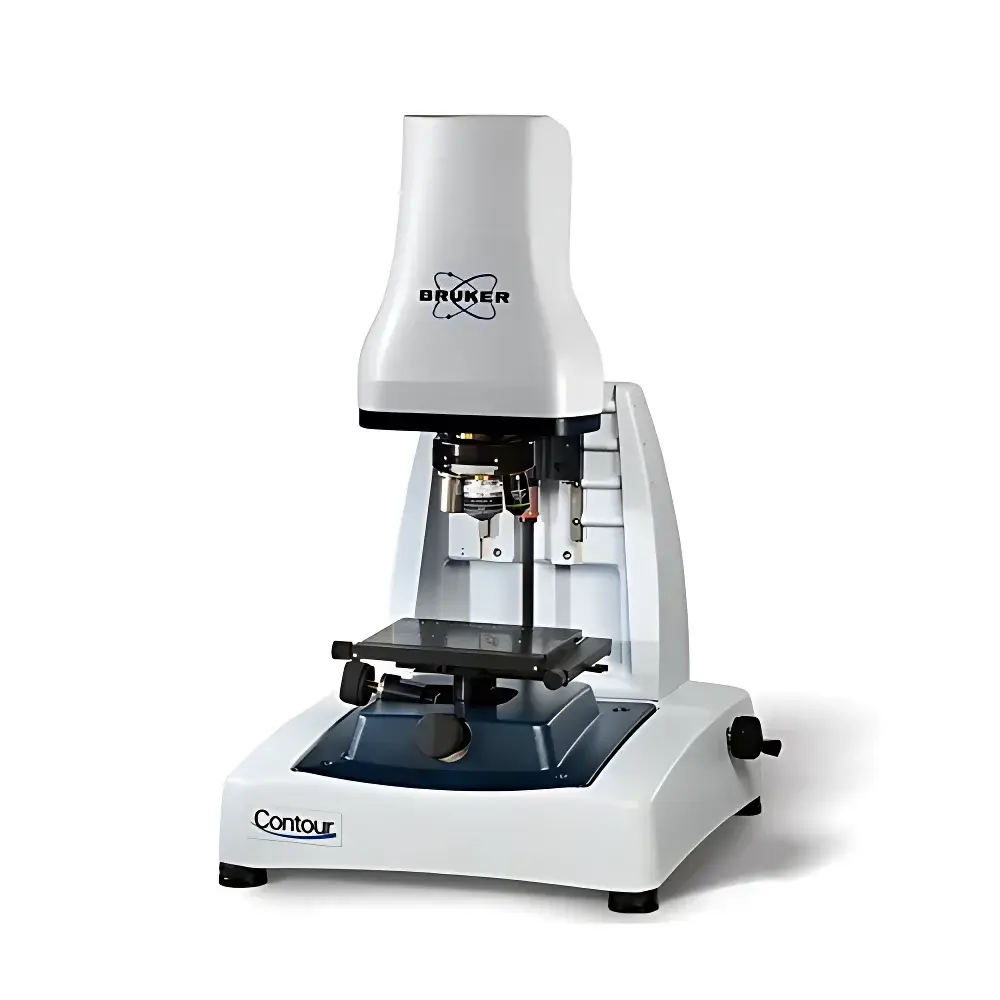
Bruker ContourX-100 White Light Interferometric Optical Profilometer
| Brand | Bruker |
|---|---|
| Origin | Germany |
| Model | ContourX-100 |
| Product Type | Non-contact Profilometer / Surface Roughness Analyzer |
| Working Principle | White Light Interferometry (WLI) |
| Camera Resolution | 5 MP |
| Measurement Mode | USI (Universal Scanning Interferometry) |
| Surface Reflectivity Range | 0.05% to 100% |
| Form Factor | Benchtop System |
| Compliance | Designed for ISO 25178, ISO 4287, ASTM E1316, and GLP/GMP-aligned workflows |
Overview
The Bruker ContourX-100 is a benchtop white light interferometric (WLI) optical profilometer engineered for high-precision, non-contact surface topography and roughness characterization. Leveraging Bruker’s four-decade heritage in optical surface metrology, the system implements coherence scanning interferometry—where broadband illumination generates localized interference fringes at the point of best focus across a surface—to reconstruct nanoscale vertical height information with sub-nanometer vertical resolution. Unlike stylus-based or confocal techniques, WLI provides full-field, diffraction-limited lateral resolution without mechanical contact, eliminating tip wear, surface damage, or scanning artifacts. The ContourX-100 delivers quantitative 2D cross-sectional profiles and fully registered 3D surface maps in a single acquisition, supporting traceable measurements compliant with international standards including ISO 25178-2 (areal surface texture), ISO 4287 (profile-based roughness), and ASTM E1316 (non-destructive evaluation terminology). Its compact footprint and modular optical path make it suitable for integration into R&D labs, quality control environments, and cleanroom-adjacent production floors.
Key Features
- 5-megapixel high-sensitivity CMOS camera enabling improved signal-to-noise ratio and faster data capture across diverse reflectivity ranges (0.05%–100%)
- Universal Scanning Interferometry (USI) mode—automatically selects optimal scan strategy based on surface slope, step height, and reflectivity to maximize measurement fidelity for polished optics, thick-film coatings, and tribological surfaces
- Bruker VisionXpress software for rapid setup and one-click analysis; Vision64 platform for advanced scripting, batch processing, and metrology-grade reporting
- Integrated motorized Z-stage with closed-loop feedback for repeatable, drift-compensated vertical scanning over ranges up to 10 mm
- Modular objective turret accommodating 2.5× to 100× Mirau and Michelson objectives—supporting lateral resolutions from ~0.4 µm to ~2.5 µm and vertical measurement ranges from 10 µm
- Benchtop architecture with vibration-damped granite base and passive thermal stabilization—designed for stable operation without active environmental control
Sample Compatibility & Compliance
The ContourX-100 accommodates samples up to 200 mm × 200 mm (with optional stage extensions) and heights up to 120 mm. It measures optically reflective, semi-transparent, and moderately scattering surfaces—including silicon wafers, MEMS devices, medical implants, optical lenses, bearing surfaces, and thin-film stacks—without sample preparation or conductive coating. Measurement traceability is maintained through NIST-traceable calibration artifacts (e.g., step-height standards, roughness reference samples) and built-in verification routines per ISO/IEC 17025 requirements. Data integrity aligns with FDA 21 CFR Part 11 expectations via audit-trail-enabled user authentication, electronic signatures, and immutable result archiving in Vision64. System validation documentation supports IQ/OQ/PQ protocols for regulated industries including semiconductor manufacturing, biomedical device QA, and aerospace component certification.
Software & Data Management
VisionXpress provides intuitive wizard-driven workflows for routine profiling, roughness, and form analysis—ideal for technicians and non-specialist users. Vision64 serves as the metrology engine for advanced users, offering customizable analysis modules (e.g., grain analysis, defect detection, film-thickness extraction from phase-shifted interferograms), Python API integration, and automated report generation in PDF, CSV, or metrology-specific formats (e.g., .sur, .xyz). All raw interferogram stacks and processed results are stored in a structured database with version-controlled metadata—including operator ID, timestamp, instrument configuration, and environmental logs. Export options support LIMS and MES integration via OPC UA or RESTful APIs, ensuring seamless alignment with Industry 4.0 data infrastructure.
Applications
- Wafer-level metrology: quantifying CMP uniformity, etch depth, and lithographic pattern fidelity on Si, GaN, and SOI substrates
- Tribology & wear analysis: measuring surface degradation, scratch morphology, and lubricant film thickness evolution under controlled loading
- Optical component qualification: verifying surface flatness (λ/20), irregularity, and micro-roughness (Ra < 0.1 nm) on mirrors, prisms, and laser windows
- Medical device surface engineering: characterizing textured implant surfaces, porous scaffolds, and ablation craters per ISO 10993-22
- Thin-film and coating QC: extracting thickness, interface roughness, and delamination signatures from multi-layer dielectric stacks
- Failure analysis: correlating surface topography anomalies with SEM/EDS or XRF compositional data in root-cause investigations
FAQ
What vertical resolution can the ContourX-100 achieve?
Vertical resolution is typically ≤0.1 nm RMS under optimal conditions, dependent on camera noise floor, vibration isolation, and surface reflectivity.
Does the system require environmental controls such as temperature stabilization or acoustic enclosures?
While not mandatory, operation within ±1°C/h ambient stability is recommended for sub-nanometer repeatability; the granite base and passive thermal mass mitigate short-term fluctuations.
Can the ContourX-100 measure transparent or semi-transparent films?
Yes—using phase-shifting interferometry (PSI) and USI modes, it resolves both top and bottom interfaces of films down to ~100 nm thickness on reflective substrates.
Is Vision64 compatible with automated manufacturing data systems?
Yes—via native OPC UA server and configurable REST endpoints, Vision64 supports real-time data streaming, SPC dashboard integration, and MES-triggered measurement sequences.
How does Bruker ensure long-term measurement consistency across instruments?
Through factory calibration using NIST-traceable step-height and roughness standards, plus on-site verification kits and annual performance qualification (PQ) protocols aligned with ISO 17025.